

Homework Answers
Request Answer!
We need at least 10 more requests to produce the answer.
0 / 10 have requested this problem solution
The more requests, the faster the answer.
Add Answer to:
Diiodoethane gas can decompose to form ethylene and iodine vapor, which is a purple. Use this...
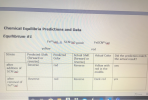
please help Chemical Equilibria Predictions and Data Equilibrium #1 Fe3+(20)_ SCNN) = FeSCN2+(ag) yellow red Stress...
 please help
Chemical Equilibria Predictions and Data Equilibrium #1 Fe3+(20)_ SCNN) = FeSCN2+(ag) yellow red Stress Predicted Shift Predicted Actual Shift Actual Color Did the prediction match (forward or Color (forward or the actual result? reverse) reverse) after Reverse red Reverse Yellow with yes addition of red in the SCN(2) middle. Reverse red Reverse Dark red yes after removal of Festaw Focus Equilibrium #2 Cu(NH3)) Cu2+ (a) + 44 45 ) pale blue dark blue Stress Predicted Shift (forward or...
please help
Chemical Equilibria Predictions and Data Equilibrium #1 Fe3+(20)_ SCNN) = FeSCN2+(ag) yellow red Stress Predicted Shift Predicted Actual Shift Actual Color Did the prediction match (forward or Color (forward or the actual result? reverse) reverse) after Reverse red Reverse Yellow with yes addition of red in the SCN(2) middle. Reverse red Reverse Dark red yes after removal of Festaw Focus Equilibrium #2 Cu(NH3)) Cu2+ (a) + 44 45 ) pale blue dark blue Stress Predicted Shift (forward or...
please help 1. Dinitrogen tetraoxide (colorless gas) is converted to nitrogen dioxide (dark reddish brown gas)...
 please help
1. Dinitrogen tetraoxide (colorless gas) is converted to nitrogen dioxide (dark reddish brown gas) and is endothermic in the forward direction: A. Write a balanced equation. B. If a closed container containing a mixture of these two gases at equilibrium is a light brown in color when it is at room temperature (20.0°C), what change would you expect to observe if the container is placed in boiling water (100.0 °C)? c. If a closed container containing a mixture...
please help
1. Dinitrogen tetraoxide (colorless gas) is converted to nitrogen dioxide (dark reddish brown gas) and is endothermic in the forward direction: A. Write a balanced equation. B. If a closed container containing a mixture of these two gases at equilibrium is a light brown in color when it is at room temperature (20.0°C), what change would you expect to observe if the container is placed in boiling water (100.0 °C)? c. If a closed container containing a mixture...
Consider the reaction between iodine gas and chlorine gas to form iodine monochloride: I2(g)+Cl2(g)⇌2ICl(g)Kp=81.9 (at 298...
Consider the reaction between iodine gas and chlorine gas to form iodine monochloride: I2(g)+Cl2(g)⇌2ICl(g)Kp=81.9 (at 298 K) A reaction mixture at 298 K initially contains PI2=0.25 atm and PCl2=0.25 atm . You may want to reference (Page) Section 15.8 while completing this problem. Part A What is the partial pressure of iodine monochloride when the reaction reaches equilibrium? Express your answer to two significant figures and include the appropriate units. atm SubmitPrevious AnswersR
this is one large question Pamela Hege Question 8 An acid (HNO) has a K, of...
 this is one large question
Pamela Hege Question 8 An acid (HNO) has a K, of 4.5 x 10⁴ Not yet answered Based on this K, value, which is favored? Points out of 16.00 Explain your reasoning for choosing which is favored. This answer will be manually graded after the quiz closes. P Flag question Write the balanced chemical reaction for the dissociation of HNO2 To ensure that the Moodle grades your answer correctly, use the following format for writing...
this is one large question
Pamela Hege Question 8 An acid (HNO) has a K, of 4.5 x 10⁴ Not yet answered Based on this K, value, which is favored? Points out of 16.00 Explain your reasoning for choosing which is favored. This answer will be manually graded after the quiz closes. P Flag question Write the balanced chemical reaction for the dissociation of HNO2 To ensure that the Moodle grades your answer correctly, use the following format for writing...
Dinitrogen tetraoxide and nitrogen dioxide are two gases that cxist in cquilibrium at brown gas while N204 is colorless...
 Dinitrogen tetraoxide and nitrogen dioxide are two gases that cxist in cquilibrium at brown gas while N204 is colorless range of tempcratures. NO2 is a reddish At High Temperature the red color is strong. At Low Temperature the gas has less color. If we represent the equilibrium as: 2 NO2(g) E N204(g) We can conclude that: A 1. This reaction is: A. Exothermic B. Endothermic C. Neutral D. More information is needed to answer this question. B 2. When the...
Nitrogen gas and hydrogen gas can ve converted into ammonia gas as shown in the reaction...
 Nitrogen gas and hydrogen gas can ve converted into ammonia
gas as shown in the reaction equation listed below. Answer each of
the questions listed below regarding this reaction.
1. Nitrogen gas and hydrogen gas can be converted into ammonia gas as shown in the reaction equation listed below. Answer each of the questions listed below regarding this reaction. N2(g) + 3 H2(g) = 2 NH3(g) AH = -92.2 kJ/mole and K = 2.6 x 10⁸ This reaction is an...
Nitrogen gas and hydrogen gas can ve converted into ammonia
gas as shown in the reaction equation listed below. Answer each of
the questions listed below regarding this reaction.
1. Nitrogen gas and hydrogen gas can be converted into ammonia gas as shown in the reaction equation listed below. Answer each of the questions listed below regarding this reaction. N2(g) + 3 H2(g) = 2 NH3(g) AH = -92.2 kJ/mole and K = 2.6 x 10⁸ This reaction is an...
prelab /postlab all questions please Questions 1. For the reaction at 20°C, NH3(aq) + H+ (aq)...
 prelab /postlab all questions please
Questions 1. For the reaction at 20°C, NH3(aq) + H+ (aq) NH4(aq), the equilibrium constant is calculated to be K = to 4.5 x10%. CHAT] A. Write the Equilibrium expression for this reaction. Keq = ỞNH TH] B. From the size of the number for Keq, does the equilibrium lie to the left or to the right? Right 2. If the reaction between iron(III) ion and thiocyanate ion, Fe3+ (aq) + SCN (aq) → FeSCN2+(aq),...
prelab /postlab all questions please
Questions 1. For the reaction at 20°C, NH3(aq) + H+ (aq) NH4(aq), the equilibrium constant is calculated to be K = to 4.5 x10%. CHAT] A. Write the Equilibrium expression for this reaction. Keq = ỞNH TH] B. From the size of the number for Keq, does the equilibrium lie to the left or to the right? Right 2. If the reaction between iron(III) ion and thiocyanate ion, Fe3+ (aq) + SCN (aq) → FeSCN2+(aq),...
Can someone help 9) Ethylene, C2H,reacts with elemental halogens in the gas phase according to the following reaction to form 1,2-dihaloethanes: НН + X-X (g) HH (9) 1,2-dihaloethane, C2H2 Ethylene...
 Can someone help
9) Ethylene, C2H,reacts with elemental halogens in the gas phase according to the following reaction to form 1,2-dihaloethanes: НН + X-X (g) HH (9) 1,2-dihaloethane, C2H2 Ethylene, C2H Elemental halogen Here, "X-X" is shorthand for Cl2. Br2.or 2 a) Use the enthalpies of formation and Third Law entropies in the table below to calculate Gibbs free energies of reaction for the formation of each dihaloethane. Although you're going to do 3the same calculation three times, you only...
Can someone help
9) Ethylene, C2H,reacts with elemental halogens in the gas phase according to the following reaction to form 1,2-dihaloethanes: НН + X-X (g) HH (9) 1,2-dihaloethane, C2H2 Ethylene, C2H Elemental halogen Here, "X-X" is shorthand for Cl2. Br2.or 2 a) Use the enthalpies of formation and Third Law entropies in the table below to calculate Gibbs free energies of reaction for the formation of each dihaloethane. Although you're going to do 3the same calculation three times, you only...
For each experiment described below 1) provide the relevant equilibrium reaction or reactions, 2) use LeChatelier's...
For each experiment described below 1) provide the relevant equilibrium reaction or reactions, 2) use LeChatelier's Principle to explain why the reaction has shifted left (L) or right (R), and 3) answer any other questions. a) To a solution containing 1M Pb(NO3)2, 1 M HCl is slowly added until a white precipitate forms. The mixture is then heated and the precipitate disappears. Is the dissociation of the precipitate endothermic or exothermic? Does the equilibrium constant (Ksp) change when the solution...
T(N)=352 please I need the answer urgent Question 1 The following gas phase reaction produces ethanol...
 T(N)=352 please I need the answer urgent
Question 1 The following gas phase reaction produces ethanol (C2H5OH) by catalytic hydrogenation of acetaldehyde (CH3CHO). The reaction reaches equilibrium at a temperature of T= T(N) and a pressure of 3 bar: CH,CHO(g) + H, (g) C,H,OH (8) The reactive system initially contains 1.5 moles of Hydrogen (Ha) for each mole of acetaldehyde (CH3CHO). The mixture is assumed to be an ideal gas. T(N) is the temperature corresponding to the student number as...
T(N)=352 please I need the answer urgent
Question 1 The following gas phase reaction produces ethanol (C2H5OH) by catalytic hydrogenation of acetaldehyde (CH3CHO). The reaction reaches equilibrium at a temperature of T= T(N) and a pressure of 3 bar: CH,CHO(g) + H, (g) C,H,OH (8) The reactive system initially contains 1.5 moles of Hydrogen (Ha) for each mole of acetaldehyde (CH3CHO). The mixture is assumed to be an ideal gas. T(N) is the temperature corresponding to the student number as...
 please help
Chemical Equilibria Predictions and Data Equilibrium #1 Fe3+(20)_ SCNN) = FeSCN2+(ag) yellow red Stress Predicted Shift Predicted Actual Shift Actual Color Did the prediction match (forward or Color (forward or the actual result? reverse) reverse) after Reverse red Reverse Yellow with yes addition of red in the SCN(2) middle. Reverse red Reverse Dark red yes after removal of Festaw Focus Equilibrium #2 Cu(NH3)) Cu2+ (a) + 44 45 ) pale blue dark blue Stress Predicted Shift (forward or...
please help
Chemical Equilibria Predictions and Data Equilibrium #1 Fe3+(20)_ SCNN) = FeSCN2+(ag) yellow red Stress Predicted Shift Predicted Actual Shift Actual Color Did the prediction match (forward or Color (forward or the actual result? reverse) reverse) after Reverse red Reverse Yellow with yes addition of red in the SCN(2) middle. Reverse red Reverse Dark red yes after removal of Festaw Focus Equilibrium #2 Cu(NH3)) Cu2+ (a) + 44 45 ) pale blue dark blue Stress Predicted Shift (forward or...
 please help
1. Dinitrogen tetraoxide (colorless gas) is converted to nitrogen dioxide (dark reddish brown gas) and is endothermic in the forward direction: A. Write a balanced equation. B. If a closed container containing a mixture of these two gases at equilibrium is a light brown in color when it is at room temperature (20.0°C), what change would you expect to observe if the container is placed in boiling water (100.0 °C)? c. If a closed container containing a mixture...
please help
1. Dinitrogen tetraoxide (colorless gas) is converted to nitrogen dioxide (dark reddish brown gas) and is endothermic in the forward direction: A. Write a balanced equation. B. If a closed container containing a mixture of these two gases at equilibrium is a light brown in color when it is at room temperature (20.0°C), what change would you expect to observe if the container is placed in boiling water (100.0 °C)? c. If a closed container containing a mixture...
 this is one large question
Pamela Hege Question 8 An acid (HNO) has a K, of 4.5 x 10⁴ Not yet answered Based on this K, value, which is favored? Points out of 16.00 Explain your reasoning for choosing which is favored. This answer will be manually graded after the quiz closes. P Flag question Write the balanced chemical reaction for the dissociation of HNO2 To ensure that the Moodle grades your answer correctly, use the following format for writing...
this is one large question
Pamela Hege Question 8 An acid (HNO) has a K, of 4.5 x 10⁴ Not yet answered Based on this K, value, which is favored? Points out of 16.00 Explain your reasoning for choosing which is favored. This answer will be manually graded after the quiz closes. P Flag question Write the balanced chemical reaction for the dissociation of HNO2 To ensure that the Moodle grades your answer correctly, use the following format for writing...
 Dinitrogen tetraoxide and nitrogen dioxide are two gases that cxist in cquilibrium at brown gas while N204 is colorless range of tempcratures. NO2 is a reddish At High Temperature the red color is strong. At Low Temperature the gas has less color. If we represent the equilibrium as: 2 NO2(g) E N204(g) We can conclude that: A 1. This reaction is: A. Exothermic B. Endothermic C. Neutral D. More information is needed to answer this question. B 2. When the...
 Nitrogen gas and hydrogen gas can ve converted into ammonia
gas as shown in the reaction equation listed below. Answer each of
the questions listed below regarding this reaction.
1. Nitrogen gas and hydrogen gas can be converted into ammonia gas as shown in the reaction equation listed below. Answer each of the questions listed below regarding this reaction. N2(g) + 3 H2(g) = 2 NH3(g) AH = -92.2 kJ/mole and K = 2.6 x 10⁸ This reaction is an...
Nitrogen gas and hydrogen gas can ve converted into ammonia
gas as shown in the reaction equation listed below. Answer each of
the questions listed below regarding this reaction.
1. Nitrogen gas and hydrogen gas can be converted into ammonia gas as shown in the reaction equation listed below. Answer each of the questions listed below regarding this reaction. N2(g) + 3 H2(g) = 2 NH3(g) AH = -92.2 kJ/mole and K = 2.6 x 10⁸ This reaction is an...
 prelab /postlab all questions please
Questions 1. For the reaction at 20°C, NH3(aq) + H+ (aq) NH4(aq), the equilibrium constant is calculated to be K = to 4.5 x10%. CHAT] A. Write the Equilibrium expression for this reaction. Keq = ỞNH TH] B. From the size of the number for Keq, does the equilibrium lie to the left or to the right? Right 2. If the reaction between iron(III) ion and thiocyanate ion, Fe3+ (aq) + SCN (aq) → FeSCN2+(aq),...
prelab /postlab all questions please
Questions 1. For the reaction at 20°C, NH3(aq) + H+ (aq) NH4(aq), the equilibrium constant is calculated to be K = to 4.5 x10%. CHAT] A. Write the Equilibrium expression for this reaction. Keq = ỞNH TH] B. From the size of the number for Keq, does the equilibrium lie to the left or to the right? Right 2. If the reaction between iron(III) ion and thiocyanate ion, Fe3+ (aq) + SCN (aq) → FeSCN2+(aq),...
 Can someone help
9) Ethylene, C2H,reacts with elemental halogens in the gas phase according to the following reaction to form 1,2-dihaloethanes: НН + X-X (g) HH (9) 1,2-dihaloethane, C2H2 Ethylene, C2H Elemental halogen Here, "X-X" is shorthand for Cl2. Br2.or 2 a) Use the enthalpies of formation and Third Law entropies in the table below to calculate Gibbs free energies of reaction for the formation of each dihaloethane. Although you're going to do 3the same calculation three times, you only...
Can someone help
9) Ethylene, C2H,reacts with elemental halogens in the gas phase according to the following reaction to form 1,2-dihaloethanes: НН + X-X (g) HH (9) 1,2-dihaloethane, C2H2 Ethylene, C2H Elemental halogen Here, "X-X" is shorthand for Cl2. Br2.or 2 a) Use the enthalpies of formation and Third Law entropies in the table below to calculate Gibbs free energies of reaction for the formation of each dihaloethane. Although you're going to do 3the same calculation three times, you only...
 T(N)=352 please I need the answer urgent
Question 1 The following gas phase reaction produces ethanol (C2H5OH) by catalytic hydrogenation of acetaldehyde (CH3CHO). The reaction reaches equilibrium at a temperature of T= T(N) and a pressure of 3 bar: CH,CHO(g) + H, (g) C,H,OH (8) The reactive system initially contains 1.5 moles of Hydrogen (Ha) for each mole of acetaldehyde (CH3CHO). The mixture is assumed to be an ideal gas. T(N) is the temperature corresponding to the student number as...
T(N)=352 please I need the answer urgent
Question 1 The following gas phase reaction produces ethanol (C2H5OH) by catalytic hydrogenation of acetaldehyde (CH3CHO). The reaction reaches equilibrium at a temperature of T= T(N) and a pressure of 3 bar: CH,CHO(g) + H, (g) C,H,OH (8) The reactive system initially contains 1.5 moles of Hydrogen (Ha) for each mole of acetaldehyde (CH3CHO). The mixture is assumed to be an ideal gas. T(N) is the temperature corresponding to the student number as...
Most questions answered within 3 hours.
-
Where is the error in this code sequence?
String s1 = "Hello";
String s2 = "ello";...
asked 10 months ago -
Financial data for Joel de Paris, Inc., for last year
follow:
Joel de Paris, Inc.
Balance...
asked 10 months ago -
Consider this reaction:
Al2(SO4)3 (aq)+ BaCl3
(aq) Al2Cl6 (aq)- +
3BaSO4(s) . What is the...
asked 10 months ago -
Suppose that Savneet is considering increasing her
recent random sample from 20 car rentals to 40...
asked 10 months ago -
Trucks arrive at an unloading terminal at an average rate of 120
per hour.
Trucks arrive...
asked 10 months ago -
Why are methanol and ethanol completely soluble in water while
octanol is not very little soluble....
asked 10 months ago -
A facilities manager at a university reads in a research report
that the mean amount of...
asked 10 months ago -
When the CuSO4 is rehydrated by adding water to the anhydrous
compound, is this an endothermic...
asked 10 months ago -
A ray of sunlight is passing from diamond into crown glass; the
angle of incidence is...
asked 10 months ago -
A block of mass 0.249 kg is placed on top of a light, vertical
spring of...
asked 10 months ago -
how do the kidneys compensate in the presences of acidosis
a) trigger hyperventilate
b) reserve acid...
asked 10 months ago -
Question 501 pts
The rental rate of capital to the firm increases. Which of the
following...
asked 10 months ago