
Homework Answers
Add Answer to:
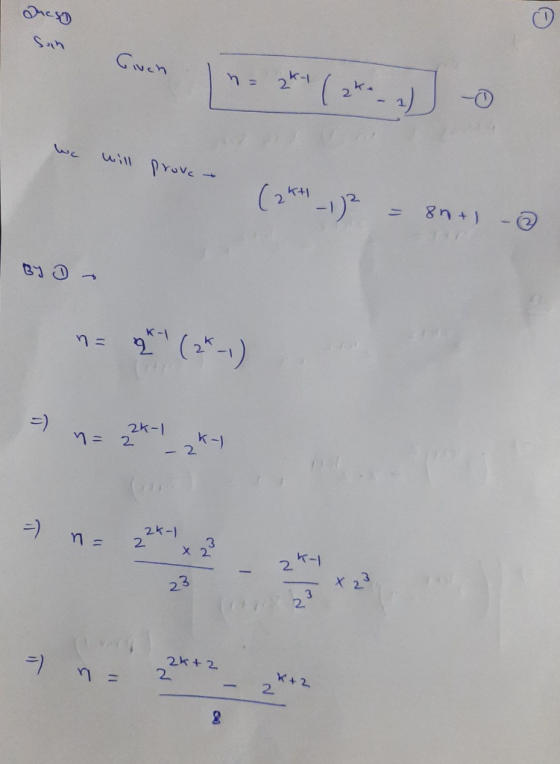
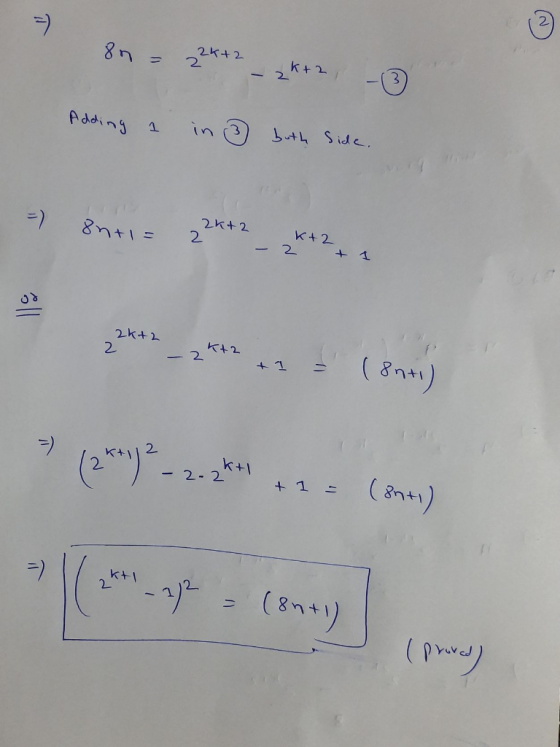
Prove: Let k be a positive integer, and set n :=2k-1(2k – 1). Then (2k+1 –...
Let n be a positive integer, and let s and t be integers. Then the following...
 Let n be a positive integer, and let s and t be integers. Then
the following hold.
I need the prove for (iii)
Lemma 8.1 Let n be a positive integer, and let s and t be integers. Then the following hold. (i) We have s et mod n if and only if n dividest - s. (ii) We have pris + t) = Hn (s) +Mn(t) mod n. (iii) We have Hr(st) = Hn (3) Men(t) mod n. Proof....
Let n be a positive integer, and let s and t be integers. Then
the following hold.
I need the prove for (iii)
Lemma 8.1 Let n be a positive integer, and let s and t be integers. Then the following hold. (i) We have s et mod n if and only if n dividest - s. (ii) We have pris + t) = Hn (s) +Mn(t) mod n. (iii) We have Hr(st) = Hn (3) Men(t) mod n. Proof....
Exercise 1: Let k 21 be a positive integer. Consider the set of ordered 2k-tuples Π...
 Exercise 1: Let k 21 be a positive integer. Consider the set of ordered 2k-tuples Π = {(zi, r2k) : ri+r2k, as (ri, -.. .r2k) vary over T? , 21 < ri s 61. Which number appears most often as the sum In other words, suppose we roll 2k six-sided standard dice, and add up the numbers that appear. Which number (as a function of k) appears most often as the sum of the values on top?
I need help to prove iii. Lemma 8.1 Let n be a positive integer, and let...
 I need help to prove iii.
Lemma 8.1 Let n be a positive integer, and let s and t be integers. Then the following hold. (i) We have s et mod n if and only if n dividest - s. (ii) We have pris + t) = Hn (s) +Mn(t) mod n. (iii) We have Hr(st) = Hn (3) Men(t) mod n. Proof. The definition of fr gives us integers u, v such that S = nu + An (8)...
I need help to prove iii.
Lemma 8.1 Let n be a positive integer, and let s and t be integers. Then the following hold. (i) We have s et mod n if and only if n dividest - s. (ii) We have pris + t) = Hn (s) +Mn(t) mod n. (iii) We have Hr(st) = Hn (3) Men(t) mod n. Proof. The definition of fr gives us integers u, v such that S = nu + An (8)...
Ok = (6) Let n be a positive integer. For every integer k, define the 2...
 Ok = (6) Let n be a positive integer. For every integer k, define the 2 x 2 matrix cos(27k/n) - sin(2nk/n) sin(2tk/n) cos(27 k/n) (a) Prove that go = I, that ok + oe for 0 < k < l< n - 1, and that Ok = Okun for all integers k. (b) Let o = 01. Prove that ok ok for all integers k. (c) Prove that {1,0,0%,...,ON-1} is a finite abelian group of order n.
Q 3 a) Let n > 2 be an integer. Prove that the set {z ET:z”...
 Q 3 a) Let n > 2 be an integer. Prove that the set {z ET:z” = 1} is a subgroup of (T, *). Show that it is isomorphic to (Zn, + mod n). b) Show that Z2 x Z2 is not isomorphic to Z4. c) Show that Z2 x Z3 is isomorphic to 26.
Let n be an odd positive integer. Consider a list of n consecutive integers, not necessarily...
Let n be an odd positive integer. Consider a list of n consecutive integers, not necessarily starting with 1. Show that the average is the middle number (that is the number in the middle of the list when they are arranged in an increasing order). What is the average when n is an even positive integer instead. We learned that for the odd numbers, we would have to show why n-1/2(2k+n)+(k+n) all over n equals k+(n+1)/2.
Prove using mathematical induction that for every positive integer n, = 1/i(i+1) = n/n+1. 2) Suppose...
 Prove using mathematical induction that for every positive integer n, = 1/i(i+1) = n/n+1. 2) Suppose r is a real number other than 1. Prove using mathematical induction that for every nonnegative integer n, = 1-r^n+1/1-r. 3) Prove using mathematical induction that for every nonnegative integer n, 1 + i+i! = (n+1)!. 4) Prove using mathematical induction that for every integer n>4, n!>2^n. 5) Prove using mathematical induction that for every positive integer n, 7 + 5 + 3 +.......
1. (Integers: primes, divisibility, parity.) (a) Let n be a positive integer. Prove that two numbers...
 1. (Integers: primes, divisibility, parity.) (a) Let n be a positive integer. Prove that two numbers na +3n+6 and n2 + 2n +7 cannot be prime at the same time. (b) Find 15261527863698656776712345678%5 without using a calculator. (c) Let a be an integer number. Suppose a%2 = 1. Find all possible values of (4a +1)%6. 2. (Integers: %, =) (a) Suppose a, b, n are integer numbers and n > 0. Prove that (a+b)%n = (a%n +B%n)%n. (b) Let a,...
2. Let n be a positive integer. Denote the number of positive integers less than n and rela- tive...
 number thoery
just need 2 answered
2. Let n be a positive integer. Denote the number of positive integers less than n and rela- tively prime to n by p(n). Let a, b be positive integers such that ged(a,n) god(b,n)-1 Consider the set s, = {(a), (ba), (ba), ) (see Prollern 1). Let s-A]. Show that slp(n). 1. Let a, b, c, and n be positive integers such that gcd(a, n) = gcd(b, n) = gcd(c, n) = 1 If...
number thoery
just need 2 answered
2. Let n be a positive integer. Denote the number of positive integers less than n and rela- tively prime to n by p(n). Let a, b be positive integers such that ged(a,n) god(b,n)-1 Consider the set s, = {(a), (ba), (ba), ) (see Prollern 1). Let s-A]. Show that slp(n). 1. Let a, b, c, and n be positive integers such that gcd(a, n) = gcd(b, n) = gcd(c, n) = 1 If...
1) Let n and m be positive integers. Prove: If nm is not divisible by an...
 1) Let n and m be positive integers. Prove: If nm is not divisible by an integer k, then neither n norm is divisible by k. Prove by proving the contrapositive of the statement. Contrapositive of the statement:_ Proof: Direct proof of the contrapositive
 Let n be a positive integer, and let s and t be integers. Then
the following hold.
I need the prove for (iii)
Lemma 8.1 Let n be a positive integer, and let s and t be integers. Then the following hold. (i) We have s et mod n if and only if n dividest - s. (ii) We have pris + t) = Hn (s) +Mn(t) mod n. (iii) We have Hr(st) = Hn (3) Men(t) mod n. Proof....
Let n be a positive integer, and let s and t be integers. Then
the following hold.
I need the prove for (iii)
Lemma 8.1 Let n be a positive integer, and let s and t be integers. Then the following hold. (i) We have s et mod n if and only if n dividest - s. (ii) We have pris + t) = Hn (s) +Mn(t) mod n. (iii) We have Hr(st) = Hn (3) Men(t) mod n. Proof....
 Exercise 1: Let k 21 be a positive integer. Consider the set of ordered 2k-tuples Π = {(zi, r2k) : ri+r2k, as (ri, -.. .r2k) vary over T? , 21 < ri s 61. Which number appears most often as the sum In other words, suppose we roll 2k six-sided standard dice, and add up the numbers that appear. Which number (as a function of k) appears most often as the sum of the values on top?
 I need help to prove iii.
Lemma 8.1 Let n be a positive integer, and let s and t be integers. Then the following hold. (i) We have s et mod n if and only if n dividest - s. (ii) We have pris + t) = Hn (s) +Mn(t) mod n. (iii) We have Hr(st) = Hn (3) Men(t) mod n. Proof. The definition of fr gives us integers u, v such that S = nu + An (8)...
I need help to prove iii.
Lemma 8.1 Let n be a positive integer, and let s and t be integers. Then the following hold. (i) We have s et mod n if and only if n dividest - s. (ii) We have pris + t) = Hn (s) +Mn(t) mod n. (iii) We have Hr(st) = Hn (3) Men(t) mod n. Proof. The definition of fr gives us integers u, v such that S = nu + An (8)...
 Ok = (6) Let n be a positive integer. For every integer k, define the 2 x 2 matrix cos(27k/n) - sin(2nk/n) sin(2tk/n) cos(27 k/n) (a) Prove that go = I, that ok + oe for 0 < k < l< n - 1, and that Ok = Okun for all integers k. (b) Let o = 01. Prove that ok ok for all integers k. (c) Prove that {1,0,0%,...,ON-1} is a finite abelian group of order n.
 Q 3 a) Let n > 2 be an integer. Prove that the set {z ET:z” = 1} is a subgroup of (T, *). Show that it is isomorphic to (Zn, + mod n). b) Show that Z2 x Z2 is not isomorphic to Z4. c) Show that Z2 x Z3 is isomorphic to 26.
 Prove using mathematical induction that for every positive integer n, = 1/i(i+1) = n/n+1. 2) Suppose r is a real number other than 1. Prove using mathematical induction that for every nonnegative integer n, = 1-r^n+1/1-r. 3) Prove using mathematical induction that for every nonnegative integer n, 1 + i+i! = (n+1)!. 4) Prove using mathematical induction that for every integer n>4, n!>2^n. 5) Prove using mathematical induction that for every positive integer n, 7 + 5 + 3 +.......
 1. (Integers: primes, divisibility, parity.) (a) Let n be a positive integer. Prove that two numbers na +3n+6 and n2 + 2n +7 cannot be prime at the same time. (b) Find 15261527863698656776712345678%5 without using a calculator. (c) Let a be an integer number. Suppose a%2 = 1. Find all possible values of (4a +1)%6. 2. (Integers: %, =) (a) Suppose a, b, n are integer numbers and n > 0. Prove that (a+b)%n = (a%n +B%n)%n. (b) Let a,...
 number thoery
just need 2 answered
2. Let n be a positive integer. Denote the number of positive integers less than n and rela- tively prime to n by p(n). Let a, b be positive integers such that ged(a,n) god(b,n)-1 Consider the set s, = {(a), (ba), (ba), ) (see Prollern 1). Let s-A]. Show that slp(n). 1. Let a, b, c, and n be positive integers such that gcd(a, n) = gcd(b, n) = gcd(c, n) = 1 If...
number thoery
just need 2 answered
2. Let n be a positive integer. Denote the number of positive integers less than n and rela- tively prime to n by p(n). Let a, b be positive integers such that ged(a,n) god(b,n)-1 Consider the set s, = {(a), (ba), (ba), ) (see Prollern 1). Let s-A]. Show that slp(n). 1. Let a, b, c, and n be positive integers such that gcd(a, n) = gcd(b, n) = gcd(c, n) = 1 If...
 1) Let n and m be positive integers. Prove: If nm is not divisible by an integer k, then neither n norm is divisible by k. Prove by proving the contrapositive of the statement. Contrapositive of the statement:_ Proof: Direct proof of the contrapositive
Most questions answered within 3 hours.
-
Where is the error in this code sequence?
String s1 = "Hello";
String s2 = "ello";...
asked 10 months ago -
Financial data for Joel de Paris, Inc., for last year
follow:
Joel de Paris, Inc.
Balance...
asked 10 months ago -
Consider this reaction:
Al2(SO4)3 (aq)+ BaCl3
(aq) Al2Cl6 (aq)- +
3BaSO4(s) . What is the...
asked 10 months ago -
Suppose that Savneet is considering increasing her
recent random sample from 20 car rentals to 40...
asked 10 months ago -
Trucks arrive at an unloading terminal at an average rate of 120
per hour.
Trucks arrive...
asked 10 months ago -
Why are methanol and ethanol completely soluble in water while
octanol is not very little soluble....
asked 10 months ago -
A facilities manager at a university reads in a research report
that the mean amount of...
asked 10 months ago -
When the CuSO4 is rehydrated by adding water to the anhydrous
compound, is this an endothermic...
asked 10 months ago -
A ray of sunlight is passing from diamond into crown glass; the
angle of incidence is...
asked 10 months ago -
A block of mass 0.249 kg is placed on top of a light, vertical
spring of...
asked 10 months ago -
how do the kidneys compensate in the presences of acidosis
a) trigger hyperventilate
b) reserve acid...
asked 10 months ago -
Question 501 pts
The rental rate of capital to the firm increases. Which of the
following...
asked 10 months ago