
Homework Answers
Add Answer to:
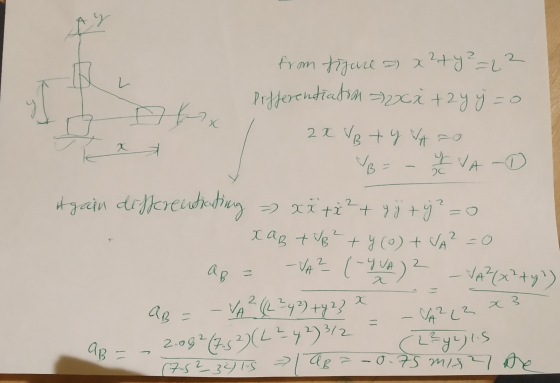
Chapter 2, Problem 2/181 Collars A and B slide along the fixed right-angle rods and are...
Problem #1: (30 pts.) The collars shown slide on a frictionless rod. Each of the collars...
 Problem #1: (30 pts.) The collars shown slide on a frictionless rod. Each of the collars have different mass: ma = 16 kg, mp = 8kg, mc = 12kg. At the instant shown collars B and C are at rest and collar A has a velocity of 2 m/s, knowing that the coefficient of restitution between the collars is 0.5: a) Determine the velocity of collar C after A hits B and B hits C in m/s. b) How would...
Zain JOO Flag question Collars A and B are pin connected to bar ABD and can...
 Zain JOO Flag question Collars A and B are pin connected to bar ABD and can slide along fixed rods. Knowing that at the instant shown the velocity of A is 1.0 m/s to the right, determine the velocity of point Din m/s. 300 mm D 300 mm 60- 60° Answer: O
Chapter 2, Problem 2/190 x Incorrect The rod of the fixed hydraulic cylinder is moving to...
 Chapter 2, Problem 2/190 x Incorrect The rod of the fixed hydraulic cylinder is moving to the left with a constant speed VA = 48 mm/s. Determine the corresponding acceleration of slider B (positive if downward, negative if upward) when 5a = 420 mm. The length of the cord is 1075 mm, and the effects of the radius of the small pulley A may be neglected. 245 mm Answer: ag = 35.563 mm/s2
Problem 14.47) Disks A, B, C, and D can ślide freely on a frictionless horizontal surface. Disks B, C, and D are connected by light rods and are at rest in the position shown when disk B is str...
 Problem 14.47) Disks A, B, C, and D can ślide freely on a frictionless horizontal surface. Disks B, C, and D are connected by light rods and are at rest in the position shown when disk B is struck squarely by disk A which is moving to the right with a velocity vo 12 m/s. The masses of the disks are m,-m,-mc - 7.5 kg, and m 15 kg. Knowing that after impact disks A and B are bound togetherV)...
PRINTER VERSION BACK NEXT Chapter 2, Problem 2/204 The rod of the fixed hydraulic cylinder is...
 PRINTER VERSION BACK NEXT Chapter 2, Problem 2/204 The rod of the fixed hydraulic cylinder is moving to the left with a constant speed VA = 38 mm/s. Determine the corresponding velocity Vg of slider B when SA = 390 mm. The length of the cord is 1660 mm, and the effects of the radius of the small pulley at A may be neglected. The velocity vg is positive if up. SA 245 mm Answer: Vg = mm/s the tolerance...
Two blocks are positioned on surfaces, each inclined at the same angle 45.6 degrees with respect...
Two blocks are positioned on surfaces, each inclined at the same angle 45.6 degrees with respect to the horizontal. The blocks are connected by a rope which rests on a frictionless pulley at the top of the inclines, so the blocks can slide together. The mass of the black block is 4.10kg and the coefficient of kinetic friction for both blocks and inclines is μk 0.370. Assume static friction has been overcome and that everything can slide. A) What must...
Chapter 2, Problem 2/182 The small sliders A and B are connected by the rigid slender...
 Chapter 2, Problem 2/182 The small sliders A and B are connected by the rigid slender rod. If the velocity of slider B is 2.73 m/s to the right and is constant over a certain interval of time, determine the speed of slider A when the system is in the position shown. R 55 2.28R UR B Answer: VA = m/s the tolerance is +/-2% Click if you would like to show Work for this question: Open Show Work LINK...
Chapter 2, Practice Problem 2/067 For an interval of motion the drum of radius b =...
 Chapter 2, Practice Problem 2/067 For an interval of motion the drum of radius b = 137 mm turns clockwise at a constant rate w = 2.7 rad/s and causes the carriage P to move to the right as the unwound length of the connecting cable is shortened. The distance h = 1.1 m. Use polar coordinates r and and find the magnitudes of the velocity v and acceleration a of P in the horizontal guide when the angle =...
Chapter 2, Problem 2/183 The distance y = 2.7 m. Find the upward velocity of A...
 Chapter 2, Problem 2/183 The distance y = 2.7 m. Find the upward velocity of A if the downward velocity of B is 2.3 m/s. Neglect the diameters of the pulleys. 9 m A B Answer: VA= m/s the tolerance is +/-2% Click if you would like to show Work for this question: Open Show Work
Problem1 The collar B to the right weighs 5 slugs. 32) 10 85 Find the force...
 Problem1 The collar B to the right weighs 5 slugs. 32) 10 85 Find the force needed to maintain the indicated angular velocity. The diagram is in the horizontal plane. F. wo.is ( s) Problem 1A Find the magnitude of acceleration when 180. a) 0 ft/s2 b) 20 ft/s2 c) 90 ft/s2 d) 150 m/s2 A or Sis é 5 rad/s 17-1.5 (2-cos θ) ft Problem Neglecting friction between the collar and rods, find the force exerted on the collar...
 Problem #1: (30 pts.) The collars shown slide on a frictionless rod. Each of the collars have different mass: ma = 16 kg, mp = 8kg, mc = 12kg. At the instant shown collars B and C are at rest and collar A has a velocity of 2 m/s, knowing that the coefficient of restitution between the collars is 0.5: a) Determine the velocity of collar C after A hits B and B hits C in m/s. b) How would...
 Zain JOO Flag question Collars A and B are pin connected to bar ABD and can slide along fixed rods. Knowing that at the instant shown the velocity of A is 1.0 m/s to the right, determine the velocity of point Din m/s. 300 mm D 300 mm 60- 60° Answer: O
 Chapter 2, Problem 2/190 x Incorrect The rod of the fixed hydraulic cylinder is moving to the left with a constant speed VA = 48 mm/s. Determine the corresponding acceleration of slider B (positive if downward, negative if upward) when 5a = 420 mm. The length of the cord is 1075 mm, and the effects of the radius of the small pulley A may be neglected. 245 mm Answer: ag = 35.563 mm/s2
 Problem 14.47) Disks A, B, C, and D can ślide freely on a frictionless horizontal surface. Disks B, C, and D are connected by light rods and are at rest in the position shown when disk B is struck squarely by disk A which is moving to the right with a velocity vo 12 m/s. The masses of the disks are m,-m,-mc - 7.5 kg, and m 15 kg. Knowing that after impact disks A and B are bound togetherV)...
 PRINTER VERSION BACK NEXT Chapter 2, Problem 2/204 The rod of the fixed hydraulic cylinder is moving to the left with a constant speed VA = 38 mm/s. Determine the corresponding velocity Vg of slider B when SA = 390 mm. The length of the cord is 1660 mm, and the effects of the radius of the small pulley at A may be neglected. The velocity vg is positive if up. SA 245 mm Answer: Vg = mm/s the tolerance...
 Chapter 2, Problem 2/182 The small sliders A and B are connected by the rigid slender rod. If the velocity of slider B is 2.73 m/s to the right and is constant over a certain interval of time, determine the speed of slider A when the system is in the position shown. R 55 2.28R UR B Answer: VA = m/s the tolerance is +/-2% Click if you would like to show Work for this question: Open Show Work LINK...
 Chapter 2, Practice Problem 2/067 For an interval of motion the drum of radius b = 137 mm turns clockwise at a constant rate w = 2.7 rad/s and causes the carriage P to move to the right as the unwound length of the connecting cable is shortened. The distance h = 1.1 m. Use polar coordinates r and and find the magnitudes of the velocity v and acceleration a of P in the horizontal guide when the angle =...
 Chapter 2, Problem 2/183 The distance y = 2.7 m. Find the upward velocity of A if the downward velocity of B is 2.3 m/s. Neglect the diameters of the pulleys. 9 m A B Answer: VA= m/s the tolerance is +/-2% Click if you would like to show Work for this question: Open Show Work
 Problem1 The collar B to the right weighs 5 slugs. 32) 10 85 Find the force needed to maintain the indicated angular velocity. The diagram is in the horizontal plane. F. wo.is ( s) Problem 1A Find the magnitude of acceleration when 180. a) 0 ft/s2 b) 20 ft/s2 c) 90 ft/s2 d) 150 m/s2 A or Sis é 5 rad/s 17-1.5 (2-cos θ) ft Problem Neglecting friction between the collar and rods, find the force exerted on the collar...
Most questions answered within 3 hours.
-
Where is the error in this code sequence?
String s1 = "Hello";
String s2 = "ello";...
asked 10 months ago -
Financial data for Joel de Paris, Inc., for last year
follow:
Joel de Paris, Inc.
Balance...
asked 10 months ago -
Consider this reaction:
Al2(SO4)3 (aq)+ BaCl3
(aq) Al2Cl6 (aq)- +
3BaSO4(s) . What is the...
asked 10 months ago -
Suppose that Savneet is considering increasing her
recent random sample from 20 car rentals to 40...
asked 10 months ago -
Trucks arrive at an unloading terminal at an average rate of 120
per hour.
Trucks arrive...
asked 10 months ago -
Why are methanol and ethanol completely soluble in water while
octanol is not very little soluble....
asked 10 months ago -
A facilities manager at a university reads in a research report
that the mean amount of...
asked 10 months ago -
When the CuSO4 is rehydrated by adding water to the anhydrous
compound, is this an endothermic...
asked 10 months ago -
A ray of sunlight is passing from diamond into crown glass; the
angle of incidence is...
asked 10 months ago -
A block of mass 0.249 kg is placed on top of a light, vertical
spring of...
asked 10 months ago -
how do the kidneys compensate in the presences of acidosis
a) trigger hyperventilate
b) reserve acid...
asked 10 months ago -
Question 501 pts
The rental rate of capital to the firm increases. Which of the
following...
asked 10 months ago