Two blocks are positioned on surfaces, each inclined at the same angle 45.6 degrees with respect...
Two blocks are positioned on surfaces, each inclined at the same angle 45.6 degrees with respect to the horizontal. The blocks are connected by a rope which rests on a frictionless pulley at the top of the inclines, so the blocks can slide together. The mass of the black block is 4.10kg and the coefficient of kinetic friction for both blocks and inclines is μk 0.370. Assume static friction has been overcome and that everything can slide. A) What must be the mass of the white block if both blocks are to slide to the right at a constant velocity? B)What must be the mass of the white block if both blocks are to slide to the left at a constant velocity? C) What must be the mass of the white block if both blocks are to slide to the right at an acceleration of 1.5m/s^2? D) What is must be the mass of the white block if both blocks are to slide to the left at an acceleration of 1.5 m/s2? E)Now, re-do part (d) above, but now assuming no friction at all on either incline. So in the absence of friction, what must be the mass of the white block such that both blocks slide to the left at an acceleration of 1.5 m/s2?
Homework Answers


Add Answer to:
Two blocks are positioned on surfaces, each inclined at the same
angle 45.6 degrees with respect...
two blocks are positioned on surfaces, each inclined at the same angle of 49.4 degrees with...
two blocks are positioned on surfaces, each inclined at the same angle of 49.4 degrees with respect to the horizontal. The blocks are connected by a rope which rests on a frictionless pulley at the top of the inclines as shown, so the blocks can slide together. The mass of the black block is 4.61 kg, and the coefficient of kinetic friction for both blocks and inclines is 0.470. Assume static friction has been overcome and that everything can slide....
Consider the blocks on the inclined surface above.
 4. Consider the blocks on the inclined surface above. They are attached by a steel rod that does not bend. Suppose the mass of block m 1=15 kg and has a coefficient of kinetic friction μ_k=.2, and a coefficient of static friction μ_s=.9 and θ=42 degrees. Suppose the mass of the second block is m2=25 kg.a. Suppose the masses are initially at rest. What is the minimum coefficient of friction of m2 required to stop both of them from sliding...
A block with mass m1 = 9.4 kg is on an incline with an angle θ = 26° with respect to the horizontal
 A block with mass m1 = 9.4 kg is on an incline with an angle θ = 26° with respect to the horizontal. For the first question there is no friction, but for the rest of this problem the coefficients of friction are: μk = 0.24 and μs = 0.264. 1) When there is no friction, what is the magnitude of the acceleration of the block? 2) Now with friction, what is the magnitude of the acceleration of the block after it...
Rope between inclines A rope rests on two platforms which are both inclined at an angle...
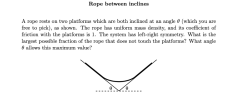 Rope between inclines A rope rests on two platforms which are both inclined at an angle θ (which you are free to pick), as shown. The rope has uniform mass density, and its coefficient of friction with the platforms is 1. The system has left-right symmetry. What is the largest possible fraction of the rope that does not touch the platforms? What angle θ allows this maximum value?
I need help on part G!!!!! Blocks A and B are on a frictionless horizontal surface....
I need help on part G!!!!! Blocks A and B are on a frictionless horizontal surface. Block A is to the left of block B. Both blocks are initially at rest. Block A has a mass of 2.1 kg and B has a mass of 1.5 kg. Block A is struck from the left with a hammer. The average force of this impact is 210 N and lasts for 0.09 seconds. Block A slides to the right, strikes and sticks...
The figure below shows two blocks connected to each other by a light cable that passes...
The figure below shows two blocks connected to each other by a light cable that passes over a pulley with negligible friction. The block of mass m1 = 4.50 kg lies on a horizontal table with negligible friction, while the block of mass m2 = 11.2 kg hangs vertically. (a) What is the magnitude of the acceleration of each block (in m/s2)? (Here, a1 is the acceleration of m1,and a2 is the acceleration of m2.) a1 = m/s2 a2 =...
Two blocks are connected by a string that passes over a frictionless pulley, as shown in...
 Two blocks are connected by a string that passes over a frictionless pulley, as shown in the figure. The pulley has a mass of mp = 2.00 kg, and can be treated as a uniform solid disk that rotates about its center. Block A, with a mass = 3.00 kg, rests on a ramp measuring 3.0 m vertically and 4.0 m horizontally. Block B hangs vertically below the pulley. Note that you can solve this exercise entirely using forces, torques,...
Two blocks, each of mass m = 6.90 kg , are connected by a massless rope...
Two blocks, each of mass m = 6.90 kg , are connected by a massless rope and start sliding down a slope of incline θ = 40.0 ∘ at t=0.000 s. The slope's top portion is a rough surface whose coefficient of kinetic friction is μk = 0.350. At a distance d = 2.90 m from block A's initial position the slope becomes frictionless. What is the velocity of the blocks 4.10 s after the blocks have started moving? Assume...
Two blocks are connected by a string that passes over a pulley, as shown in the...
Two blocks are connected by a string that passes over a pulley, as shown in the figure. The pulley rotates without friction and its mass can be neglected. Block A rests on a ramp measuring 3.0 m vertically and 4.0 m horizontally. Block B hangs vertically below the pulley. Note that you can solve this exercise entirely using forces and the constant-acceleration equations, but see if you can apply energy ideas instead. Use g = 10 \; m/s^2g=10m/s2. When the...
3. Each block on the inclined plane weighs 100 kg. (a) For what maximum angle the...
 3. Each block on the inclined plane weighs 100 kg. (a) For what maximum angle the blocks will not slide if the coefficient of static friction between the blocks and the inclined surface is 0.2? (b) Will the inclined angle calculated in part (a) increase, decrease or remain same if the block weights increase to 200 kg each? Simply circle the right answer, no need to justify. (c) If the coefficient of static friction between block B and the surface...
 4. Consider the blocks on the inclined surface above. They are attached by a steel rod that does not bend. Suppose the mass of block m 1=15 kg and has a coefficient of kinetic friction μ_k=.2, and a coefficient of static friction μ_s=.9 and θ=42 degrees. Suppose the mass of the second block is m2=25 kg.a. Suppose the masses are initially at rest. What is the minimum coefficient of friction of m2 required to stop both of them from sliding...
 Rope between inclines A rope rests on two platforms which are both inclined at an angle θ (which you are free to pick), as shown. The rope has uniform mass density, and its coefficient of friction with the platforms is 1. The system has left-right symmetry. What is the largest possible fraction of the rope that does not touch the platforms? What angle θ allows this maximum value?
 Two blocks are connected by a string that passes over a frictionless pulley, as shown in the figure. The pulley has a mass of mp = 2.00 kg, and can be treated as a uniform solid disk that rotates about its center. Block A, with a mass = 3.00 kg, rests on a ramp measuring 3.0 m vertically and 4.0 m horizontally. Block B hangs vertically below the pulley. Note that you can solve this exercise entirely using forces, torques,...
 3. Each block on the inclined plane weighs 100 kg. (a) For what maximum angle the blocks will not slide if the coefficient of static friction between the blocks and the inclined surface is 0.2? (b) Will the inclined angle calculated in part (a) increase, decrease or remain same if the block weights increase to 200 kg each? Simply circle the right answer, no need to justify. (c) If the coefficient of static friction between block B and the surface...
Most questions answered within 3 hours.
-
Where is the error in this code sequence?
String s1 = "Hello";
String s2 = "ello";...
asked 10 months ago -
Financial data for Joel de Paris, Inc., for last year
follow:
Joel de Paris, Inc.
Balance...
asked 10 months ago -
Consider this reaction:
Al2(SO4)3 (aq)+ BaCl3
(aq) Al2Cl6 (aq)- +
3BaSO4(s) . What is the...
asked 10 months ago -
Suppose that Savneet is considering increasing her
recent random sample from 20 car rentals to 40...
asked 10 months ago -
Trucks arrive at an unloading terminal at an average rate of 120
per hour.
Trucks arrive...
asked 10 months ago -
Why are methanol and ethanol completely soluble in water while
octanol is not very little soluble....
asked 10 months ago -
A facilities manager at a university reads in a research report
that the mean amount of...
asked 10 months ago -
When the CuSO4 is rehydrated by adding water to the anhydrous
compound, is this an endothermic...
asked 10 months ago -
A ray of sunlight is passing from diamond into crown glass; the
angle of incidence is...
asked 10 months ago -
A block of mass 0.249 kg is placed on top of a light, vertical
spring of...
asked 10 months ago -
how do the kidneys compensate in the presences of acidosis
a) trigger hyperventilate
b) reserve acid...
asked 10 months ago -
Question 501 pts
The rental rate of capital to the firm increases. Which of the
following...
asked 10 months ago