What are the resulting products of transamination between glutamate and oxaloacetate, respectively? Select one: a. alpha-ketoglutarate...
What are the resulting products of transamination between glutamate and oxaloacetate, respectively?
Select one:
a. alpha-ketoglutarate and aspartate
b. alpha-ketoglutarate and alanine
c. glutamine and aspartate
d. glutamate and alanine
e. None of these
Homework Answers
Option A is correct.
Transamination is the process of transfer of amino group from an amino acid to a keto acid.
Two important transamination reactions are -
1. L glutamate + pyruvate → alpha ketoglutarate + L alanine (by enzyme glutamate pyruvate transaminase)
2. L glutamate + oxaloacetate → alpha ketoglutarate + L aspartate
Please rate high.
Add Answer to:
What are the resulting products of transamination between
glutamate and oxaloacetate, respectively?
Select one:
a. alpha-ketoglutarate...
Write the mechanism of the PLP-dependent transamination reaction of glutamate and oxaloacetate to yicld α-ketoglutarate plus...
 Write the mechanism of the PLP-dependent transamination reaction of glutamate and oxaloacetate to yicld α-ketoglutarate plus aspartate. 5.3
Select all that apply. What amino acids are synthesized from alpha - ketoglutarate? histidine valine glutamate...
 Select all that apply. What amino acids are synthesized from alpha - ketoglutarate? histidine valine glutamate methionine proline arginine isoleucine alanine lysine glutamine phenylalanine leucine
I need help with pathway traces for the four following: 1) Aspartate (D) ? Oxaloacetate via...
I need help with pathway traces for the four following: 1) Aspartate (D) ? Oxaloacetate via Transaminase 2) Glutamate (E) ? Alpha ketoglutarate via Transaminase 3) Alanine ? Pyruvate via transaminase 3)Glutamate(E) ? Glutamine (Q) via glutamine synthase→ this might be glutamine synthetase not synthase *please put the substrate, enzyme and product*
help with questions but short answer Amino acid catabolism in skeletal muscle: the Alanine cycle Transamination...
 help with questions but short answer
Amino acid catabolism in skeletal muscle: the Alanine cycle Transamination reactions: the relationship between alanine/pyruvate; aspartate/oxaloacetate and glutamate/a ketoglutarate. Draw these transamination reactions with structures. GPCR and RTK signaling pathways. Use your knowledge of these pathways to predict how experimental situations will influence cell signaling as discussed in class. Products of amino acids and their role in signaling. Role of hormones in regulation of metabolism.
help with questions but short answer
Amino acid catabolism in skeletal muscle: the Alanine cycle Transamination reactions: the relationship between alanine/pyruvate; aspartate/oxaloacetate and glutamate/a ketoglutarate. Draw these transamination reactions with structures. GPCR and RTK signaling pathways. Use your knowledge of these pathways to predict how experimental situations will influence cell signaling as discussed in class. Products of amino acids and their role in signaling. Role of hormones in regulation of metabolism.
P11. When glutamate is oxidatively deaminated by GDH, the products A) NADH, α-iminoglutarate, and NH3 (...
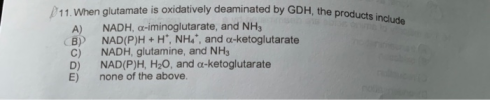 P11. When glutamate is oxidatively deaminated by GDH, the products A) NADH, α-iminoglutarate, and NH3 ( B)) NAD(P)H + H+, NH4+, and α-ketoglutarate C) NADH, glutamine, and NH3 D) NAD(P)H, H20, and a-ketoglutarate E) none of the above
Options for each are lactate, alanine, acetaldehyde, oxaloacetate, and acetyl-CoA. Match the following showing reaction products...
 Options for each are lactate, alanine, acetaldehyde,
oxaloacetate, and acetyl-CoA.
Match the following showing reaction products of pyruvate: a) Decarboxylation by pyruvate decarboxylase b) Carboxylation c) Transamination d) Reduction e) Decarboxylation by pyruvate dehydrogenase
Options for each are lactate, alanine, acetaldehyde,
oxaloacetate, and acetyl-CoA.
Match the following showing reaction products of pyruvate: a) Decarboxylation by pyruvate decarboxylase b) Carboxylation c) Transamination d) Reduction e) Decarboxylation by pyruvate dehydrogenase
18. The carbon atoms of glutamate can enter the citric acid cycle after transamination to the...
 18. The carbon atoms of glutamate can enter the citric acid cycle after transamination to the corresponding a-keto acid (see question #7). When [a-14C]-glutamate undergoes transamination, what is the labeling pattern (if any) in the succinate generated immediately from the labeled glutamate? A. 2014C-CH=CHCOO is produced from la calutamate A. None, OOC-CH2-CH2-COO is produced from [a-14C]-glutamate B. 0014C-CH=14CH-COO is produced from [a-14C]-glutamate C. OOC-14CH2-14CH2-COO is produced from [a-14C]-glutamate D. 0014C-CH2-CH2-14COO is produced from [a-14C]-glutamate E. OOC-14C0-14CH2-COO is produced from [a-14C]-glutamate
16. What enzyme classes are responsible for interconverting glutamate and a-ketoglutarate? A) hydrolases B) transferases C)...
16. What enzyme classes are responsible for interconverting glutamate and a-ketoglutarate? A) hydrolases B) transferases C) ligases D) All of the answers are correct. E) None of the answers is correct. the answer is D. Could you give some example about A.B and C ? Thanks!!
Can someone please check my answers and aid in #12? 1. The amide nitrogen of glutamine:...
Can someone please check my answers and aid in #12? 1. The amide nitrogen of glutamine: A. represents a nontoxic transport form of ammonia. B. is a major source of ammonia for urinary excretion. C. is used in the synthesis of asparagine, purines, and pynimidines. D. can be recovered as ammonia by the action of glutaminase. E. all of the above are correct. 2- Which of the following statements about glutamate is NOT true: a It can be synthesized in...
The number of electrons produced by one cycle of Krebs is 6 b. 8 &n
The number of electrons produced by one cycle of Krebs is 6 b. 8 c. 4 d. 2 The Ala that comes from the muscle is returned to the muscle as pyruvate c. glucose glutamate d. a-ketoglutarate Oxaloacetate enters the urea cycle as citrulline c. glutamate aspartate d. fumarate The oxidation of pyruvate to AcCoA uses similar cofactors as the oxidation of malate succinate a-ketoglutarate isocitrate The enzyme that requires FAD as cofactor is...
 Write the mechanism of the PLP-dependent transamination reaction of glutamate and oxaloacetate to yicld α-ketoglutarate plus aspartate. 5.3
 Select all that apply. What amino acids are synthesized from alpha - ketoglutarate? histidine valine glutamate methionine proline arginine isoleucine alanine lysine glutamine phenylalanine leucine
 help with questions but short answer
Amino acid catabolism in skeletal muscle: the Alanine cycle Transamination reactions: the relationship between alanine/pyruvate; aspartate/oxaloacetate and glutamate/a ketoglutarate. Draw these transamination reactions with structures. GPCR and RTK signaling pathways. Use your knowledge of these pathways to predict how experimental situations will influence cell signaling as discussed in class. Products of amino acids and their role in signaling. Role of hormones in regulation of metabolism.
help with questions but short answer
Amino acid catabolism in skeletal muscle: the Alanine cycle Transamination reactions: the relationship between alanine/pyruvate; aspartate/oxaloacetate and glutamate/a ketoglutarate. Draw these transamination reactions with structures. GPCR and RTK signaling pathways. Use your knowledge of these pathways to predict how experimental situations will influence cell signaling as discussed in class. Products of amino acids and their role in signaling. Role of hormones in regulation of metabolism.
 P11. When glutamate is oxidatively deaminated by GDH, the products A) NADH, α-iminoglutarate, and NH3 ( B)) NAD(P)H + H+, NH4+, and α-ketoglutarate C) NADH, glutamine, and NH3 D) NAD(P)H, H20, and a-ketoglutarate E) none of the above
 Options for each are lactate, alanine, acetaldehyde,
oxaloacetate, and acetyl-CoA.
Match the following showing reaction products of pyruvate: a) Decarboxylation by pyruvate decarboxylase b) Carboxylation c) Transamination d) Reduction e) Decarboxylation by pyruvate dehydrogenase
Options for each are lactate, alanine, acetaldehyde,
oxaloacetate, and acetyl-CoA.
Match the following showing reaction products of pyruvate: a) Decarboxylation by pyruvate decarboxylase b) Carboxylation c) Transamination d) Reduction e) Decarboxylation by pyruvate dehydrogenase
 18. The carbon atoms of glutamate can enter the citric acid cycle after transamination to the corresponding a-keto acid (see question #7). When [a-14C]-glutamate undergoes transamination, what is the labeling pattern (if any) in the succinate generated immediately from the labeled glutamate? A. 2014C-CH=CHCOO is produced from la calutamate A. None, OOC-CH2-CH2-COO is produced from [a-14C]-glutamate B. 0014C-CH=14CH-COO is produced from [a-14C]-glutamate C. OOC-14CH2-14CH2-COO is produced from [a-14C]-glutamate D. 0014C-CH2-CH2-14COO is produced from [a-14C]-glutamate E. OOC-14C0-14CH2-COO is produced from [a-14C]-glutamate
Most questions answered within 3 hours.
-
Where is the error in this code sequence?
String s1 = "Hello";
String s2 = "ello";...
asked 11 months ago -
Financial data for Joel de Paris, Inc., for last year
follow:
Joel de Paris, Inc.
Balance...
asked 11 months ago -
Consider this reaction:
Al2(SO4)3 (aq)+ BaCl3
(aq) Al2Cl6 (aq)- +
3BaSO4(s) . What is the...
asked 11 months ago -
Suppose that Savneet is considering increasing her
recent random sample from 20 car rentals to 40...
asked 11 months ago -
Trucks arrive at an unloading terminal at an average rate of 120
per hour.
Trucks arrive...
asked 11 months ago -
Why are methanol and ethanol completely soluble in water while
octanol is not very little soluble....
asked 11 months ago -
A facilities manager at a university reads in a research report
that the mean amount of...
asked 11 months ago -
When the CuSO4 is rehydrated by adding water to the anhydrous
compound, is this an endothermic...
asked 11 months ago -
A ray of sunlight is passing from diamond into crown glass; the
angle of incidence is...
asked 11 months ago -
A block of mass 0.249 kg is placed on top of a light, vertical
spring of...
asked 11 months ago -
how do the kidneys compensate in the presences of acidosis
a) trigger hyperventilate
b) reserve acid...
asked 11 months ago -
Question 501 pts
The rental rate of capital to the firm increases. Which of the
following...
asked 11 months ago