
Homework Answers

Add Answer to:
show all wrk
6. If a proton has a de Broglie wavelength of 7.63 x 10⁻¹²...
show all wrk Show your works and units for full credits 1. If the wavelength of...
 show all wrk
Show your works and units for full credits 1. If the wavelength of a red light photon in vacuum is a = 680 nm, what is the energy of the photon in units of eV? (1 eV = 1.6 x 10⁻¹⁹ and Planck constanth 6.63 x 10⁴ ) E- 2. What is the wavelength of a laser light beam that has the photon energy of 3.12 x 10⁻²⁰ ? 2 3. If an electron moves a speed...
show all wrk
Show your works and units for full credits 1. If the wavelength of a red light photon in vacuum is a = 680 nm, what is the energy of the photon in units of eV? (1 eV = 1.6 x 10⁻¹⁹ and Planck constanth 6.63 x 10⁴ ) E- 2. What is the wavelength of a laser light beam that has the photon energy of 3.12 x 10⁻²⁰ ? 2 3. If an electron moves a speed...
33.3 What is the de Broglie wavelength of: (a) an electron (melectron electron 9.1 x 10⁻³¹...
 33.3 What is the de Broglie wavelength of: (a) an electron (melectron electron 9.1 x 10⁻³¹ kg) travelling at 15 kms-1? (b) an electron with a kinetic energy of 1 eV? (c) a proton (mproton -1.67x 10⁻²⁷ kg travelling at 15kms-1? (d) a proton with a kinetic energy of 1 eV? (e) an elephant (melephant 10 tonnes) travelling at 15 km h-1? (D an elephant with a kinetic energy of 1 evi
5. Find the kinetic energy of an electron whose de Broglie wavelength is 34.0 nm. 6....
 5. Find the kinetic energy of an electron whose de Broglie wavelength is 34.0 nm. 6. Light with a frequency of 1.85 x 10¹⁵ Hz ejects electrons from the surface of zinc, which has a work function of 4.33 eV. What is the minimum de Broglie wavelength of the ejected electrons? nm
5. Find the kinetic energy of an electron whose de Broglie wavelength is 34.0 nm. J...
 5. Find the kinetic energy of an electron whose de Broglie wavelength is 34.0 nm. J 6. Light with a frequency of 1.85 x 10¹⁵ Hz ejects electrons from the surface of zinc, which has a work function of 4.33 eV. What is the minimum de Broglie wavelength of the ejected electrons? nm
10. Show the ratio of the Compton wavelength to the de Broglie wavelength for a relativistic...
 10. Show the ratio of the Compton wavelength to the de Broglie wavelength for a relativistic electron with Energy E is given by 소 11. Non-relativistic electrons and protons are accelerated from rest though the same potential difference Δ V, show the ratio of their de Broglie wavelengths is given by: 弖
What is the de Broglie wavelength for a proton (m = 1.67× 10⁻²⁷ kg) moving at...
What is the de Broglie wavelength for a proton (m = 1.67× 10⁻²⁷ kg) moving at a speed of 9.50 × 10⁶ m/s? (h = 6.63 × 10⁻³⁴ J⋅s)
What is the de Broglie wavelength of a proton (m = 1.67×10⁻²⁷ kg) moving at 440,000...
What is the de Broglie wavelength of a proton (m = 1.67×10⁻²⁷ kg) moving at 440,000 m/s? (Express your answer to two significant figures).
A nonrelativistic electron has a larger de Broglie wavelength than a nonrelativistic proton. Which one of...
A nonrelativistic electron has a larger de Broglie wavelength than a nonrelativistic proton. Which one of the following statements about these particles must be accurate? A) The proton has more momentum than the electron B) Both particles have the same kinetic energy. C) The proton has more kinetic energy than the electron. D) The electron has more kinetic energy than the proton. E) The electron has more momentum than the proton. Answer is A. Pleas explain step by step how...
What is the de Broglie wavelength of a proton (m = 1.67××10−27−27 kg) moving at 440,000...
What is the de Broglie wavelength of a proton (m = 1.67××10−27−27 kg) moving at 440,000 m/s? (Express your answer to two significant figures.
If electrons are quantized particles that behave like waves then based on the de Broglie hypothesis...
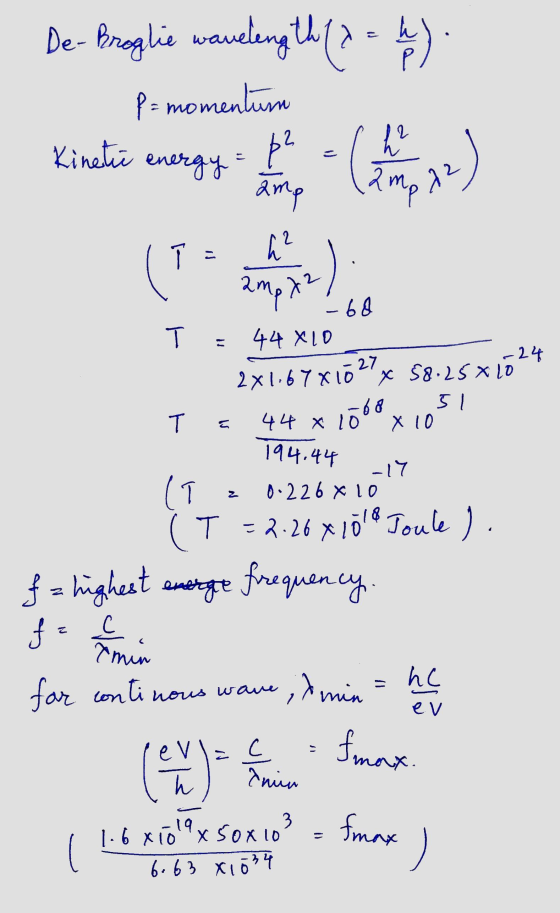
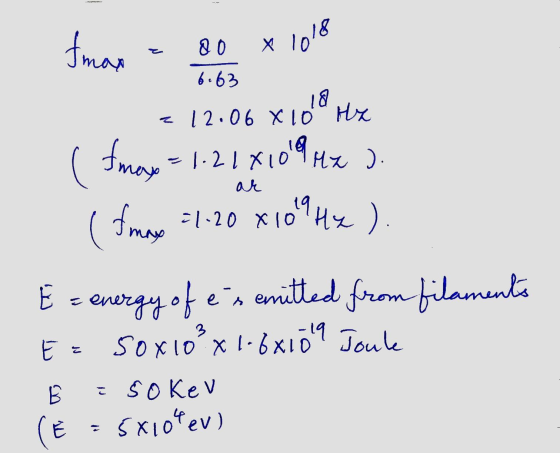
If electrons are quantized particles that behave like waves then based on the de Broglie hypothesis their kinetic energy is well defined. (a) Determine the energy and wavelength of free electrons (electrons in vacuum or those not confined in an atom) accelerated by a potential difference of 100 kV. (b) Do the same calculation for electrons with a potential energy of 1 eV. (c) On the other hand electrons trapped in a typical solid, such as a conducting metal, have...
 show all wrk
Show your works and units for full credits 1. If the wavelength of a red light photon in vacuum is a = 680 nm, what is the energy of the photon in units of eV? (1 eV = 1.6 x 10⁻¹⁹ and Planck constanth 6.63 x 10⁴ ) E- 2. What is the wavelength of a laser light beam that has the photon energy of 3.12 x 10⁻²⁰ ? 2 3. If an electron moves a speed...
show all wrk
Show your works and units for full credits 1. If the wavelength of a red light photon in vacuum is a = 680 nm, what is the energy of the photon in units of eV? (1 eV = 1.6 x 10⁻¹⁹ and Planck constanth 6.63 x 10⁴ ) E- 2. What is the wavelength of a laser light beam that has the photon energy of 3.12 x 10⁻²⁰ ? 2 3. If an electron moves a speed...
 33.3 What is the de Broglie wavelength of: (a) an electron (melectron electron 9.1 x 10⁻³¹ kg) travelling at 15 kms-1? (b) an electron with a kinetic energy of 1 eV? (c) a proton (mproton -1.67x 10⁻²⁷ kg travelling at 15kms-1? (d) a proton with a kinetic energy of 1 eV? (e) an elephant (melephant 10 tonnes) travelling at 15 km h-1? (D an elephant with a kinetic energy of 1 evi
 5. Find the kinetic energy of an electron whose de Broglie wavelength is 34.0 nm. 6. Light with a frequency of 1.85 x 10¹⁵ Hz ejects electrons from the surface of zinc, which has a work function of 4.33 eV. What is the minimum de Broglie wavelength of the ejected electrons? nm
 5. Find the kinetic energy of an electron whose de Broglie wavelength is 34.0 nm. J 6. Light with a frequency of 1.85 x 10¹⁵ Hz ejects electrons from the surface of zinc, which has a work function of 4.33 eV. What is the minimum de Broglie wavelength of the ejected electrons? nm
 10. Show the ratio of the Compton wavelength to the de Broglie wavelength for a relativistic electron with Energy E is given by 소 11. Non-relativistic electrons and protons are accelerated from rest though the same potential difference Δ V, show the ratio of their de Broglie wavelengths is given by: 弖
Most questions answered within 3 hours.
-
Where is the error in this code sequence?
String s1 = "Hello";
String s2 = "ello";...
asked 11 months ago -
Financial data for Joel de Paris, Inc., for last year
follow:
Joel de Paris, Inc.
Balance...
asked 11 months ago -
Consider this reaction:
Al2(SO4)3 (aq)+ BaCl3
(aq) Al2Cl6 (aq)- +
3BaSO4(s) . What is the...
asked 11 months ago -
Suppose that Savneet is considering increasing her
recent random sample from 20 car rentals to 40...
asked 11 months ago -
Trucks arrive at an unloading terminal at an average rate of 120
per hour.
Trucks arrive...
asked 11 months ago -
Why are methanol and ethanol completely soluble in water while
octanol is not very little soluble....
asked 11 months ago -
A facilities manager at a university reads in a research report
that the mean amount of...
asked 11 months ago -
When the CuSO4 is rehydrated by adding water to the anhydrous
compound, is this an endothermic...
asked 11 months ago -
A ray of sunlight is passing from diamond into crown glass; the
angle of incidence is...
asked 11 months ago -
A block of mass 0.249 kg is placed on top of a light, vertical
spring of...
asked 11 months ago -
how do the kidneys compensate in the presences of acidosis
a) trigger hyperventilate
b) reserve acid...
asked 11 months ago -
Question 501 pts
The rental rate of capital to the firm increases. Which of the
following...
asked 11 months ago