
Homework Answers
10) The Compton wavelength is

The de Broglie wavelength is  . By taking the ratio of the Compton wavelength to the de Broglie
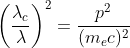
wavelength and square it
. By taking the ratio of the Compton wavelength to the de Broglie
wavelength and square it
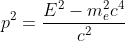
the momentum for a slowly-moving or rapidly moving object is described by
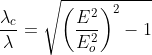
Substituting and simplifying

Add Answer to:
10. Show the ratio of the Compton wavelength to the de Broglie wavelength for a relativistic...
An electron is accelerated from rest through a difference of potential V. a) Show that the...
An electron is accelerated from rest through a difference of potential V. a) Show that the de Broglie wavelength, in unit of angstrom Å (10-10 m), for a non- relativistic electron accelerated through a small potential difference is: λ =12.27/(v)^1/2 b) Calculate λ if the electron is accelerated through 50 V. c) Find the de Broglie wavelength for a relativistic electron that is accelerated from rest through a large difference potential difference at a modern particle collider. d) Show that...
Show that the de Broglie wavelength of an electron accelerated from rest through potential difference of...
 Show that the de Broglie wavelength of an electron accelerated from rest through potential difference of V volts is 1.226/squareroot V nm.
The de Broglie wavelength calculation for an object holds even at relativistic speeds. At what total...
 The de Broglie wavelength calculation for an object holds even at relativistic speeds. At what total energy E will the de Broglie wavelength of an electron be different by a factor of two from the wavelength of a photon with the same energy?
de Broglie Matter waves and the non-relativistic electron: The Double slit experiment for electrons (a) Electrons...
de Broglie Matter waves and the non-relativistic electron: The Double slit experiment for electrons (a) Electrons were accelerated through a potential difference of V = 50 kV. Is it permissible to use non- relativistic expressions to find the linear momentum of the electrons? Calculate the de Broglie wavelength of an electron in the Hitachi experiment (b) The spacing between the fringes observed was 90 nm. [The image shown in Fig 1.4 in the textbook has been magnified further of course,...
(a) Using the relativistic relation between E and p, show that electrons and photons with the...
 (a) Using the relativistic relation between E and p, show that electrons and photons with the same energy E have different wavelengths. (Note: Even at relativistic energies, the de Broglie wavelength equation is valid.) (b) Show that the ratio of their wavelengths approach equality as their common energy E gets much larger than mec^.
A) If the De Broglie wavelength of an electron is equal to 350 nm calculate the...
A) If the De Broglie wavelength of an electron is equal to 350 nm calculate the velocity of the electron. Assume that the electron's speed is non-relativistic. B) If the kinetic energy of an electron is 440 eV, calculate its De Broglie wavelength. For this non-relativistic electron you must first calculate its velocity from the general kinetic energy equation. Then you can find the De Broglie wavelength of the electron.
If the De Broglie wavelength of an electron is equal to 400 nm calculate the velocity...
If the De Broglie wavelength of an electron is equal to 400 nm calculate the velocity of the electron. Assume that the electron's speed is non-relativistic. Answer: 1832.42 m/s If the kinetic energy of an electron is 400 eV, calculate its De Broglie wavelength. For this non-relativistic electron you must first calculate its velocity from the general kinetic energy equation. Then you can find the De Broglie wavelength of the electron. I cannot figure out the second part, please explain!
What must be the kinetic energy of an electron if the ratio of its de Broglie...
What must be the kinetic energy of an electron if the ratio of its de Broglie wavelength to its Compton wavelength is 10^-3?
What is the de Broglie wavelength of: (a) A N2 molecule in a container at room...
What is the de Broglie wavelength of: (a) A N2 molecule in a container at room temperature moving at 500 m/s? (b) An electron accelerated through a potential difference of 100 V? (c) An electron in the first Bohr orbit of a hydrogen atom?
De Broglie postulated that the relationship ? = h/p is valid for relativistic particles. What is...
De Broglie postulated that the relationship ? = h/p is valid for relativistic particles. What is the de Broglie wavelength for a (relativistic) electron having a kinetic energy of 3.39 MeV? answer in m
 Show that the de Broglie wavelength of an electron accelerated from rest through potential difference of V volts is 1.226/squareroot V nm.
 The de Broglie wavelength calculation for an object holds even at relativistic speeds. At what total energy E will the de Broglie wavelength of an electron be different by a factor of two from the wavelength of a photon with the same energy?
 (a) Using the relativistic relation between E and p, show that electrons and photons with the same energy E have different wavelengths. (Note: Even at relativistic energies, the de Broglie wavelength equation is valid.) (b) Show that the ratio of their wavelengths approach equality as their common energy E gets much larger than mec^.
Most questions answered within 3 hours.
-
Where is the error in this code sequence?
String s1 = "Hello";
String s2 = "ello";...
asked 11 months ago -
Financial data for Joel de Paris, Inc., for last year
follow:
Joel de Paris, Inc.
Balance...
asked 11 months ago -
Consider this reaction:
Al2(SO4)3 (aq)+ BaCl3
(aq) Al2Cl6 (aq)- +
3BaSO4(s) . What is the...
asked 11 months ago -
Suppose that Savneet is considering increasing her
recent random sample from 20 car rentals to 40...
asked 11 months ago -
Trucks arrive at an unloading terminal at an average rate of 120
per hour.
Trucks arrive...
asked 11 months ago -
Why are methanol and ethanol completely soluble in water while
octanol is not very little soluble....
asked 11 months ago -
A facilities manager at a university reads in a research report
that the mean amount of...
asked 11 months ago -
When the CuSO4 is rehydrated by adding water to the anhydrous
compound, is this an endothermic...
asked 11 months ago -
A ray of sunlight is passing from diamond into crown glass; the
angle of incidence is...
asked 11 months ago -
A block of mass 0.249 kg is placed on top of a light, vertical
spring of...
asked 11 months ago -
how do the kidneys compensate in the presences of acidosis
a) trigger hyperventilate
b) reserve acid...
asked 11 months ago -
Question 501 pts
The rental rate of capital to the firm increases. Which of the
following...
asked 11 months ago