What is the de Broglie wavelength of: (a) A N2 molecule in a container at room...
What is the de Broglie wavelength of: (a) A N2 molecule in a container at room temperature moving at 500 m/s? (b) An electron accelerated through a potential difference of 100 V? (c) An electron in the first Bohr orbit of a hydrogen atom?
Homework Answers
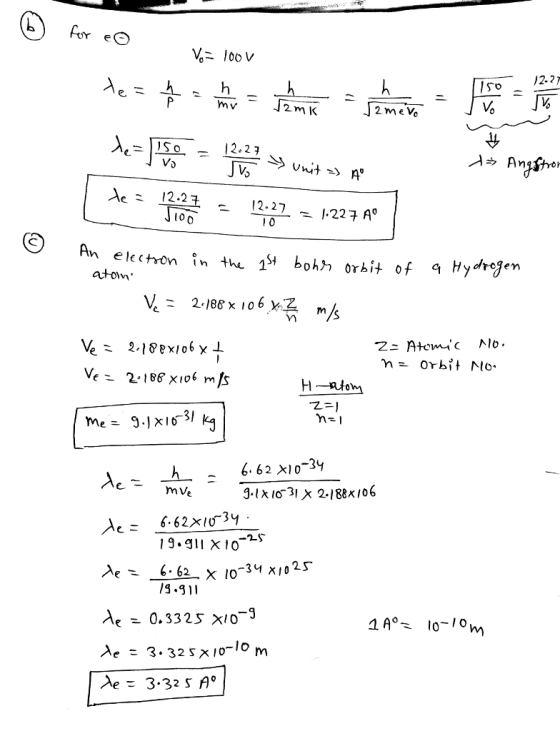
De Broglie wavelength is inversely proportional to linear momentum.
Wavelength= h/p
P= linear momentum
h= Planck constant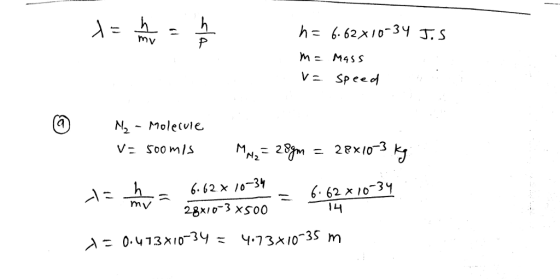
Add Answer to:
What is the de Broglie wavelength of: (a) A N2 molecule in a
container at room...
An electron has a de Broglie wavelength λ = 3.9 10-10 m. (a) What is its...
An electron has a de Broglie wavelength λ = 3.9 10-10 m. (a) What is its momentum? _____ kg·m/s (b) What is its speed? _____ m/s (c) Through what voltage difference does it need to be accelerated to reach this speed? _____ V (d) What's the speed of a 50 kg person having a de Broglie wavelength of λ = 4.4e-38 m? _____ m/s
Show that the de Broglie wavelength of an electron accelerated from rest through potential difference of...
 Show that the de Broglie wavelength of an electron accelerated from rest through potential difference of V volts is 1.226/squareroot V nm.
Part B The hypothesis that was put forward by Louis de Broglie in 1924 was astonishing...
 Part B
The hypothesis that was put forward by Louis de Broglie in 1924 was astonishing for a number of reasons. An obvious reason is that associating a wavelike nature with particles is far from intuitive, but another astonishing aspect was how well the hypothesis fit in with certain parts of existing physics. In this problem, we explore the correspondence between the de Broglie picture of the wave nature of electrons and the Bohr model of the hydrogen atom. What...
Part B
The hypothesis that was put forward by Louis de Broglie in 1924 was astonishing for a number of reasons. An obvious reason is that associating a wavelike nature with particles is far from intuitive, but another astonishing aspect was how well the hypothesis fit in with certain parts of existing physics. In this problem, we explore the correspondence between the de Broglie picture of the wave nature of electrons and the Bohr model of the hydrogen atom. What...
10. Show the ratio of the Compton wavelength to the de Broglie wavelength for a relativistic...
 10. Show the ratio of the Compton wavelength to the de Broglie wavelength for a relativistic electron with Energy E is given by 소 11. Non-relativistic electrons and protons are accelerated from rest though the same potential difference Δ V, show the ratio of their de Broglie wavelengths is given by: 弖
Through what potential difference should you accelerate an electron from rest so its de Broglie wavelength...
 Through what potential difference should you accelerate an electron from rest so its de Broglie wavelength will be the size of a hydrogen atom, about 0.1 nm? Give your answer to two significant figures
1. (A) Find the de Broglie wavelength (in nm) associated with an electron that is moving...
1. (A) Find the de Broglie wavelength (in nm) associated with an electron that is moving with a velocity of 2310 km/s. The electron rest mass is 9.11 x 10⁻³¹ kg. Note, electrons having this speed would need to be treated as waves in atoms because the wavelength is on the order of the size of atoms. (B) A baseball weighs 220 g. Top speed for a professional pitcher is about 100 mph when he throws a fast ball. Find...
2. Estimate the de Broglie wavelength of an electron (me - 9.11 x 10- kg) as...
 2. Estimate the de Broglie wavelength of an electron (me - 9.11 x 10- kg) as it orbits a hydrogen atom with a period of 0.166 fs. (1 fs = 1 x 10-'s). Take the Bohr radius to be 0.05 nm.
A proton is accelerated through a potential difference of 25,000V. What is the de Broglie wavelength...
A proton is accelerated through a potential difference of 25,000V. What is the de Broglie wavelength of the proton(in m)? A. 5.9*10^12 B. 6.8*10^12 C.6.5*10^12 D.18*10^12 E. 5.5*10^12
14. Consider the hydrogen atom. (a) What value of wavelength is associated with the Lyman series...
 14. Consider the hydrogen atom. (a) What value of wavelength is associated with the Lyman series for n = 2? (Rydberg constant RH = 1.097 x 10^7 m^-1). (b) An electron in a hydrogen atom makes a transition from the n = 4 to the n = 3 energy state. Determine the energy (in eV) of the emitted photon. (c) Calculate the radius, speed. linear momentum. and de Broglie wavelength of the electron in the first Bohr orbit. (me =...
What is the de Broglie wavelength of an electron in the n=2 level of a hydrogen...
What is the de Broglie wavelength of an electron in the n=2 level of a hydrogen atom? 0.067 m 0.67 nm 0.21 nm 3.2 nm 14.1 nm The answer is (A) why?
 Show that the de Broglie wavelength of an electron accelerated from rest through potential difference of V volts is 1.226/squareroot V nm.
 Part B
The hypothesis that was put forward by Louis de Broglie in 1924 was astonishing for a number of reasons. An obvious reason is that associating a wavelike nature with particles is far from intuitive, but another astonishing aspect was how well the hypothesis fit in with certain parts of existing physics. In this problem, we explore the correspondence between the de Broglie picture of the wave nature of electrons and the Bohr model of the hydrogen atom. What...
Part B
The hypothesis that was put forward by Louis de Broglie in 1924 was astonishing for a number of reasons. An obvious reason is that associating a wavelike nature with particles is far from intuitive, but another astonishing aspect was how well the hypothesis fit in with certain parts of existing physics. In this problem, we explore the correspondence between the de Broglie picture of the wave nature of electrons and the Bohr model of the hydrogen atom. What...
 10. Show the ratio of the Compton wavelength to the de Broglie wavelength for a relativistic electron with Energy E is given by 소 11. Non-relativistic electrons and protons are accelerated from rest though the same potential difference Δ V, show the ratio of their de Broglie wavelengths is given by: 弖
 Through what potential difference should you accelerate an electron from rest so its de Broglie wavelength will be the size of a hydrogen atom, about 0.1 nm? Give your answer to two significant figures
 2. Estimate the de Broglie wavelength of an electron (me - 9.11 x 10- kg) as it orbits a hydrogen atom with a period of 0.166 fs. (1 fs = 1 x 10-'s). Take the Bohr radius to be 0.05 nm.
 14. Consider the hydrogen atom. (a) What value of wavelength is associated with the Lyman series for n = 2? (Rydberg constant RH = 1.097 x 10^7 m^-1). (b) An electron in a hydrogen atom makes a transition from the n = 4 to the n = 3 energy state. Determine the energy (in eV) of the emitted photon. (c) Calculate the radius, speed. linear momentum. and de Broglie wavelength of the electron in the first Bohr orbit. (me =...
Most questions answered within 3 hours.
-
Where is the error in this code sequence?
String s1 = "Hello";
String s2 = "ello";...
asked 11 months ago -
Financial data for Joel de Paris, Inc., for last year
follow:
Joel de Paris, Inc.
Balance...
asked 11 months ago -
Consider this reaction:
Al2(SO4)3 (aq)+ BaCl3
(aq) Al2Cl6 (aq)- +
3BaSO4(s) . What is the...
asked 11 months ago -
Suppose that Savneet is considering increasing her
recent random sample from 20 car rentals to 40...
asked 11 months ago -
Trucks arrive at an unloading terminal at an average rate of 120
per hour.
Trucks arrive...
asked 11 months ago -
Why are methanol and ethanol completely soluble in water while
octanol is not very little soluble....
asked 11 months ago -
A facilities manager at a university reads in a research report
that the mean amount of...
asked 11 months ago -
When the CuSO4 is rehydrated by adding water to the anhydrous
compound, is this an endothermic...
asked 11 months ago -
A ray of sunlight is passing from diamond into crown glass; the
angle of incidence is...
asked 11 months ago -
A block of mass 0.249 kg is placed on top of a light, vertical
spring of...
asked 11 months ago -
how do the kidneys compensate in the presences of acidosis
a) trigger hyperventilate
b) reserve acid...
asked 11 months ago -
Question 501 pts
The rental rate of capital to the firm increases. Which of the
following...
asked 11 months ago