
Homework Answers
Add Answer to:
The two-member structure is connected at by, a pin, which is fixed to BDE and passes...
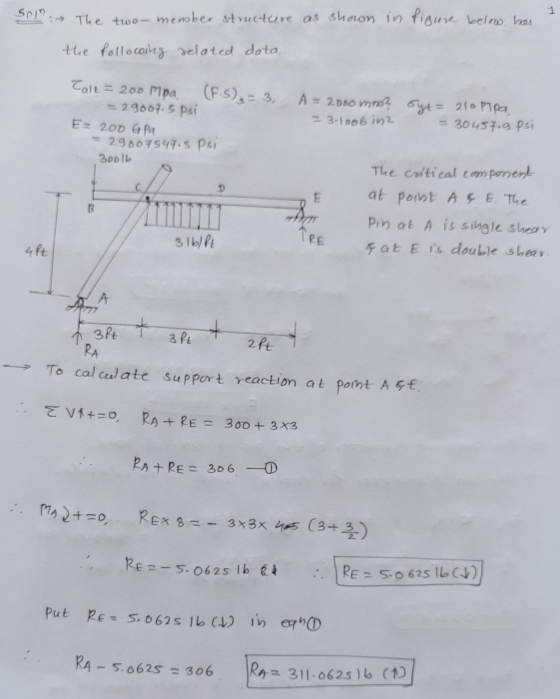
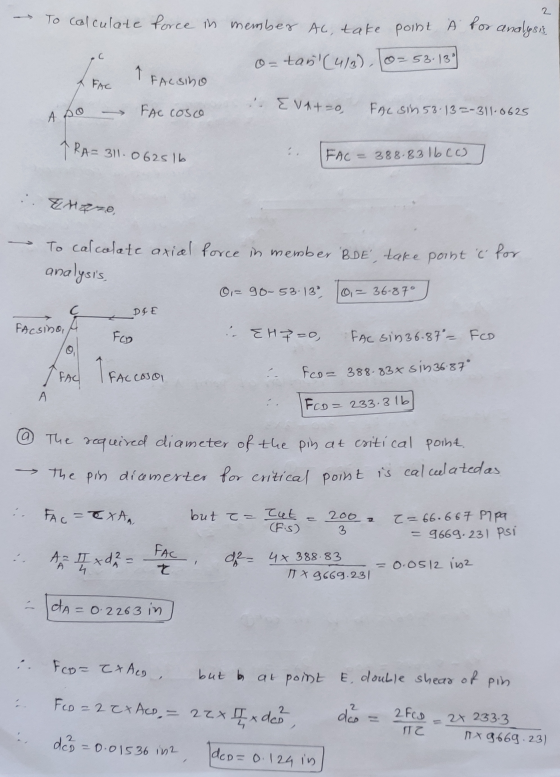
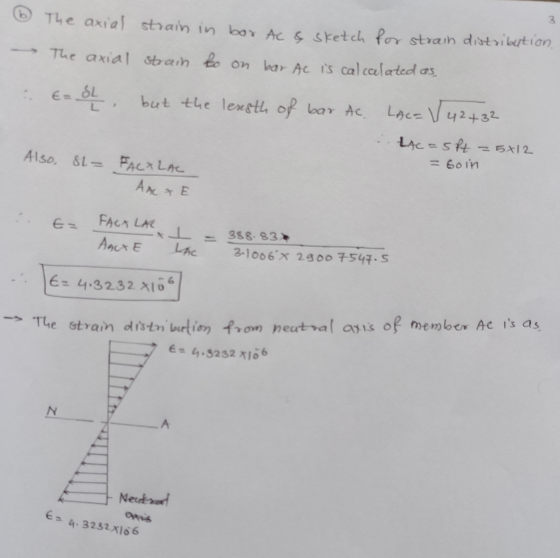
The two-member structure is connected at C by a pin, which is fixed to BDE and...
 The two-member structure is connected at C by a pin, which is fixed to BDE and passes through the smooth slot in member AC. Set F 300 lb (Figure 1) Determine the horizontal component of reaction at the support E Express your answer with the appropriate units. Value Units Submit Part D Determine the vertical component of reaction at the support E Express your answer with the appropriate units. gure 1 of 1 E 900 lb Submit X Incorrect; Try...
The rigid bar shown is supported by axial bar (1) and by a pin connection at C. Axial bar (1) has...
 The rigid bar shown is supported by axial bar (1) and by a pin
connection at C. Axial bar (1) has a cross-sectional area
of A1 = 250 mm2, an elastic modulus
of E = 200 GPa, and a coefficient of thermal expansion of
α= 11.3 × 10⁻⁶/°C. The pin at C has a diameter
of 40 mm. After load P has been applied and the
temperature of the entire assembly has been increased by 10°C, the
total strain in...
The rigid bar shown is supported by axial bar (1) and by a pin
connection at C. Axial bar (1) has a cross-sectional area
of A1 = 250 mm2, an elastic modulus
of E = 200 GPa, and a coefficient of thermal expansion of
α= 11.3 × 10⁻⁶/°C. The pin at C has a diameter
of 40 mm. After load P has been applied and the
temperature of the entire assembly has been increased by 10°C, the
total strain in...
Two bars BC and CD of cross sectional areas 100 mm2 and 50 mm2 respectively rigidly connected at C and also to fixed wa...
 Two bars BC and CD of cross sectional areas 100 mm2 and 50 mm2 respectively rigidly connected at C and also to fixed walls at their other ends as shown in Figure 4. Both bars are made of the same material having an elastic modulus E = 200 GPa and have the same length 0.5 m. An axial load P is applied at C (towards B) as shown in the figure. Find the maximum force P that can be safely...
Bar B of the pin connected system is made of aluminum alloy (E=105 GPa, A=1200 mm^2)...
 Bar B of the pin connected system is made of aluminum alloy
(E=105 GPa, A=1200 mm^2) and bar A is made of a hardened carbon
steel (E=210 GPa, A=1200 mm^2). Bar CDE is rigid. When the system
is unloaded, Bars A and B are unstressed.
Determine:
a) The Normal Stress in bars A and B. (5pts)
b) The Shearing Stress in the 20-mm diameter pin E which is in
double shear. (5pts)
c) If the yield stress of the material...
Bar B of the pin connected system is made of aluminum alloy
(E=105 GPa, A=1200 mm^2) and bar A is made of a hardened carbon
steel (E=210 GPa, A=1200 mm^2). Bar CDE is rigid. When the system
is unloaded, Bars A and B are unstressed.
Determine:
a) The Normal Stress in bars A and B. (5pts)
b) The Shearing Stress in the 20-mm diameter pin E which is in
double shear. (5pts)
c) If the yield stress of the material...
Plz do it right cus it’s really important question connection at C. Axial bar (1) has...
 Plz do it right cus it’s really important question
connection at C. Axial bar (1) has a 15. The rigid bar shown is supported by axial bar (1) and by a pin cross-sectional area of A, 350 mm2, an elastic modulus of E 200 thermal expansion of a 12.8 x 10rC. The pin at Chas a diameter of 35 been applied and the temperature of the entire assembly has been strain in bar (1) is measured as 950 ue (elongation)....
Plz do it right cus it’s really important question
connection at C. Axial bar (1) has a 15. The rigid bar shown is supported by axial bar (1) and by a pin cross-sectional area of A, 350 mm2, an elastic modulus of E 200 thermal expansion of a 12.8 x 10rC. The pin at Chas a diameter of 35 been applied and the temperature of the entire assembly has been strain in bar (1) is measured as 950 ue (elongation)....
1. (60 points) The two-member structure is connected at B by a pin, which is fixed...
 1. (60 points) The two-member structure is connected at B by a pin, which is fixed so RCD and passes through the smooth slot in member AR. Determine the horizontal and vertical components of reaction the supports A, C and D. 4 tt FBD 200 1b/it 3 ft
The pin-connected structure shown in Fig. 5 consists of a rigid bar ABCD and two 1,500-mm-long...
 The pin-connected structure shown in Fig. 5 consists of a rigid bar ABCD and two 1,500-mm-long bars. Bar (1) is steel [E=200 GPa] with a cross-sectional area of A1 = 510 mm2. Bar (2) is an aluminium alloy [E-70 GPa] with a cross-sectional area of A2 1,300 mm2. All bars are unstressed before the load P is applied. If a concentrated load of P 200 kN acts on the structure at D determine: (a) the normal stresses in both bars...
A pin-connected beam AC shown in Figure is supported by 1.6m of strut BD. The beam is subjected t...
 A pin-connected beam AC shown in Figure is supported by 1.6m of strut BD. The beam is subjected to uniformly distributed load of 20 kN/m at 2.5m from A and an inclined concentrated load of 30 KN with 30℃ angle at respectively. The beam has a constant cross-sectional area of Abm = 0.004 m2 and the strut has a constant cross sectional area of Ast = 0.002 m2 respectively. The diameter of all pins is 20 mm. I. Determine the resultant...
Two samples made from a material with elastic modulus E 200 GPa are subjected to four...
 Two samples made from a material with elastic modulus E 200 GPa are subjected to four loading conditions by applying a force F 20 kN. The first sample is a solid circular bar with a 4 cm diameter. The second sample is another circular 4 cm bar, but with a 3 cm diameter hole bored down the centerline. The undeformed (original) length of both samples is Lo 80 cm ne any stresses are below the elastic limit for the material....
INGE 4019 Introduction to Mechanics of Materials Problem 1. The figure shows a pin-connected structure where...
 INGE 4019 Introduction to Mechanics of Materials Problem 1. The figure shows a pin-connected structure where rod CD is made of an alloy with a yield strength of 41 ksi, an ultimate strength of 62 ksi, a Modulus of Elasticity of 10.6x10' ksi and a Poisson's coefficient of 0.32. The pin at B is made of a material with a yield strength in shear of 24 ksi, and ultimate strength in shear of 38 ksi. The bearing strength of the...
 The two-member structure is connected at C by a pin, which is fixed to BDE and passes through the smooth slot in member AC. Set F 300 lb (Figure 1) Determine the horizontal component of reaction at the support E Express your answer with the appropriate units. Value Units Submit Part D Determine the vertical component of reaction at the support E Express your answer with the appropriate units. gure 1 of 1 E 900 lb Submit X Incorrect; Try...
 The rigid bar shown is supported by axial bar (1) and by a pin
connection at C. Axial bar (1) has a cross-sectional area
of A1 = 250 mm2, an elastic modulus
of E = 200 GPa, and a coefficient of thermal expansion of
α= 11.3 × 10⁻⁶/°C. The pin at C has a diameter
of 40 mm. After load P has been applied and the
temperature of the entire assembly has been increased by 10°C, the
total strain in...
The rigid bar shown is supported by axial bar (1) and by a pin
connection at C. Axial bar (1) has a cross-sectional area
of A1 = 250 mm2, an elastic modulus
of E = 200 GPa, and a coefficient of thermal expansion of
α= 11.3 × 10⁻⁶/°C. The pin at C has a diameter
of 40 mm. After load P has been applied and the
temperature of the entire assembly has been increased by 10°C, the
total strain in...
 Two bars BC and CD of cross sectional areas 100 mm2 and 50 mm2 respectively rigidly connected at C and also to fixed walls at their other ends as shown in Figure 4. Both bars are made of the same material having an elastic modulus E = 200 GPa and have the same length 0.5 m. An axial load P is applied at C (towards B) as shown in the figure. Find the maximum force P that can be safely...
 Bar B of the pin connected system is made of aluminum alloy
(E=105 GPa, A=1200 mm^2) and bar A is made of a hardened carbon
steel (E=210 GPa, A=1200 mm^2). Bar CDE is rigid. When the system
is unloaded, Bars A and B are unstressed.
Determine:
a) The Normal Stress in bars A and B. (5pts)
b) The Shearing Stress in the 20-mm diameter pin E which is in
double shear. (5pts)
c) If the yield stress of the material...
Bar B of the pin connected system is made of aluminum alloy
(E=105 GPa, A=1200 mm^2) and bar A is made of a hardened carbon
steel (E=210 GPa, A=1200 mm^2). Bar CDE is rigid. When the system
is unloaded, Bars A and B are unstressed.
Determine:
a) The Normal Stress in bars A and B. (5pts)
b) The Shearing Stress in the 20-mm diameter pin E which is in
double shear. (5pts)
c) If the yield stress of the material...
 Plz do it right cus it’s really important question
connection at C. Axial bar (1) has a 15. The rigid bar shown is supported by axial bar (1) and by a pin cross-sectional area of A, 350 mm2, an elastic modulus of E 200 thermal expansion of a 12.8 x 10rC. The pin at Chas a diameter of 35 been applied and the temperature of the entire assembly has been strain in bar (1) is measured as 950 ue (elongation)....
Plz do it right cus it’s really important question
connection at C. Axial bar (1) has a 15. The rigid bar shown is supported by axial bar (1) and by a pin cross-sectional area of A, 350 mm2, an elastic modulus of E 200 thermal expansion of a 12.8 x 10rC. The pin at Chas a diameter of 35 been applied and the temperature of the entire assembly has been strain in bar (1) is measured as 950 ue (elongation)....
 1. (60 points) The two-member structure is connected at B by a pin, which is fixed so RCD and passes through the smooth slot in member AR. Determine the horizontal and vertical components of reaction the supports A, C and D. 4 tt FBD 200 1b/it 3 ft
 The pin-connected structure shown in Fig. 5 consists of a rigid bar ABCD and two 1,500-mm-long bars. Bar (1) is steel [E=200 GPa] with a cross-sectional area of A1 = 510 mm2. Bar (2) is an aluminium alloy [E-70 GPa] with a cross-sectional area of A2 1,300 mm2. All bars are unstressed before the load P is applied. If a concentrated load of P 200 kN acts on the structure at D determine: (a) the normal stresses in both bars...
 Two samples made from a material with elastic modulus E 200 GPa are subjected to four loading conditions by applying a force F 20 kN. The first sample is a solid circular bar with a 4 cm diameter. The second sample is another circular 4 cm bar, but with a 3 cm diameter hole bored down the centerline. The undeformed (original) length of both samples is Lo 80 cm ne any stresses are below the elastic limit for the material....
 INGE 4019 Introduction to Mechanics of Materials Problem 1. The figure shows a pin-connected structure where rod CD is made of an alloy with a yield strength of 41 ksi, an ultimate strength of 62 ksi, a Modulus of Elasticity of 10.6x10' ksi and a Poisson's coefficient of 0.32. The pin at B is made of a material with a yield strength in shear of 24 ksi, and ultimate strength in shear of 38 ksi. The bearing strength of the...
Most questions answered within 3 hours.
-
Where is the error in this code sequence?
String s1 = "Hello";
String s2 = "ello";...
asked 10 months ago -
Financial data for Joel de Paris, Inc., for last year
follow:
Joel de Paris, Inc.
Balance...
asked 10 months ago -
Consider this reaction:
Al2(SO4)3 (aq)+ BaCl3
(aq) Al2Cl6 (aq)- +
3BaSO4(s) . What is the...
asked 10 months ago -
Suppose that Savneet is considering increasing her
recent random sample from 20 car rentals to 40...
asked 10 months ago -
Trucks arrive at an unloading terminal at an average rate of 120
per hour.
Trucks arrive...
asked 10 months ago -
Why are methanol and ethanol completely soluble in water while
octanol is not very little soluble....
asked 10 months ago -
A facilities manager at a university reads in a research report
that the mean amount of...
asked 10 months ago -
When the CuSO4 is rehydrated by adding water to the anhydrous
compound, is this an endothermic...
asked 10 months ago -
A ray of sunlight is passing from diamond into crown glass; the
angle of incidence is...
asked 10 months ago -
A block of mass 0.249 kg is placed on top of a light, vertical
spring of...
asked 10 months ago -
how do the kidneys compensate in the presences of acidosis
a) trigger hyperventilate
b) reserve acid...
asked 10 months ago -
Question 501 pts
The rental rate of capital to the firm increases. Which of the
following...
asked 10 months ago