
Homework Answers
Request Answer!
We need at least 10 more requests to produce the answer.
0 / 10 have requested this problem solution
The more requests, the faster the answer.
Add Answer to:
The type of bond that is most important in maintaining secondary structure of a protein is...
A glycerophospholipid with the phosphate ester group bonded to ethanolamine would be classified as a cephalin....
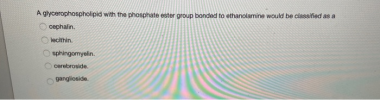 A glycerophospholipid with the phosphate ester group bonded to ethanolamine would be classified as a cephalin. lecithin. sphingomyelin cerebroside. ganglioside.
QUESTION 1 The following molecule (shown below) represents a compound that can induce platelet aggregation and...
 QUESTION 1 The following molecule (shown below) represents a compound that can induce platelet aggregation and vasoconstriction COOH OH True O False QUESTION 2 A glycerophospholipid with the phosphate ester group bonded to ethanolamine would be classified as a O cephalin O lecithin Osphingomyelin cerebroside ganglioside
QUESTION 3 The following amino shown below would be classified as HN 000 NH, O nonelectric...
 QUESTION 3 The following amino shown below would be classified as HN 000 NH, O nonelectric O non-polar. O basic O acidic. polar O QUESTION 4 The type of bond that is most important in maintaining secondary structure of a protein is O disulfide bridges O hydrogen bonding between R groups O hydrogen bonding within the backbone. O salt bridges O hydrophobic interactions O metal ion coordination
29. All of the following are non-covalent interactions important in maintaining the secondary. tertiary, and quaternary aspects of amino acids except
29. All of the following are non-covalent interactions important in maintaining the secondary. tertiary, and quaternary aspects of amino acids except A) salt bridges between R groups. B) hydrogen bonding between R groups. C) hydrogen bonding along the backbone. D) sulfur-sulfur bonds. E) hydrophobic interactions between R groups. 30. A hemiacetal consists of a A) carbon atom bonded to both an -OH and an-OR group B) carbonyl group that is also bonded to a hydroxyl group. C) carbon atom bonded to two-OH groups....
2) At a pH greater than that of its isoelectric point, the structure of glycine is...
 2) At a pH greater than that of its isoelectric point, the structure of glycine is a) H-CH-COOH b) H-CH-C00- c) H-CH-CO e) H-CH-COO COOH b) H-CH-C00- c) H-CH-COOH d) H-CH-COO NH2 NH2 NH2 NH3 NH 3) Which of the following structures can be destroyed by the dena structures can be destroyed by the denaturation of a protein? a) Only primary and tertiary structures of a protein. b) Only secondary, tertiary y secondary, tertiary, and quaternary structures of a protein....
The _______ of amino acids in a protein is referred to as its primary structure
24. The _______ of amino acids in a protein is referred to as its primary structure. A) twisting B) sequencing C) folding D) none of these 25. The structure of a protein is most important because the _______ of the amino acids determines its overall shape, function and properties. A) primary, twisting B) primary, sequencing C) secondary, twisting D) secondary, folding E) none of these 26. The secondary structure of a protein is due to_______ between amino acid residues. A) hydrophobic interactions B) hydrogen bonding...
The type of bonding that maintains the secondary structure in a protein is the
The type of bonding that maintains the secondary structure in a protein is theA) Hydrogen bonds between the carbonyl and amino groups of the backboneB) Covalent bond between the carbonyl and amino groups of the amino acidsC) Hydrogen bonds between two amino acidsD) Disulfide bonds that hold two polypeptide chains togetherE) Hydrogen bonds between two amino groups
O points 1 attempts left Check my work What interactions are responsible for maintaining quaternary protein...
 O points 1 attempts left Check my work What interactions are responsible for maintaining quaternary protein structure? Select all that apply O ionic bridges van der Waals forces hydrogen bonding O disulfide bonds peptide bonds
Which of the following is true of secondary structure in protein folding? Pick ALL that apply....
Which of the following is true of secondary structure in protein folding? Pick ALL that apply. A. It involves hydrogen bonding. B. It involves the side chains. C. It involves hydrophobic interactions. D. It results in alpha helicies with the side chains hidden inside the helix. E. It results in beta-pleated sheets with side chains sticking out of the plain of the sheet. F. It involves the peptide backbone.
Your study group is trying to identify differences in the four levels of protein structure. The...
Your study group is trying to identify differences in the four levels of protein structure. The secondary structure but not the tertiary structure is stabilized by: a. ionic attractions between oppositely charged side chains. b. H-bonding between polar side chains. c. hydrophobic interactions between nonpolar side chains. d. H-bonding between the oxygen of the backbone carbonyl and the hydrogen of the backbone amine. e. van der Waals forces.
 A glycerophospholipid with the phosphate ester group bonded to ethanolamine would be classified as a cephalin. lecithin. sphingomyelin cerebroside. ganglioside.
 QUESTION 1 The following molecule (shown below) represents a compound that can induce platelet aggregation and vasoconstriction COOH OH True O False QUESTION 2 A glycerophospholipid with the phosphate ester group bonded to ethanolamine would be classified as a O cephalin O lecithin Osphingomyelin cerebroside ganglioside
 QUESTION 3 The following amino shown below would be classified as HN 000 NH, O nonelectric O non-polar. O basic O acidic. polar O QUESTION 4 The type of bond that is most important in maintaining secondary structure of a protein is O disulfide bridges O hydrogen bonding between R groups O hydrogen bonding within the backbone. O salt bridges O hydrophobic interactions O metal ion coordination
 2) At a pH greater than that of its isoelectric point, the structure of glycine is a) H-CH-COOH b) H-CH-C00- c) H-CH-CO e) H-CH-COO COOH b) H-CH-C00- c) H-CH-COOH d) H-CH-COO NH2 NH2 NH2 NH3 NH 3) Which of the following structures can be destroyed by the dena structures can be destroyed by the denaturation of a protein? a) Only primary and tertiary structures of a protein. b) Only secondary, tertiary y secondary, tertiary, and quaternary structures of a protein....
 O points 1 attempts left Check my work What interactions are responsible for maintaining quaternary protein structure? Select all that apply O ionic bridges van der Waals forces hydrogen bonding O disulfide bonds peptide bonds
Most questions answered within 3 hours.
-
Where is the error in this code sequence?
String s1 = "Hello";
String s2 = "ello";...
asked 11 months ago -
Financial data for Joel de Paris, Inc., for last year
follow:
Joel de Paris, Inc.
Balance...
asked 11 months ago -
Consider this reaction:
Al2(SO4)3 (aq)+ BaCl3
(aq) Al2Cl6 (aq)- +
3BaSO4(s) . What is the...
asked 11 months ago -
Suppose that Savneet is considering increasing her
recent random sample from 20 car rentals to 40...
asked 11 months ago -
Trucks arrive at an unloading terminal at an average rate of 120
per hour.
Trucks arrive...
asked 11 months ago -
Why are methanol and ethanol completely soluble in water while
octanol is not very little soluble....
asked 11 months ago -
A facilities manager at a university reads in a research report
that the mean amount of...
asked 11 months ago -
When the CuSO4 is rehydrated by adding water to the anhydrous
compound, is this an endothermic...
asked 11 months ago -
A ray of sunlight is passing from diamond into crown glass; the
angle of incidence is...
asked 11 months ago -
A block of mass 0.249 kg is placed on top of a light, vertical
spring of...
asked 11 months ago -
how do the kidneys compensate in the presences of acidosis
a) trigger hyperventilate
b) reserve acid...
asked 11 months ago -
Question 501 pts
The rental rate of capital to the firm increases. Which of the
following...
asked 11 months ago