Which of the following is true of secondary structure in protein folding? Pick ALL that apply....
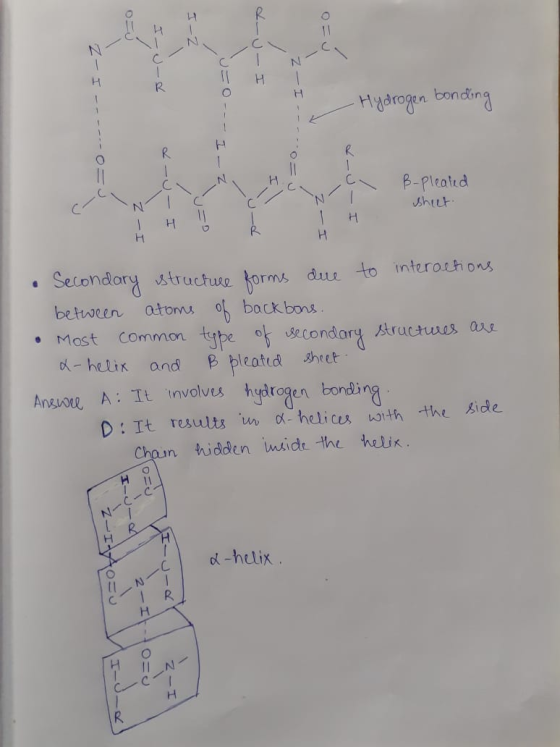
Which of the following is true of secondary structure in protein folding? Pick ALL that apply.
| A. |
It involves hydrogen bonding. |
|
| B. |
It involves the side chains. |
|
| C. |
It involves hydrophobic interactions. |
|
| D. |
It results in alpha helicies with the side chains hidden inside the helix. |
|
| E. |
It results in beta-pleated sheets with side chains sticking out of the plain of the sheet. |
|
| F. |
It involves the peptide backbone. |
Homework Answers

Add Answer to:
Which of the following is true of secondary structure in protein
folding? Pick ALL that apply....
The _______ of amino acids in a protein is referred to as its primary structure
24. The _______ of amino acids in a protein is referred to as its primary structure. A) twisting B) sequencing C) folding D) none of these 25. The structure of a protein is most important because the _______ of the amino acids determines its overall shape, function and properties. A) primary, twisting B) primary, sequencing C) secondary, twisting D) secondary, folding E) none of these 26. The secondary structure of a protein is due to_______ between amino acid residues. A) hydrophobic interactions B) hydrogen bonding...
which of the following is not a way in which amino acid structure in sequence might...
which of the following is not a way in which amino acid structure in sequence might affect the properties of a protein a) Amino acid side chains form peptide bonds with each other causing the molecule to twist into a secondary structure b) Amino side chains interact with each other causing polypeptides to bend into a tertiary structure c) Hydrogen bonding between every fourth amino acid results in the formation of a coil called an a helix d) Hydrogen bonding...
Which interaction holds the a-helix and the B-pleated sheet into its unique folding pattern? hydrogen bonding...
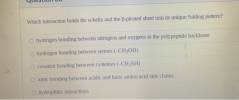 Which interaction holds the a-helix and the B-pleated sheet into its unique folding pattern? hydrogen bonding between nitrogens and oxygens in the polypeptide backbone hydrogen bonding between serines (-CH2OH) covalent bonding between cysteines (-CH2SH) ionic bonding between acidic and basic amino acid side chains hydrophilic interactions
Your study group is trying to identify differences in the four levels of protein structure. The...
Your study group is trying to identify differences in the four levels of protein structure. The secondary structure but not the tertiary structure is stabilized by: a. ionic attractions between oppositely charged side chains. b. H-bonding between polar side chains. c. hydrophobic interactions between nonpolar side chains. d. H-bonding between the oxygen of the backbone carbonyl and the hydrogen of the backbone amine. e. van der Waals forces.
Which of the following is true about proteins? a. Peptides linkages are made between the side...
 Which of the following is true about proteins? a. Peptides linkages are made between the side chain and the carboxyl group. b. Hydrogen bonding between the NH and CEO of the backbone results in only alpha helices! c. Electrostatic interactions between the NH and C=O of the backbone results in only beta sheets. d. Quaternary structures of proteins involve multiple peptide chains interacting together.
What happens when a primary structure forms a secondary structure? Match the words in the left...
 What happens when a primary structure forms a secondary structure? Match the words in the left column to the appropriate blanks in the sentences on the right. Make certain each sentence is complete before submitting your answer. Terms may be used once, more than once, or not at all. Reset Help carboxylic acid a helix When atoms in the backbone of a protein or peptide form within a single or between chains, a secondary structure results. The two most common...
Question 1 The protein in the diagram is (circle all that apply): Group of answer choices...
 Question 1
The protein in the diagram is (circle all that apply):
Group of answer choices
a) a peripheral membrane protein
b) an integral membrane protein
c) a lipid anchored protein
Question 2
The protein shown in the diagram could potentially function as
(circle all that apply):
Group of answer choices
a) a receptor
b) a transmembrane anchor
c) a pore or channel
Question 3
The protein shown in the diagram has which of the following
(choose all that apply)?...
Question 1
The protein in the diagram is (circle all that apply):
Group of answer choices
a) a peripheral membrane protein
b) an integral membrane protein
c) a lipid anchored protein
Question 2
The protein shown in the diagram could potentially function as
(circle all that apply):
Group of answer choices
a) a receptor
b) a transmembrane anchor
c) a pore or channel
Question 3
The protein shown in the diagram has which of the following
(choose all that apply)?...
1) Select all that apply. Globular proteins: a)are found in hair and wool. b)include myoglobin and...
1) Select all that apply. Globular proteins: a)are found in hair and wool. b)include myoglobin and collagen. c)are usually water soluble. d)aggregate in aqueous media. e)are often made of β-pleated sheet and α-helix sections wrapped into compact structures. 2) Select all that apply. The Bohr effect: a)depends on the atomic orbital structure of hydrogen. b)can be summarized as a reduction in the oxygen affinity of hemoglobin with decreasing pH. c)is explained by the protonation of key amino acids, including the...
The type of bond that is most important in maintaining secondary structure of a protein is...
 The type of bond that is most important in maintaining secondary structure of a protein is disulfide bridges hydrogen bonding between R groups hydrogen bonding within the backbone salt bridges hydrophobic interactions metal ion coordination QUESTION 2 A glycerophospholipid with the phosphate ester group bonded to ethanolamine would be classified as a cephalin lecithin sphingomyelin cerebroside ganglioside
QUESTION 7 Which of the following does not cause a protein to denature? O A heat...
 QUESTION 7 Which of the following does not cause a protein to denature? O A heat 0 B. pH o detergent D. None of the above QUESTION 8 Repeating structural motifs, which make up secondary structures, such a alpha helices and beta sheets, are predominantly formed as a result of A hydrophobic interactions B. peptide bonds oC electrostatic interactions D. intramolecular hydrogen bonding QUESTION 9 Hydrophobic interactions could occur be Avaine and a nine B. aspartate and argnine C glutamine...
 Which interaction holds the a-helix and the B-pleated sheet into its unique folding pattern? hydrogen bonding between nitrogens and oxygens in the polypeptide backbone hydrogen bonding between serines (-CH2OH) covalent bonding between cysteines (-CH2SH) ionic bonding between acidic and basic amino acid side chains hydrophilic interactions
 Which of the following is true about proteins? a. Peptides linkages are made between the side chain and the carboxyl group. b. Hydrogen bonding between the NH and CEO of the backbone results in only alpha helices! c. Electrostatic interactions between the NH and C=O of the backbone results in only beta sheets. d. Quaternary structures of proteins involve multiple peptide chains interacting together.
 What happens when a primary structure forms a secondary structure? Match the words in the left column to the appropriate blanks in the sentences on the right. Make certain each sentence is complete before submitting your answer. Terms may be used once, more than once, or not at all. Reset Help carboxylic acid a helix When atoms in the backbone of a protein or peptide form within a single or between chains, a secondary structure results. The two most common...
 Question 1
The protein in the diagram is (circle all that apply):
Group of answer choices
a) a peripheral membrane protein
b) an integral membrane protein
c) a lipid anchored protein
Question 2
The protein shown in the diagram could potentially function as
(circle all that apply):
Group of answer choices
a) a receptor
b) a transmembrane anchor
c) a pore or channel
Question 3
The protein shown in the diagram has which of the following
(choose all that apply)?...
Question 1
The protein in the diagram is (circle all that apply):
Group of answer choices
a) a peripheral membrane protein
b) an integral membrane protein
c) a lipid anchored protein
Question 2
The protein shown in the diagram could potentially function as
(circle all that apply):
Group of answer choices
a) a receptor
b) a transmembrane anchor
c) a pore or channel
Question 3
The protein shown in the diagram has which of the following
(choose all that apply)?...
 The type of bond that is most important in maintaining secondary structure of a protein is disulfide bridges hydrogen bonding between R groups hydrogen bonding within the backbone salt bridges hydrophobic interactions metal ion coordination QUESTION 2 A glycerophospholipid with the phosphate ester group bonded to ethanolamine would be classified as a cephalin lecithin sphingomyelin cerebroside ganglioside
 QUESTION 7 Which of the following does not cause a protein to denature? O A heat 0 B. pH o detergent D. None of the above QUESTION 8 Repeating structural motifs, which make up secondary structures, such a alpha helices and beta sheets, are predominantly formed as a result of A hydrophobic interactions B. peptide bonds oC electrostatic interactions D. intramolecular hydrogen bonding QUESTION 9 Hydrophobic interactions could occur be Avaine and a nine B. aspartate and argnine C glutamine...
Most questions answered within 3 hours.
-
Where is the error in this code sequence?
String s1 = "Hello";
String s2 = "ello";...
asked 11 months ago -
Financial data for Joel de Paris, Inc., for last year
follow:
Joel de Paris, Inc.
Balance...
asked 11 months ago -
Consider this reaction:
Al2(SO4)3 (aq)+ BaCl3
(aq) Al2Cl6 (aq)- +
3BaSO4(s) . What is the...
asked 11 months ago -
Suppose that Savneet is considering increasing her
recent random sample from 20 car rentals to 40...
asked 11 months ago -
Trucks arrive at an unloading terminal at an average rate of 120
per hour.
Trucks arrive...
asked 11 months ago -
Why are methanol and ethanol completely soluble in water while
octanol is not very little soluble....
asked 11 months ago -
A facilities manager at a university reads in a research report
that the mean amount of...
asked 11 months ago -
When the CuSO4 is rehydrated by adding water to the anhydrous
compound, is this an endothermic...
asked 11 months ago -
A ray of sunlight is passing from diamond into crown glass; the
angle of incidence is...
asked 11 months ago -
A block of mass 0.249 kg is placed on top of a light, vertical
spring of...
asked 11 months ago -
how do the kidneys compensate in the presences of acidosis
a) trigger hyperventilate
b) reserve acid...
asked 11 months ago -
Question 501 pts
The rental rate of capital to the firm increases. Which of the
following...
asked 11 months ago