
Question 1
The protein in the diagram is (circle all that apply):
Group of answer choices
a) a peripheral membrane protein
b) an integral membrane protein
c) a lipid anchored protein
Question 2
The protein shown in the diagram could potentially function as (circle all that apply):
Group of answer choices
a) a receptor
b) a transmembrane anchor
c) a pore or channel
Question 3
The protein shown in the diagram has which of the following (choose all that apply)?
Group of answer choices
a) primary structure
b) secondary structure
c) tertiary structure
d) quaternary structure
Question 4
The structures in the red circles represent which of the following (choose all that apply)?
Group of answer choices
a) fatty acid
b) cholesterol
c) oligosaccharides
d) GPI anchors
Question 5
The structures in the red squares represent which of the following (choose all that apply)?
Group of answer choices
a) fatty acids
b) cholesterol
c) oligosaccharides
d) GPI anchors
Question 6
The red arrow is pointing to which of the following (choose all that apply)?
Group of answer choices
a) an intramolecular bond
b) an intermolecular bond
c) an amino acid
d) a disulfide bond
e) a van der Waals interaction
Question 7
Which of the following are important for stabilizing the tertiary structure of this protein (circle all that apply)?
Group of answer choices
a) the structure in the red squares
b) the structure in the red circles
c) the structure indicated by the red arrow
d) hydrophobic/hydrophilic interactions
e) hydrogen bonding
f) van der Waals interactions
Question 8
What structural feature allows this protein to span the lipid bilayer?
Group of answer choices
a) quaternary structure
b) beta pleated sheets
c) alpha helices
d) both beta pleated sheets and alpha helices
Question 9
What chemical bonding or interaction stabilizes the structure you chose for “8”?
Group of answer choices
a) ionic bonds
b) van der Waals interactions
c) hydrogen bonding
d) covalent bonding
e) hydrophobic/hydrophilic interactions
Question 10
You entered the primary amino acid sequences of this protein into the protein database and generated one of the plots shown below in which the relative average hydrophobicity of amino acids is plotted on a scale of 1-10 (with 1 being very hydrophilic and 10 being very hydrophobic). The individual data points on the graph represent the average hydrophobicity of 5 amino acid blocks (for example, amino acids 1-5, 2-6, 3-7, etc), all the way along the protein.
Which of the graphs below (A-F) describes the protein in the diagram at the beginning of the problem set?


Homework Answers
1. The protein in the diagram is an integral membrane protein.
2. The protein shown in the diagram could potentially function as a receptor.
3. the protein shown in the diagram has quaternary structure.
4. The structure in the red circle represents cholesterol.
Add Answer to:
Question 1
The protein in the diagram is (circle all that apply):
Group of answer choices...
The _______ of amino acids in a protein is referred to as its primary structure
24. The _______ of amino acids in a protein is referred to as its primary structure. A) twisting B) sequencing C) folding D) none of these 25. The structure of a protein is most important because the _______ of the amino acids determines its overall shape, function and properties. A) primary, twisting B) primary, sequencing C) secondary, twisting D) secondary, folding E) none of these 26. The secondary structure of a protein is due to_______ between amino acid residues. A) hydrophobic interactions B) hydrogen bonding...
1. Which of the following statements is consistent with the structural motifs in 1OPF? This protein...
 1. Which of the following statements is consistent with the
structural motifs in 1OPF?
This protein has tertiary structure, where each subunit is a
large parallel beta barrel.
This protein has quaternary structure, where each subunit is a
large antiparallel beta barrel.
This protein has tertiary structure, where each subunit is a
large antiparallel beta barrel.
This protein has quaternary structure, where each subunit is a
large parallel beta barrel.
3. Given the information in the PDB entry for 1OPF,...
1. Which of the following statements is consistent with the
structural motifs in 1OPF?
This protein has tertiary structure, where each subunit is a
large parallel beta barrel.
This protein has quaternary structure, where each subunit is a
large antiparallel beta barrel.
This protein has tertiary structure, where each subunit is a
large antiparallel beta barrel.
This protein has quaternary structure, where each subunit is a
large parallel beta barrel.
3. Given the information in the PDB entry for 1OPF,...
Your study group is trying to identify differences in the four levels of protein structure. The...
Your study group is trying to identify differences in the four levels of protein structure. The secondary structure but not the tertiary structure is stabilized by: a. ionic attractions between oppositely charged side chains. b. H-bonding between polar side chains. c. hydrophobic interactions between nonpolar side chains. d. H-bonding between the oxygen of the backbone carbonyl and the hydrogen of the backbone amine. e. van der Waals forces.
Which of the following is true of secondary structure in protein folding? Pick ALL that apply....
Which of the following is true of secondary structure in protein folding? Pick ALL that apply. A. It involves hydrogen bonding. B. It involves the side chains. C. It involves hydrophobic interactions. D. It results in alpha helicies with the side chains hidden inside the helix. E. It results in beta-pleated sheets with side chains sticking out of the plain of the sheet. F. It involves the peptide backbone.
1. What is the name for the dipeptide shown below 2. Label each as primary, secondary,...
 1. What is the name for the dipeptide shown below
2. Label each as primary, secondary, tertiary, or quaternary
3. Indicate whether each is hydrophobic or hydrophilic: Ananine,
Tyr, Lysine, V
CH, O CH OH NH-CH=C-NHCHCOOH The protein folds into a compact structure stabilized by interactions between R groups. the combination of two or more protein molecules to form an active protein pleated sheet the peptide bonds between the amino acids the structural level achieved when hydrogen bonds form between...
1. What is the name for the dipeptide shown below
2. Label each as primary, secondary, tertiary, or quaternary
3. Indicate whether each is hydrophobic or hydrophilic: Ananine,
Tyr, Lysine, V
CH, O CH OH NH-CH=C-NHCHCOOH The protein folds into a compact structure stabilized by interactions between R groups. the combination of two or more protein molecules to form an active protein pleated sheet the peptide bonds between the amino acids the structural level achieved when hydrogen bonds form between...
QUESTION 1 A segment of a protein has a large positive hydropathic index. This segment of...
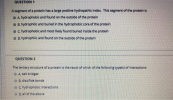 QUESTION 1 A segment of a protein has a large positive hydropathic index. This segment of the protein is O A. hydrophobic and found on the outside of the protein B. hydrophilic and buried in the hydrophobic core of the protein ochydrophobic and most likely found buried inside the protein O D. hydrophilic and found on the outside of the protein QUESTION 2 The tertiary structure of a protein is the result of which of the following type(s) of interactions...
- DELIS SUSTESTD comprennen n eu Question Completion Status QUESTION 1 A segment of a protein...
 - DELIS SUSTESTD comprennen n eu Question Completion Status QUESTION 1 A segment of a protein has a large positive role index. This segment of the protein is O A hydrophobic and found on the outside of the protein OB. hydrophilic and buried in the hydrophobic core of the protein O Chydrophobic and most likely found buried inside the protein O D. hydrophilic and found on the outside of the protein QUESTION 2 The tertiary structure of a protein is...
O points 1 attempts left Check my work What interactions are responsible for maintaining quaternary protein...
 O points 1 attempts left Check my work What interactions are responsible for maintaining quaternary protein structure? Select all that apply O ionic bridges van der Waals forces hydrogen bonding O disulfide bonds peptide bonds
How are lipid bilayers formed? What is their fluidity dependent on? Group of answer choices: -...
How are lipid bilayers formed? What is their fluidity dependent on? Group of answer choices: - Hydrophobic interactions are the driving force of forming bimolecular sheets of lipids spontaneously. Due to the hydrophobic effect, any tears in the lipid bilayer cause it to spontaneously rearrange to eliminate the free edge. Membrane fluidity depends on the percentage of unsaturated fatty acids. - Hydrophobic interactions are the driving force of forming bimolecular sheets of lipids spontaneously. Due to the hydrophobic effect, any...
1) Select all that apply. Globular proteins: a)are found in hair and wool. b)include myoglobin and...
1) Select all that apply. Globular proteins: a)are found in hair and wool. b)include myoglobin and collagen. c)are usually water soluble. d)aggregate in aqueous media. e)are often made of β-pleated sheet and α-helix sections wrapped into compact structures. 2) Select all that apply. The Bohr effect: a)depends on the atomic orbital structure of hydrogen. b)can be summarized as a reduction in the oxygen affinity of hemoglobin with decreasing pH. c)is explained by the protonation of key amino acids, including the...
 1. Which of the following statements is consistent with the
structural motifs in 1OPF?
This protein has tertiary structure, where each subunit is a
large parallel beta barrel.
This protein has quaternary structure, where each subunit is a
large antiparallel beta barrel.
This protein has tertiary structure, where each subunit is a
large antiparallel beta barrel.
This protein has quaternary structure, where each subunit is a
large parallel beta barrel.
3. Given the information in the PDB entry for 1OPF,...
1. Which of the following statements is consistent with the
structural motifs in 1OPF?
This protein has tertiary structure, where each subunit is a
large parallel beta barrel.
This protein has quaternary structure, where each subunit is a
large antiparallel beta barrel.
This protein has tertiary structure, where each subunit is a
large antiparallel beta barrel.
This protein has quaternary structure, where each subunit is a
large parallel beta barrel.
3. Given the information in the PDB entry for 1OPF,...
 1. What is the name for the dipeptide shown below
2. Label each as primary, secondary, tertiary, or quaternary
3. Indicate whether each is hydrophobic or hydrophilic: Ananine,
Tyr, Lysine, V
CH, O CH OH NH-CH=C-NHCHCOOH The protein folds into a compact structure stabilized by interactions between R groups. the combination of two or more protein molecules to form an active protein pleated sheet the peptide bonds between the amino acids the structural level achieved when hydrogen bonds form between...
1. What is the name for the dipeptide shown below
2. Label each as primary, secondary, tertiary, or quaternary
3. Indicate whether each is hydrophobic or hydrophilic: Ananine,
Tyr, Lysine, V
CH, O CH OH NH-CH=C-NHCHCOOH The protein folds into a compact structure stabilized by interactions between R groups. the combination of two or more protein molecules to form an active protein pleated sheet the peptide bonds between the amino acids the structural level achieved when hydrogen bonds form between...
 QUESTION 1 A segment of a protein has a large positive hydropathic index. This segment of the protein is O A. hydrophobic and found on the outside of the protein B. hydrophilic and buried in the hydrophobic core of the protein ochydrophobic and most likely found buried inside the protein O D. hydrophilic and found on the outside of the protein QUESTION 2 The tertiary structure of a protein is the result of which of the following type(s) of interactions...
 - DELIS SUSTESTD comprennen n eu Question Completion Status QUESTION 1 A segment of a protein has a large positive role index. This segment of the protein is O A hydrophobic and found on the outside of the protein OB. hydrophilic and buried in the hydrophobic core of the protein O Chydrophobic and most likely found buried inside the protein O D. hydrophilic and found on the outside of the protein QUESTION 2 The tertiary structure of a protein is...
 O points 1 attempts left Check my work What interactions are responsible for maintaining quaternary protein structure? Select all that apply O ionic bridges van der Waals forces hydrogen bonding O disulfide bonds peptide bonds
Most questions answered within 3 hours.
-
Where is the error in this code sequence?
String s1 = "Hello";
String s2 = "ello";...
asked 10 months ago -
Financial data for Joel de Paris, Inc., for last year
follow:
Joel de Paris, Inc.
Balance...
asked 10 months ago -
Consider this reaction:
Al2(SO4)3 (aq)+ BaCl3
(aq) Al2Cl6 (aq)- +
3BaSO4(s) . What is the...
asked 10 months ago -
Suppose that Savneet is considering increasing her
recent random sample from 20 car rentals to 40...
asked 10 months ago -
Trucks arrive at an unloading terminal at an average rate of 120
per hour.
Trucks arrive...
asked 10 months ago -
Why are methanol and ethanol completely soluble in water while
octanol is not very little soluble....
asked 10 months ago -
A facilities manager at a university reads in a research report
that the mean amount of...
asked 10 months ago -
When the CuSO4 is rehydrated by adding water to the anhydrous
compound, is this an endothermic...
asked 10 months ago -
A ray of sunlight is passing from diamond into crown glass; the
angle of incidence is...
asked 10 months ago -
A block of mass 0.249 kg is placed on top of a light, vertical
spring of...
asked 10 months ago -
how do the kidneys compensate in the presences of acidosis
a) trigger hyperventilate
b) reserve acid...
asked 10 months ago -
Question 501 pts
The rental rate of capital to the firm increases. Which of the
following...
asked 10 months ago