
Homework Answers
1.c. hydrophobic and most likely found buried inside the protein(llarge positive hydropathic index indicate hydrophobic nature
2. All of the above
Add Answer to:
QUESTION 1 A segment of a protein has a large positive hydropathic index. This segment of...
- DELIS SUSTESTD comprennen n eu Question Completion Status QUESTION 1 A segment of a protein...
 - DELIS SUSTESTD comprennen n eu Question Completion Status QUESTION 1 A segment of a protein has a large positive role index. This segment of the protein is O A hydrophobic and found on the outside of the protein OB. hydrophilic and buried in the hydrophobic core of the protein O Chydrophobic and most likely found buried inside the protein O D. hydrophilic and found on the outside of the protein QUESTION 2 The tertiary structure of a protein is...
In most cases, mutations in the core of a protein that replace a smaller nonpolar side...
 In most cases, mutations in the core of a protein that replace a
smaller nonpolar side chain in the wild-type (e.g., Ala, Val) with
a larger nonpolar side chain (e.g., Leu, Ile, Phe, Trp) in the
mutant, result in significant destabilization and misfolding of the
mutant. What feature of the protein core explains this observation?
Why would such a mutation prevent a protein from folding
properly?
Reset Help disulfide bridges small van der Waals contacts side chains in the protein...
In most cases, mutations in the core of a protein that replace a
smaller nonpolar side chain in the wild-type (e.g., Ala, Val) with
a larger nonpolar side chain (e.g., Leu, Ile, Phe, Trp) in the
mutant, result in significant destabilization and misfolding of the
mutant. What feature of the protein core explains this observation?
Why would such a mutation prevent a protein from folding
properly?
Reset Help disulfide bridges small van der Waals contacts side chains in the protein...
The type of bond that is most important in maintaining secondary structure of a protein is...
 The type of bond that is most important in maintaining secondary structure of a protein is disulfide bridges hydrogen bonding between R groups hydrogen bonding within the backbone salt bridges hydrophobic interactions metal ion coordination QUESTION 2 A glycerophospholipid with the phosphate ester group bonded to ethanolamine would be classified as a cephalin lecithin sphingomyelin cerebroside ganglioside
1. Which of the following statements is consistent with the structural motifs in 1OPF? This protein...
 1. Which of the following statements is consistent with the
structural motifs in 1OPF?
This protein has tertiary structure, where each subunit is a
large parallel beta barrel.
This protein has quaternary structure, where each subunit is a
large antiparallel beta barrel.
This protein has tertiary structure, where each subunit is a
large antiparallel beta barrel.
This protein has quaternary structure, where each subunit is a
large parallel beta barrel.
3. Given the information in the PDB entry for 1OPF,...
1. Which of the following statements is consistent with the
structural motifs in 1OPF?
This protein has tertiary structure, where each subunit is a
large parallel beta barrel.
This protein has quaternary structure, where each subunit is a
large antiparallel beta barrel.
This protein has tertiary structure, where each subunit is a
large antiparallel beta barrel.
This protein has quaternary structure, where each subunit is a
large parallel beta barrel.
3. Given the information in the PDB entry for 1OPF,...
QUESTION 3 The following amino shown below would be classified as HN 000 NH, O nonelectric...
 QUESTION 3 The following amino shown below would be classified as HN 000 NH, O nonelectric O non-polar. O basic O acidic. polar O QUESTION 4 The type of bond that is most important in maintaining secondary structure of a protein is O disulfide bridges O hydrogen bonding between R groups O hydrogen bonding within the backbone. O salt bridges O hydrophobic interactions O metal ion coordination
QUESTIONS The primary structure of a protein is the result of which of the following bond...
 QUESTIONS The primary structure of a protein is the result of which of the following bond types? O A amide bond B. hydrophobic interactions o disulfide bond D. hydrogen bond QUESTION 6 Quaternary structure is associated with A the sum of the secondary and tertiary structures B. the relative orientation of one polypeptide to another polypeptide in a multisubunit protein o the formation of the primary structure D. the shape of the polypeptide chain
2) At a pH greater than that of its isoelectric point, the structure of glycine is...
 2) At a pH greater than that of its isoelectric point, the structure of glycine is a) H-CH-COOH b) H-CH-C00- c) H-CH-CO e) H-CH-COO COOH b) H-CH-C00- c) H-CH-COOH d) H-CH-COO NH2 NH2 NH2 NH3 NH 3) Which of the following structures can be destroyed by the dena structures can be destroyed by the denaturation of a protein? a) Only primary and tertiary structures of a protein. b) Only secondary, tertiary y secondary, tertiary, and quaternary structures of a protein....
Distinguish between the Different levels of Protein Structure, Induding Primary, Secondary. Tertiary and Quaternary Question Which...
 Distinguish between the Different levels of Protein Structure, Induding Primary, Secondary. Tertiary and Quaternary Question Which of the following types of connections maintain the primary structure of a protein? Select all that apply hydrophobic interactions hydrogen bonds peptide bonds disulfide bonds FEEDBACK MORE INSTRUCTIO Activity Details ✓ You have viewed this op Visited Oct 3, 2019 11:12 PM Ota 35N
please help! 39. Albumin is a large protein which circulates freely in human irculates freely in...
 please help!
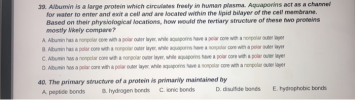
39. Albumin is a large protein which circulates freely in human irculates freely in human plasma. Aquaporins act as a channel for water to enter and exit a cell and are located within the lipid bilayer of the cell membrane Based on their physiological locations, how would the tertiary structure of these two proteins mostly likely compare? A. Albumin has a nonpolar core with a polar outer layer, while aquaporins have a polar core with a norpolar outer...
please help!
39. Albumin is a large protein which circulates freely in human irculates freely in human plasma. Aquaporins act as a channel for water to enter and exit a cell and are located within the lipid bilayer of the cell membrane Based on their physiological locations, how would the tertiary structure of these two proteins mostly likely compare? A. Albumin has a nonpolar core with a polar outer layer, while aquaporins have a polar core with a norpolar outer...
Question 1 The protein in the diagram is (circle all that apply): Group of answer choices...
 Question 1
The protein in the diagram is (circle all that apply):
Group of answer choices
a) a peripheral membrane protein
b) an integral membrane protein
c) a lipid anchored protein
Question 2
The protein shown in the diagram could potentially function as
(circle all that apply):
Group of answer choices
a) a receptor
b) a transmembrane anchor
c) a pore or channel
Question 3
The protein shown in the diagram has which of the following
(choose all that apply)?...
Question 1
The protein in the diagram is (circle all that apply):
Group of answer choices
a) a peripheral membrane protein
b) an integral membrane protein
c) a lipid anchored protein
Question 2
The protein shown in the diagram could potentially function as
(circle all that apply):
Group of answer choices
a) a receptor
b) a transmembrane anchor
c) a pore or channel
Question 3
The protein shown in the diagram has which of the following
(choose all that apply)?...
 - DELIS SUSTESTD comprennen n eu Question Completion Status QUESTION 1 A segment of a protein has a large positive role index. This segment of the protein is O A hydrophobic and found on the outside of the protein OB. hydrophilic and buried in the hydrophobic core of the protein O Chydrophobic and most likely found buried inside the protein O D. hydrophilic and found on the outside of the protein QUESTION 2 The tertiary structure of a protein is...
 In most cases, mutations in the core of a protein that replace a
smaller nonpolar side chain in the wild-type (e.g., Ala, Val) with
a larger nonpolar side chain (e.g., Leu, Ile, Phe, Trp) in the
mutant, result in significant destabilization and misfolding of the
mutant. What feature of the protein core explains this observation?
Why would such a mutation prevent a protein from folding
properly?
Reset Help disulfide bridges small van der Waals contacts side chains in the protein...
In most cases, mutations in the core of a protein that replace a
smaller nonpolar side chain in the wild-type (e.g., Ala, Val) with
a larger nonpolar side chain (e.g., Leu, Ile, Phe, Trp) in the
mutant, result in significant destabilization and misfolding of the
mutant. What feature of the protein core explains this observation?
Why would such a mutation prevent a protein from folding
properly?
Reset Help disulfide bridges small van der Waals contacts side chains in the protein...
 The type of bond that is most important in maintaining secondary structure of a protein is disulfide bridges hydrogen bonding between R groups hydrogen bonding within the backbone salt bridges hydrophobic interactions metal ion coordination QUESTION 2 A glycerophospholipid with the phosphate ester group bonded to ethanolamine would be classified as a cephalin lecithin sphingomyelin cerebroside ganglioside
 1. Which of the following statements is consistent with the
structural motifs in 1OPF?
This protein has tertiary structure, where each subunit is a
large parallel beta barrel.
This protein has quaternary structure, where each subunit is a
large antiparallel beta barrel.
This protein has tertiary structure, where each subunit is a
large antiparallel beta barrel.
This protein has quaternary structure, where each subunit is a
large parallel beta barrel.
3. Given the information in the PDB entry for 1OPF,...
1. Which of the following statements is consistent with the
structural motifs in 1OPF?
This protein has tertiary structure, where each subunit is a
large parallel beta barrel.
This protein has quaternary structure, where each subunit is a
large antiparallel beta barrel.
This protein has tertiary structure, where each subunit is a
large antiparallel beta barrel.
This protein has quaternary structure, where each subunit is a
large parallel beta barrel.
3. Given the information in the PDB entry for 1OPF,...
 QUESTION 3 The following amino shown below would be classified as HN 000 NH, O nonelectric O non-polar. O basic O acidic. polar O QUESTION 4 The type of bond that is most important in maintaining secondary structure of a protein is O disulfide bridges O hydrogen bonding between R groups O hydrogen bonding within the backbone. O salt bridges O hydrophobic interactions O metal ion coordination
 QUESTIONS The primary structure of a protein is the result of which of the following bond types? O A amide bond B. hydrophobic interactions o disulfide bond D. hydrogen bond QUESTION 6 Quaternary structure is associated with A the sum of the secondary and tertiary structures B. the relative orientation of one polypeptide to another polypeptide in a multisubunit protein o the formation of the primary structure D. the shape of the polypeptide chain
 2) At a pH greater than that of its isoelectric point, the structure of glycine is a) H-CH-COOH b) H-CH-C00- c) H-CH-CO e) H-CH-COO COOH b) H-CH-C00- c) H-CH-COOH d) H-CH-COO NH2 NH2 NH2 NH3 NH 3) Which of the following structures can be destroyed by the dena structures can be destroyed by the denaturation of a protein? a) Only primary and tertiary structures of a protein. b) Only secondary, tertiary y secondary, tertiary, and quaternary structures of a protein....
 Distinguish between the Different levels of Protein Structure, Induding Primary, Secondary. Tertiary and Quaternary Question Which of the following types of connections maintain the primary structure of a protein? Select all that apply hydrophobic interactions hydrogen bonds peptide bonds disulfide bonds FEEDBACK MORE INSTRUCTIO Activity Details ✓ You have viewed this op Visited Oct 3, 2019 11:12 PM Ota 35N
 please help!
39. Albumin is a large protein which circulates freely in human irculates freely in human plasma. Aquaporins act as a channel for water to enter and exit a cell and are located within the lipid bilayer of the cell membrane Based on their physiological locations, how would the tertiary structure of these two proteins mostly likely compare? A. Albumin has a nonpolar core with a polar outer layer, while aquaporins have a polar core with a norpolar outer...
please help!
39. Albumin is a large protein which circulates freely in human irculates freely in human plasma. Aquaporins act as a channel for water to enter and exit a cell and are located within the lipid bilayer of the cell membrane Based on their physiological locations, how would the tertiary structure of these two proteins mostly likely compare? A. Albumin has a nonpolar core with a polar outer layer, while aquaporins have a polar core with a norpolar outer...
 Question 1
The protein in the diagram is (circle all that apply):
Group of answer choices
a) a peripheral membrane protein
b) an integral membrane protein
c) a lipid anchored protein
Question 2
The protein shown in the diagram could potentially function as
(circle all that apply):
Group of answer choices
a) a receptor
b) a transmembrane anchor
c) a pore or channel
Question 3
The protein shown in the diagram has which of the following
(choose all that apply)?...
Question 1
The protein in the diagram is (circle all that apply):
Group of answer choices
a) a peripheral membrane protein
b) an integral membrane protein
c) a lipid anchored protein
Question 2
The protein shown in the diagram could potentially function as
(circle all that apply):
Group of answer choices
a) a receptor
b) a transmembrane anchor
c) a pore or channel
Question 3
The protein shown in the diagram has which of the following
(choose all that apply)?...
Most questions answered within 3 hours.
-
Where is the error in this code sequence?
String s1 = "Hello";
String s2 = "ello";...
asked 10 months ago -
Financial data for Joel de Paris, Inc., for last year
follow:
Joel de Paris, Inc.
Balance...
asked 10 months ago -
Consider this reaction:
Al2(SO4)3 (aq)+ BaCl3
(aq) Al2Cl6 (aq)- +
3BaSO4(s) . What is the...
asked 10 months ago -
Suppose that Savneet is considering increasing her
recent random sample from 20 car rentals to 40...
asked 10 months ago -
Trucks arrive at an unloading terminal at an average rate of 120
per hour.
Trucks arrive...
asked 10 months ago -
Why are methanol and ethanol completely soluble in water while
octanol is not very little soluble....
asked 10 months ago -
A facilities manager at a university reads in a research report
that the mean amount of...
asked 10 months ago -
When the CuSO4 is rehydrated by adding water to the anhydrous
compound, is this an endothermic...
asked 10 months ago -
A ray of sunlight is passing from diamond into crown glass; the
angle of incidence is...
asked 10 months ago -
A block of mass 0.249 kg is placed on top of a light, vertical
spring of...
asked 10 months ago -
how do the kidneys compensate in the presences of acidosis
a) trigger hyperventilate
b) reserve acid...
asked 10 months ago -
Question 501 pts
The rental rate of capital to the firm increases. Which of the
following...
asked 10 months ago