A pair of elementary reaction occurs as follows: 2 A (aq) = 3 C The forward...
A pair of elementary reaction occurs as follows:
2 A (aq) = 3 C
The forward and reverse rate constants are 35.32 M-1min-1 and 24.41 M-2min-1, respectively. The equilibrium constant for this reaction is:
(a) 0.572 M (b) 1.45 M (c) 2.70 M (d) 0.517 M-1
Homework Answers
Request Answer!
We need at least 10 more requests to produce the answer.
0 / 10 have requested this problem solution
The more requests, the faster the answer.
Add Answer to:
A pair of elementary reaction occurs as follows:
2 A (aq) = 3 C
The forward...
4. (5 pts.) A pair of elementary reaction occurs as follows: 2 A (aq) → 30...
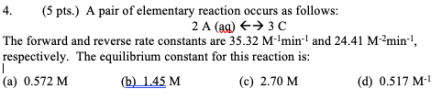 4. (5 pts.) A pair of elementary reaction occurs as follows: 2 A (aq) → 30 The forward and reverse rate constants are 35.32 M-'min-1 and 24.41 M-2min!, respectively. The equilibrium constant for this reaction is: (a) 0.572 M (b) 1.45 M (C) 2.70 M (d) 0.517 M
Multiple choice: 3. (5 pts.) The oxidation of copper metal by iron (III) chloride used in...
 Multiple choice: 3. (5 pts.) The oxidation of copper metal by iron (III) chloride used in the etching of circuit boards goes as follows: 2 Fe3+ (aq) + Cu (s) → 2 Fe2+ (aq) + Cu2+ (aq) The reduction potential for the Fe3+/Fe2+ and Cu2+/Cu pair are +0.772 V and -0.340 V, respectively. The concentrations are [Fe3+] = 1.24 M, [Fe2+] = .248 M, and [Cu2+] = .342 M. The electrical potential for this cell at 25.00C is: (a) +1.057...
At a given temperature, the elementary reaction A --->B in the forward direction is first order...
At a given temperature, the elementary reaction A --->B in the forward direction is first order in A with a rate constant of 1.60*10^2 s^-1. The reverse reaction is first order in B and the rate constant is 9.30*10^-2 s^-1 What is the value of the equilibrium constant for the reaction A --->B at this temperature? What is the value of equilibrium constant for the reaction B-->A at this temperature? (and all reactions are in equilibrium of course i just...
At a given temperature, the elementary reaction A↽−−⇀B,A↽−−⇀B, in the forward direction, is first order in...
At a given temperature, the elementary reaction A↽−−⇀B,A↽−−⇀B, in the forward direction, is first order in AA with a rate constant of 0.0480 s−10.0480 s−1. The reverse reaction is first order in BB and the rate constant is 0.0840 s−10.0840 s−1. What is the value of the equilibrium constant for the reaction A↽−−⇀BA↽−−⇀B at this temperature? What is the value of the equilibrium constant for the reaction B↽−−⇀AB↽−−⇀A at this temperature? ?=K= ?=K=
Is it possible for a reaction to have a large equilibrium constant but small forward and...
 Is it possible for a reaction to have a large equilibrium constant but small forward and reverse rate constants? Choose one - A. No, the equilibrium constant and rate constant are both determined by the same thermodynamic parameters. B. Yes, the equilibrium constant is determined by the ratio of the forward and reverse rate constants, not the absolute value of those rates C. No, a large equilibrium constant means that the rate constants must also be large D. Yes, the...
2. a) The forward rate constant for an elementary solution-phase reaction is 100 sl, and the...
 2. a) The forward rate constant for an elementary solution-phase reaction is 100 sl, and the reverse rate constant is 0.1 M's!. What is the standard Gibbs free energy change, AG", for this reaction? The temperature is 300 K. b) For the same reaction, the free energy of activation, AG , for the forward reaction is 50 kJ/mole. What is the activation free energy, AG,, for the reverse reaction? c) If the solvent is changed to one that interacts with...
3) Consider an elementary reversible reaction that describes the bind ing of a hormone (H) to...
 3) Consider an elementary reversible reaction that describes the bind ing of a hormone (H) to a cell surface receptor (R): k H R HR k, The forward rate constant (k) is 1 mM-1 s, and the reverse rate constant (k) is 2 s. a) Write a rate law for the rate of formation of HR in terms of the species and rate constants. b) If the initial concentrations of H, R, and HR are 0.0005, 0.2, and 0.1 mM,...
2. For the equilibrium between dinitrogen tetroxide and nitrogen dioxide: N204 = 2 NO2 Suppose that...
 2. For the equilibrium between dinitrogen tetroxide and nitrogen dioxide: N204 = 2 NO2 Suppose that both the forward and reverse reactions are elementary processes with rate constants of k, and kr respectively, and the equilibrium constant for the process is 14.48 at 298 K. If the rate of the reverse reaction is 1324 M/s when (NO2) = 0.60 M, what is the half-life for the decomposition of dinitrogen tetroxide (the forward reaction) at the same temperature?
A+B=C+D equilibrium constant can be expressed as a ratio of the concentrations: KOD AB his is...
 A+B=C+D equilibrium constant can be expressed as a ratio of the concentrations: KOD AB his is an elementary chemical reaction, then there is a single forward rate and a single reverse rate for this reaction, which can be written as follows: forward rate = kr[A][B] reverse rate = k CD ere kr and ky are the forward and reverse rate constants, respectively. When equilibriums reached, the forward and reverse rates are equal ky[A] B-k CD us, the rate constants are...
The ion pair MgSO4 is formed in solution via the reaction below: In a system where...
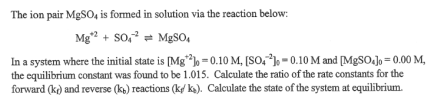 The ion pair MgSO4 is formed in solution via the reaction below: In a system where the initial state is [Mg"2-0.10 M, [S04-21,-0.10 M and [MgSOJ,-0.00 M, the equilibrium constant was found to be 1.015. Calculate the ratio of the rate constants for the forward (k) and reverse (kb) reactions (kf/ ko). Calculate the state of the system at equilibrium.
 4. (5 pts.) A pair of elementary reaction occurs as follows: 2 A (aq) → 30 The forward and reverse rate constants are 35.32 M-'min-1 and 24.41 M-2min!, respectively. The equilibrium constant for this reaction is: (a) 0.572 M (b) 1.45 M (C) 2.70 M (d) 0.517 M
 Multiple choice: 3. (5 pts.) The oxidation of copper metal by iron (III) chloride used in the etching of circuit boards goes as follows: 2 Fe3+ (aq) + Cu (s) → 2 Fe2+ (aq) + Cu2+ (aq) The reduction potential for the Fe3+/Fe2+ and Cu2+/Cu pair are +0.772 V and -0.340 V, respectively. The concentrations are [Fe3+] = 1.24 M, [Fe2+] = .248 M, and [Cu2+] = .342 M. The electrical potential for this cell at 25.00C is: (a) +1.057...
 Is it possible for a reaction to have a large equilibrium constant but small forward and reverse rate constants? Choose one - A. No, the equilibrium constant and rate constant are both determined by the same thermodynamic parameters. B. Yes, the equilibrium constant is determined by the ratio of the forward and reverse rate constants, not the absolute value of those rates C. No, a large equilibrium constant means that the rate constants must also be large D. Yes, the...
 2. a) The forward rate constant for an elementary solution-phase reaction is 100 sl, and the reverse rate constant is 0.1 M's!. What is the standard Gibbs free energy change, AG", for this reaction? The temperature is 300 K. b) For the same reaction, the free energy of activation, AG , for the forward reaction is 50 kJ/mole. What is the activation free energy, AG,, for the reverse reaction? c) If the solvent is changed to one that interacts with...
 3) Consider an elementary reversible reaction that describes the bind ing of a hormone (H) to a cell surface receptor (R): k H R HR k, The forward rate constant (k) is 1 mM-1 s, and the reverse rate constant (k) is 2 s. a) Write a rate law for the rate of formation of HR in terms of the species and rate constants. b) If the initial concentrations of H, R, and HR are 0.0005, 0.2, and 0.1 mM,...
 2. For the equilibrium between dinitrogen tetroxide and nitrogen dioxide: N204 = 2 NO2 Suppose that both the forward and reverse reactions are elementary processes with rate constants of k, and kr respectively, and the equilibrium constant for the process is 14.48 at 298 K. If the rate of the reverse reaction is 1324 M/s when (NO2) = 0.60 M, what is the half-life for the decomposition of dinitrogen tetroxide (the forward reaction) at the same temperature?
 A+B=C+D equilibrium constant can be expressed as a ratio of the concentrations: KOD AB his is an elementary chemical reaction, then there is a single forward rate and a single reverse rate for this reaction, which can be written as follows: forward rate = kr[A][B] reverse rate = k CD ere kr and ky are the forward and reverse rate constants, respectively. When equilibriums reached, the forward and reverse rates are equal ky[A] B-k CD us, the rate constants are...
 The ion pair MgSO4 is formed in solution via the reaction below: In a system where the initial state is [Mg"2-0.10 M, [S04-21,-0.10 M and [MgSOJ,-0.00 M, the equilibrium constant was found to be 1.015. Calculate the ratio of the rate constants for the forward (k) and reverse (kb) reactions (kf/ ko). Calculate the state of the system at equilibrium.
Most questions answered within 3 hours.
-
Where is the error in this code sequence?
String s1 = "Hello";
String s2 = "ello";...
asked 11 months ago -
Financial data for Joel de Paris, Inc., for last year
follow:
Joel de Paris, Inc.
Balance...
asked 11 months ago -
Consider this reaction:
Al2(SO4)3 (aq)+ BaCl3
(aq) Al2Cl6 (aq)- +
3BaSO4(s) . What is the...
asked 11 months ago -
Suppose that Savneet is considering increasing her
recent random sample from 20 car rentals to 40...
asked 11 months ago -
Trucks arrive at an unloading terminal at an average rate of 120
per hour.
Trucks arrive...
asked 11 months ago -
Why are methanol and ethanol completely soluble in water while
octanol is not very little soluble....
asked 11 months ago -
A facilities manager at a university reads in a research report
that the mean amount of...
asked 11 months ago -
When the CuSO4 is rehydrated by adding water to the anhydrous
compound, is this an endothermic...
asked 11 months ago -
A ray of sunlight is passing from diamond into crown glass; the
angle of incidence is...
asked 11 months ago -
A block of mass 0.249 kg is placed on top of a light, vertical
spring of...
asked 11 months ago -
how do the kidneys compensate in the presences of acidosis
a) trigger hyperventilate
b) reserve acid...
asked 11 months ago -
Question 501 pts
The rental rate of capital to the firm increases. Which of the
following...
asked 11 months ago