
Homework Answers
Add Answer to:
it
is one question it just has many parts
ere is only a single correct answer...
Problem 3: Interpolation, least squares, and finite difference Consider the following data table: 2 0 0.2...
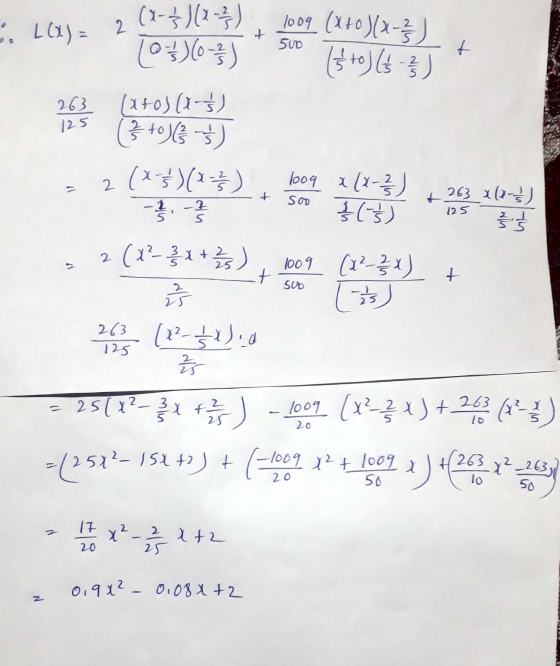
 Problem 3: Interpolation, least squares, and finite difference Consider the following data table: 2 0 0.2 0.4 0.6 f(x) = 2 2.018 2.104 2.306 3 The quadratic Lagrange interpolator L2,0() used to quadratically interpolate between data points #1 = 0.12 = 0.2, and as = 0.4 is (Chop after 2 decimal places) None of the above -5.00x^2+7.50x+2.00 5.00x^2-1.00 12.50x^2-7.50x+1.00 25.05x^2-10.25%
Problem 1: Interpolation, least squares, and finite difference Consider the following data table: rol 2 0.2...
 Problem 1: Interpolation, least squares, and finite difference Consider the following data table: rol 2 0.2 2.018 f(x) = 0.4 2.104 0.6 2.306 The linear Lagrange interpolator L12 (1) used to linearly interpolate between data points #2 = 0.2 and 33 = 0.4 is (Chop after 2 decimal places) 2 = 3 -5.00x+2.00 5.00x-1.00 O -5.00x+2.00 -2.50x+0.20 None of the above.
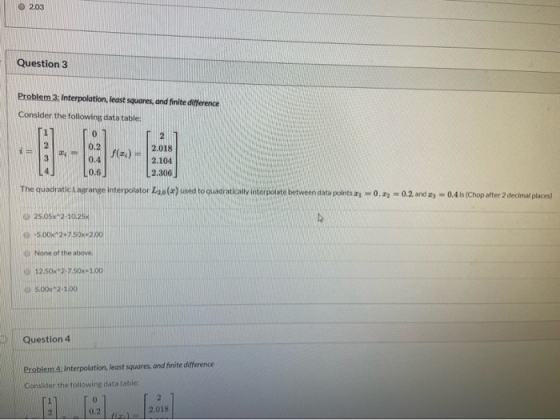
Problem 3: Interpolation, least squares, and finite difference Consider the following data table: 2 = f(x)...
 Problem 3: Interpolation, least squares, and finite difference Consider the following data table: 2 = f(x) = 0.2 0.4 0.6 2 2.018 2.104 2.306 The quadratic Lagrange interpolator L2,0 (2) used to quadratically interpolate between data points 2 = 0.22 = 0.2. and 2'3 = 0.4 is (Chop after 2 decimal places) 25.05x^2-10.25x -5.00x^2+7.50x+2.00 12.50x 2-7.50x+1.00 5.00x^2-1.00 None of the above.
Consider the following data table: 0 2i = 0.2 0.4 f(xi) = 2 2.018 2.104 2.306...
 Consider the following data table: 0 2i = 0.2 0.4 f(xi) = 2 2.018 2.104 2.306 0.6 0.2 and 23=0.4 is The linear Lagrange interpolator L1,1 (2) used to linearly interpolate between data points 12 (Chop after 2 decimal places) None of the above. -2.50x+0.20 -5.00x+2.00 -5.00x+2.00 5.00x-1.00 Consider the following data table: 2 Ti = 0 0.2 0.4 0.6 f(x) = 2.018 2.104 2.306 0.2 and 23 = 0.4, the value obtained at 2=0.3 is Using Lagrange linear interpolation...
Problem 1: Interpolation, least squares, and finite difference Consider the following data table: 0 0.2 2.018...
 Problem 1: Interpolation, least squares, and finite difference Consider the following data table: 0 0.2 2.018 f(a) = 2.104 0.6 2.306 The linear Lagrange Interpolator L. (t) used to linearly interpolate between data points 12 = 0.2 and 13 = 0.4 is (Chop after 2 decimal places) 0.4 -2.50x 0.20 None of the above 500100 500-200 -5.00-2.00
they all relate to the first one its the same question judt with parts D Question...
 they all relate to the first one its the same question judt
with parts
D Question 5 1 pts Problem 5: Interpolation, least squares, and finite difference Consider the following datatable 0 2 0.2 2.018 0.4 2.104 0.6 L2.306 In order to apply clamped conditions on a cubic spline interpolation over these data there arises the need to specify the derivatives at the endpoints. Use a second-order accurate finite difference to estimate the first derivative at y = 0, the...
they all relate to the first one its the same question judt
with parts
D Question 5 1 pts Problem 5: Interpolation, least squares, and finite difference Consider the following datatable 0 2 0.2 2.018 0.4 2.104 0.6 L2.306 In order to apply clamped conditions on a cubic spline interpolation over these data there arises the need to specify the derivatives at the endpoints. Use a second-order accurate finite difference to estimate the first derivative at y = 0, the...
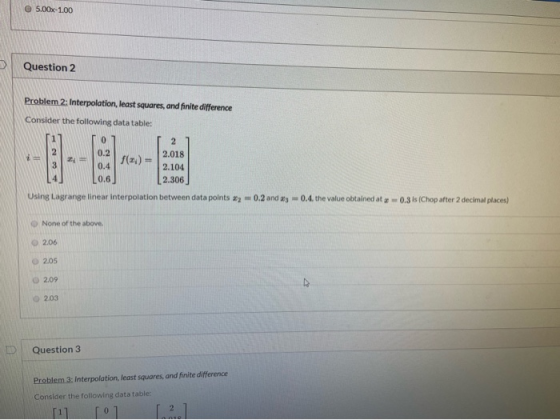
Problem 2: Interpolation, least squares, and finite difference Consider the following data table: 0 2 0.2...
 Problem 2: Interpolation, least squares, and finite difference Consider the following data table: 0 2 0.2 2.018 ti f(x) = 0.4 2.104 0.6 2.306 Using Lagrange linear interpolation between data points 22 = 0.2 and as = 0.4, the value obtained at z = 0.3 is (Chop after 2 decimal places) فو واقع = 2.06 2.09 2.03 None of the above. 2.05
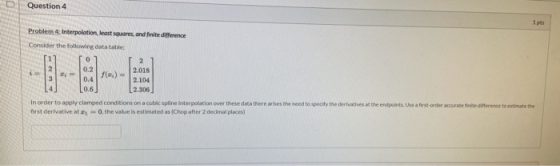
Question 4 1 pts Problem 4: Interpolation, least squares, and finite difference Consider the following data...
 Question 4 1 pts Problem 4: Interpolation, least squares, and finite difference Consider the following data table: 0 2 11 co 2 = 0.2 2.018 f(a) = 0.4 2.104 0.6] 2.306) In order to apply clamped conditions on a cubic spline interpolation over these data there arises the need to specify the derivatives at the endpoints. Use a first-order accurate finite difference to estimate the first derivative at #1 = 0. the value is estimated as (Chop after 2 decimal...
Question 9 1 pts Problem 9: Interpolation, least squares, and finite difference Consider the following data...
 Question 9 1 pts Problem 9: Interpolation, least squares, and finite difference Consider the following data table: 0 2 0.2 2.018 = f(0) = 0.4 2.104 0.6 L2.306 The resulting linear least-squares fit is (Chop after 2 decimal places) None of the above. yx) - 1.95+4,50 x yix)- 4+2.50 x yox)- 1.95+0.50 x yox) 4.34-2.50 x
Question 10 1 pts Problem 10: Interpolation, least squares, and finite difference Consider the following data...
 Question 10 1 pts Problem 10: Interpolation, least squares, and finite difference Consider the following data table: CON 2 = 0 0.2 0.4 0.6 f(t) = 2 2.018 2.104 2.306 If the Sum of the Squares of the errors for the linear least-squares fit for the above problem is computed as SSE = 8.579 x 10⁻³ and the sum of the squares of the deviation from their mean is computed as SS, = 0.059, then the R2 value for the...
 Problem 3: Interpolation, least squares, and finite difference Consider the following data table: 2 0 0.2 0.4 0.6 f(x) = 2 2.018 2.104 2.306 3 The quadratic Lagrange interpolator L2,0() used to quadratically interpolate between data points #1 = 0.12 = 0.2, and as = 0.4 is (Chop after 2 decimal places) None of the above -5.00x^2+7.50x+2.00 5.00x^2-1.00 12.50x^2-7.50x+1.00 25.05x^2-10.25%
 Problem 1: Interpolation, least squares, and finite difference Consider the following data table: rol 2 0.2 2.018 f(x) = 0.4 2.104 0.6 2.306 The linear Lagrange interpolator L12 (1) used to linearly interpolate between data points #2 = 0.2 and 33 = 0.4 is (Chop after 2 decimal places) 2 = 3 -5.00x+2.00 5.00x-1.00 O -5.00x+2.00 -2.50x+0.20 None of the above.
 Problem 3: Interpolation, least squares, and finite difference Consider the following data table: 2 = f(x) = 0.2 0.4 0.6 2 2.018 2.104 2.306 The quadratic Lagrange interpolator L2,0 (2) used to quadratically interpolate between data points 2 = 0.22 = 0.2. and 2'3 = 0.4 is (Chop after 2 decimal places) 25.05x^2-10.25x -5.00x^2+7.50x+2.00 12.50x 2-7.50x+1.00 5.00x^2-1.00 None of the above.
 Consider the following data table: 0 2i = 0.2 0.4 f(xi) = 2 2.018 2.104 2.306 0.6 0.2 and 23=0.4 is The linear Lagrange interpolator L1,1 (2) used to linearly interpolate between data points 12 (Chop after 2 decimal places) None of the above. -2.50x+0.20 -5.00x+2.00 -5.00x+2.00 5.00x-1.00 Consider the following data table: 2 Ti = 0 0.2 0.4 0.6 f(x) = 2.018 2.104 2.306 0.2 and 23 = 0.4, the value obtained at 2=0.3 is Using Lagrange linear interpolation...
 Problem 1: Interpolation, least squares, and finite difference Consider the following data table: 0 0.2 2.018 f(a) = 2.104 0.6 2.306 The linear Lagrange Interpolator L. (t) used to linearly interpolate between data points 12 = 0.2 and 13 = 0.4 is (Chop after 2 decimal places) 0.4 -2.50x 0.20 None of the above 500100 500-200 -5.00-2.00
 they all relate to the first one its the same question judt
with parts
D Question 5 1 pts Problem 5: Interpolation, least squares, and finite difference Consider the following datatable 0 2 0.2 2.018 0.4 2.104 0.6 L2.306 In order to apply clamped conditions on a cubic spline interpolation over these data there arises the need to specify the derivatives at the endpoints. Use a second-order accurate finite difference to estimate the first derivative at y = 0, the...
they all relate to the first one its the same question judt
with parts
D Question 5 1 pts Problem 5: Interpolation, least squares, and finite difference Consider the following datatable 0 2 0.2 2.018 0.4 2.104 0.6 L2.306 In order to apply clamped conditions on a cubic spline interpolation over these data there arises the need to specify the derivatives at the endpoints. Use a second-order accurate finite difference to estimate the first derivative at y = 0, the...
 Problem 2: Interpolation, least squares, and finite difference Consider the following data table: 0 2 0.2 2.018 ti f(x) = 0.4 2.104 0.6 2.306 Using Lagrange linear interpolation between data points 22 = 0.2 and as = 0.4, the value obtained at z = 0.3 is (Chop after 2 decimal places) فو واقع = 2.06 2.09 2.03 None of the above. 2.05
 Question 4 1 pts Problem 4: Interpolation, least squares, and finite difference Consider the following data table: 0 2 11 co 2 = 0.2 2.018 f(a) = 0.4 2.104 0.6] 2.306) In order to apply clamped conditions on a cubic spline interpolation over these data there arises the need to specify the derivatives at the endpoints. Use a first-order accurate finite difference to estimate the first derivative at #1 = 0. the value is estimated as (Chop after 2 decimal...
 Question 9 1 pts Problem 9: Interpolation, least squares, and finite difference Consider the following data table: 0 2 0.2 2.018 = f(0) = 0.4 2.104 0.6 L2.306 The resulting linear least-squares fit is (Chop after 2 decimal places) None of the above. yx) - 1.95+4,50 x yix)- 4+2.50 x yox)- 1.95+0.50 x yox) 4.34-2.50 x
 Question 10 1 pts Problem 10: Interpolation, least squares, and finite difference Consider the following data table: CON 2 = 0 0.2 0.4 0.6 f(t) = 2 2.018 2.104 2.306 If the Sum of the Squares of the errors for the linear least-squares fit for the above problem is computed as SSE = 8.579 x 10⁻³ and the sum of the squares of the deviation from their mean is computed as SS, = 0.059, then the R2 value for the...
Most questions answered within 3 hours.
-
Where is the error in this code sequence?
String s1 = "Hello";
String s2 = "ello";...
asked 11 months ago -
Financial data for Joel de Paris, Inc., for last year
follow:
Joel de Paris, Inc.
Balance...
asked 11 months ago -
Consider this reaction:
Al2(SO4)3 (aq)+ BaCl3
(aq) Al2Cl6 (aq)- +
3BaSO4(s) . What is the...
asked 11 months ago -
Suppose that Savneet is considering increasing her
recent random sample from 20 car rentals to 40...
asked 11 months ago -
Trucks arrive at an unloading terminal at an average rate of 120
per hour.
Trucks arrive...
asked 11 months ago -
Why are methanol and ethanol completely soluble in water while
octanol is not very little soluble....
asked 11 months ago -
A facilities manager at a university reads in a research report
that the mean amount of...
asked 11 months ago -
When the CuSO4 is rehydrated by adding water to the anhydrous
compound, is this an endothermic...
asked 11 months ago -
A ray of sunlight is passing from diamond into crown glass; the
angle of incidence is...
asked 11 months ago -
A block of mass 0.249 kg is placed on top of a light, vertical
spring of...
asked 11 months ago -
how do the kidneys compensate in the presences of acidosis
a) trigger hyperventilate
b) reserve acid...
asked 11 months ago -
Question 501 pts
The rental rate of capital to the firm increases. Which of the
following...
asked 11 months ago