Consider the second Galerkin Example (videos:
GalerkinDiscrete-Example_1 to 3). Solve this example if u(0) = 0,
du(2)/dx =0, and 0 ≤ x ≤2. Every single step must be
shown.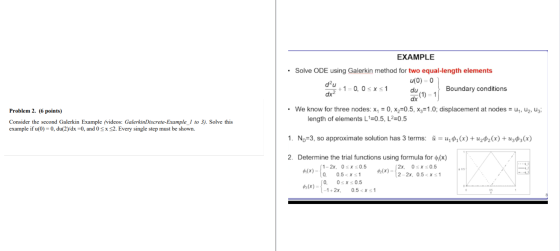
Homework Answers


Add Answer to:
Consider the second Galerkin Example (videos:
GalerkinDiscrete-Example_1 to 3). Solve this example if u(0) = 0,...
Consider the first Galerkin Example (video: GalerkinMethod_Example). Solve this example using three trial functions, 1(x) =...
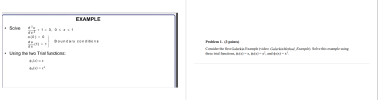 Consider the first Galerkin Example (video:
GalerkinMethod_Example). Solve this example using three trial
functions, 1(x) = x, 2(x) = x2 , and 3(x) = x3 .
EXAMPLE Solve d2u + 1 = 0, OSX S1 d x2 u (0) = 0 du Boundary conditions (1) = 1 dx Problem 1. (3 points) Consider the first Galerkin Example (video: GalerkinMethod_Example). Solve this example using three trial functions, 01(x) = x, 02(x) = x², and $3(x) = x3. Using the two Trial...
Consider the first Galerkin Example (video:
GalerkinMethod_Example). Solve this example using three trial
functions, 1(x) = x, 2(x) = x2 , and 3(x) = x3 .
EXAMPLE Solve d2u + 1 = 0, OSX S1 d x2 u (0) = 0 du Boundary conditions (1) = 1 dx Problem 1. (3 points) Consider the first Galerkin Example (video: GalerkinMethod_Example). Solve this example using three trial functions, 01(x) = x, 02(x) = x², and $3(x) = x3. Using the two Trial...
Problem 1 (3 points) Solve the following boundary value problem with the Galerkin method in which...
 Problem 1 (3 points) Solve the following boundary value problem with the Galerkin method in which a three-term approximation, u(x) = 60, () + 0,02(x) + C303(x) with 0,(x)=(1-x), 02(x)=x(1-x), and 03(x)=x (1-x), is used. du + x2 = 0, 0<x<1 dx2 f(0) = 1 Boundary Conditions: lu(1) = 0
3.24 Solve the differential equation in Example 3.4.1 for the mixed boundary conditions u(0) = 0,...
 3.24 Solve the differential equation in Example 3.4.1 for the mixed boundary conditions u(0) = 0, (d) = 1 dx/x=1 Use the uniform mesh of three linear elements. The exact solution is mm)_ 2 cos(1 – 2) - sin 2 - + x2 – 2 cos(1) Answer: U2 = 0.4134, Uz = 0.7958, U4 = 1.1420, (Q1)def = -1.2402. Example 3.4.1 Use the finite element method to solve the problem described by the following differential equation and boundary conditions (see...
EXAMPLE 3 Find dx. 13 - 2x² SOLUTION Let u = 3 - 2x. Then du...
 EXAMPLE 3 Find dx. 13 - 2x² SOLUTION Let u = 3 - 2x. Then du dx, so x dx du and 1 3 = 2x2 dx = = 1.I tu du 1 wrz du (27ū)+c 11 Il + C (in terms of x).
Question 3 døy Not yet answered Marked out of 2.0000 P Flag question Consider the following...
 Question 3 døy Not yet answered Marked out of 2.0000 P Flag question Consider the following Ordinary Differential Equation (ODE) for function y(x) on interval [0, 1] dy dy + (-8.6) + 14.03 dx3 dx2 dx +(-2.47) + y(x) = 3.762 with the following initial conditions at point x = 0: dy y = 4.862, = 15.4696 = 77.4217 dx dx? Introducting notations dy dydy dx dx dx2 convert the ODE to the system of three first-order ODEs for functions...
EXAMPLE 3 Find EXAMPLE 3 Find vom av 2 ox. SOLUTION Let u= 1 – 182....
 EXAMPLE 3 Find EXAMPLE 3 Find vom av 2 ox. SOLUTION Let u= 1 – 182. Then du = -88 I ho du SOLUTION Let u = 1 - 4x2. Then du = - 8x dx, so x dx = x, so x dx = -8 du and du and -1/2 du (2017) + c + C (in terms of x).
solve problem #1 depending on the given information Consider the following 1D second order elliptic equation with Dirichlet boundary conditions du(x) (c(x)du ) = f(x) (a $15 b), u(a) = ga, u(b) = gb...
 solve problem #1 depending on the given information
Consider the following 1D second order elliptic equation with Dirichlet boundary conditions du(x) (c(x)du ) = f(x) (a $15 b), u(a) = ga, u(b) = gb dr: where u(x) is the unknown function, ga and gb are the Dirichlet boundary values, c(x) is a given coefficient function and f(x) is a given source function. See the theorem 10.1 in the textbook for the existence and uniqueness of the solution. 1.1 Weak Formulation...
solve problem #1 depending on the given information
Consider the following 1D second order elliptic equation with Dirichlet boundary conditions du(x) (c(x)du ) = f(x) (a $15 b), u(a) = ga, u(b) = gb dr: where u(x) is the unknown function, ga and gb are the Dirichlet boundary values, c(x) is a given coefficient function and f(x) is a given source function. See the theorem 10.1 in the textbook for the existence and uniqueness of the solution. 1.1 Weak Formulation...
ďyi dx dx 1 Consider the following Ordinary Differential Equation (ODE) for function yı(x) on interval...
 ďyi dx dx 1 Consider the following Ordinary Differential Equation (ODE) for function yı(x) on interval [0, 1] dyi dyi +(-4.7) * + 4.4 * +(-0.7) * yı(x) = -0.216. el.1-x dx dx2 with the following initial conditions at point x = 0: dyi dayı Yi = -0.316, = 6.2424, = 22.3846 dx2 Introducting notations dyi dy2 dy1 Y2 = Y3 = dx2 convert the ODE to the system of three first-order ODEs for functions yi, Y2, y3 in the...
Q1: Solve the ODE: f) Vyy' + y3/2-1. y(1) = 0. g) (2x +y)dx(2x+y-1)dy 0. i) dx=xy2e": y(2)=0. j) ...
 Q1: Solve the ODE: f) Vyy' + y3/2-1. y(1) = 0. g) (2x +y)dx(2x+y-1)dy 0. i) dx=xy2e": y(2)=0. j) (1 + x*)dy + (1 + y*)dx = 0; y(1) = V3.
Q1: Solve the ODE: f) Vyy' + y3/2-1. y(1) = 0. g) (2x +y)dx(2x+y-1)dy 0. i) dx=xy2e": y(2)=0. j) (1 + x*)dy + (1 + y*)dx = 0; y(1) = V3.
Q1: Solve the ODE: f) Vyy' + y3/2-1. y(1) = 0. g) (2x +y)dx(2x+y-1)dy 0. i) dx=xy2e": y(2)=0. j) (1 + x*)dy + (1 + y*)dx = 0; y(1) = V3.
Consider the following boundary value problem: du du dx dx u=-e* sin(x) Discretize the ODE using...
 Consider the following boundary value problem: du du dx dx u=-e* sin(x) Discretize the ODE using backward second-order accurate scheme for both derivatives. The second order finite accuracy difference for the derivatives are given by: 2h (3)-1(1,2)-45 (7.1)+31(x) 8 (*)== (4.5) +41 (1.2) -51 (3.1) +2f (x) h?
 Consider the first Galerkin Example (video:
GalerkinMethod_Example). Solve this example using three trial
functions, 1(x) = x, 2(x) = x2 , and 3(x) = x3 .
EXAMPLE Solve d2u + 1 = 0, OSX S1 d x2 u (0) = 0 du Boundary conditions (1) = 1 dx Problem 1. (3 points) Consider the first Galerkin Example (video: GalerkinMethod_Example). Solve this example using three trial functions, 01(x) = x, 02(x) = x², and $3(x) = x3. Using the two Trial...
Consider the first Galerkin Example (video:
GalerkinMethod_Example). Solve this example using three trial
functions, 1(x) = x, 2(x) = x2 , and 3(x) = x3 .
EXAMPLE Solve d2u + 1 = 0, OSX S1 d x2 u (0) = 0 du Boundary conditions (1) = 1 dx Problem 1. (3 points) Consider the first Galerkin Example (video: GalerkinMethod_Example). Solve this example using three trial functions, 01(x) = x, 02(x) = x², and $3(x) = x3. Using the two Trial...
 Problem 1 (3 points) Solve the following boundary value problem with the Galerkin method in which a three-term approximation, u(x) = 60, () + 0,02(x) + C303(x) with 0,(x)=(1-x), 02(x)=x(1-x), and 03(x)=x (1-x), is used. du + x2 = 0, 0<x<1 dx2 f(0) = 1 Boundary Conditions: lu(1) = 0
 3.24 Solve the differential equation in Example 3.4.1 for the mixed boundary conditions u(0) = 0, (d) = 1 dx/x=1 Use the uniform mesh of three linear elements. The exact solution is mm)_ 2 cos(1 – 2) - sin 2 - + x2 – 2 cos(1) Answer: U2 = 0.4134, Uz = 0.7958, U4 = 1.1420, (Q1)def = -1.2402. Example 3.4.1 Use the finite element method to solve the problem described by the following differential equation and boundary conditions (see...
 EXAMPLE 3 Find dx. 13 - 2x² SOLUTION Let u = 3 - 2x. Then du dx, so x dx du and 1 3 = 2x2 dx = = 1.I tu du 1 wrz du (27ū)+c 11 Il + C (in terms of x).
 Question 3 døy Not yet answered Marked out of 2.0000 P Flag question Consider the following Ordinary Differential Equation (ODE) for function y(x) on interval [0, 1] dy dy + (-8.6) + 14.03 dx3 dx2 dx +(-2.47) + y(x) = 3.762 with the following initial conditions at point x = 0: dy y = 4.862, = 15.4696 = 77.4217 dx dx? Introducting notations dy dydy dx dx dx2 convert the ODE to the system of three first-order ODEs for functions...
 EXAMPLE 3 Find EXAMPLE 3 Find vom av 2 ox. SOLUTION Let u= 1 – 182. Then du = -88 I ho du SOLUTION Let u = 1 - 4x2. Then du = - 8x dx, so x dx = x, so x dx = -8 du and du and -1/2 du (2017) + c + C (in terms of x).
 solve problem #1 depending on the given information
Consider the following 1D second order elliptic equation with Dirichlet boundary conditions du(x) (c(x)du ) = f(x) (a $15 b), u(a) = ga, u(b) = gb dr: where u(x) is the unknown function, ga and gb are the Dirichlet boundary values, c(x) is a given coefficient function and f(x) is a given source function. See the theorem 10.1 in the textbook for the existence and uniqueness of the solution. 1.1 Weak Formulation...
solve problem #1 depending on the given information
Consider the following 1D second order elliptic equation with Dirichlet boundary conditions du(x) (c(x)du ) = f(x) (a $15 b), u(a) = ga, u(b) = gb dr: where u(x) is the unknown function, ga and gb are the Dirichlet boundary values, c(x) is a given coefficient function and f(x) is a given source function. See the theorem 10.1 in the textbook for the existence and uniqueness of the solution. 1.1 Weak Formulation...
 ďyi dx dx 1 Consider the following Ordinary Differential Equation (ODE) for function yı(x) on interval [0, 1] dyi dyi +(-4.7) * + 4.4 * +(-0.7) * yı(x) = -0.216. el.1-x dx dx2 with the following initial conditions at point x = 0: dyi dayı Yi = -0.316, = 6.2424, = 22.3846 dx2 Introducting notations dyi dy2 dy1 Y2 = Y3 = dx2 convert the ODE to the system of three first-order ODEs for functions yi, Y2, y3 in the...
 Q1: Solve the ODE: f) Vyy' + y3/2-1. y(1) = 0. g) (2x +y)dx(2x+y-1)dy 0. i) dx=xy2e": y(2)=0. j) (1 + x*)dy + (1 + y*)dx = 0; y(1) = V3.
Q1: Solve the ODE: f) Vyy' + y3/2-1. y(1) = 0. g) (2x +y)dx(2x+y-1)dy 0. i) dx=xy2e": y(2)=0. j) (1 + x*)dy + (1 + y*)dx = 0; y(1) = V3.
Q1: Solve the ODE: f) Vyy' + y3/2-1. y(1) = 0. g) (2x +y)dx(2x+y-1)dy 0. i) dx=xy2e": y(2)=0. j) (1 + x*)dy + (1 + y*)dx = 0; y(1) = V3.
 Consider the following boundary value problem: du du dx dx u=-e* sin(x) Discretize the ODE using backward second-order accurate scheme for both derivatives. The second order finite accuracy difference for the derivatives are given by: 2h (3)-1(1,2)-45 (7.1)+31(x) 8 (*)== (4.5) +41 (1.2) -51 (3.1) +2f (x) h?
Most questions answered within 3 hours.
-
Where is the error in this code sequence?
String s1 = "Hello";
String s2 = "ello";...
asked 11 months ago -
Financial data for Joel de Paris, Inc., for last year
follow:
Joel de Paris, Inc.
Balance...
asked 11 months ago -
Consider this reaction:
Al2(SO4)3 (aq)+ BaCl3
(aq) Al2Cl6 (aq)- +
3BaSO4(s) . What is the...
asked 11 months ago -
Suppose that Savneet is considering increasing her
recent random sample from 20 car rentals to 40...
asked 11 months ago -
Trucks arrive at an unloading terminal at an average rate of 120
per hour.
Trucks arrive...
asked 11 months ago -
Why are methanol and ethanol completely soluble in water while
octanol is not very little soluble....
asked 11 months ago -
A facilities manager at a university reads in a research report
that the mean amount of...
asked 11 months ago -
When the CuSO4 is rehydrated by adding water to the anhydrous
compound, is this an endothermic...
asked 11 months ago -
A ray of sunlight is passing from diamond into crown glass; the
angle of incidence is...
asked 11 months ago -
A block of mass 0.249 kg is placed on top of a light, vertical
spring of...
asked 11 months ago -
how do the kidneys compensate in the presences of acidosis
a) trigger hyperventilate
b) reserve acid...
asked 11 months ago -
Question 501 pts
The rental rate of capital to the firm increases. Which of the
following...
asked 11 months ago