
Homework Answers
In this Galerkin method, the integral of the Residual function R, multiplied by a weighing function Wi is forced to be zero.
Every step by step procedure is explained in clear way in below images:


Add Answer to:
Problem 1 (3 points) Solve the following boundary value problem with the Galerkin method in which...
Consider the second Galerkin Example (videos: GalerkinDiscrete-Example_1 to 3). Solve this example if u(0) = 0,...
 Consider the second Galerkin Example (videos:
GalerkinDiscrete-Example_1 to 3). Solve this example if u(0) = 0,
du(2)/dx =0, and 0 ≤ x ≤2. Every single step must be
shown.
EXAMPLE Solve ODE using Galerkin method for two equal-length elements du u(0) = 0 +1 = 0, 0 < x < 1 dx2 du Boundary conditions (1) dx We know for three nodes: X2 = 0, X2=0.5, X3=1.0; displacement at nodes = Uy, U2, U3; length of elements L1=0.5, L2=0.5 -...
Consider the second Galerkin Example (videos:
GalerkinDiscrete-Example_1 to 3). Solve this example if u(0) = 0,
du(2)/dx =0, and 0 ≤ x ≤2. Every single step must be
shown.
EXAMPLE Solve ODE using Galerkin method for two equal-length elements du u(0) = 0 +1 = 0, 0 < x < 1 dx2 du Boundary conditions (1) dx We know for three nodes: X2 = 0, X2=0.5, X3=1.0; displacement at nodes = Uy, U2, U3; length of elements L1=0.5, L2=0.5 -...
Consider the first Galerkin Example (video: GalerkinMethod_Example). Solve this example using three trial functions, 1(x) =...
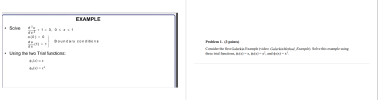 Consider the first Galerkin Example (video:
GalerkinMethod_Example). Solve this example using three trial
functions, 1(x) = x, 2(x) = x2 , and 3(x) = x3 .
EXAMPLE Solve d2u + 1 = 0, OSX S1 d x2 u (0) = 0 du Boundary conditions (1) = 1 dx Problem 1. (3 points) Consider the first Galerkin Example (video: GalerkinMethod_Example). Solve this example using three trial functions, 01(x) = x, 02(x) = x², and $3(x) = x3. Using the two Trial...
Consider the first Galerkin Example (video:
GalerkinMethod_Example). Solve this example using three trial
functions, 1(x) = x, 2(x) = x2 , and 3(x) = x3 .
EXAMPLE Solve d2u + 1 = 0, OSX S1 d x2 u (0) = 0 du Boundary conditions (1) = 1 dx Problem 1. (3 points) Consider the first Galerkin Example (video: GalerkinMethod_Example). Solve this example using three trial functions, 01(x) = x, 02(x) = x², and $3(x) = x3. Using the two Trial...
Apply method of images and Fourier transformation to solve the following boundary value problem f...
 Apply method of images and Fourier transformation to solve the following boundary value problem for the heat equation in the quarter plane, ut = 8uzz, cos 2 u(r,0 Uz (0, t) = 0, (10) lim u(x, t)=0
Apply method of images and Fourier transformation to solve the following boundary value problem for the heat equation in the quarter plane, ut = 8uzz, cos 2 u(r,0 Uz (0, t) = 0, (10) lim u(x, t)=0
Apply method of images and Fourier transformation to solve the following boundary value problem for the heat equation in the quarter plane, ut = 8uzz, cos 2 u(r,0 Uz (0, t) = 0, (10) lim u(x, t)=0
Set up and solve a boundary value problem using the shooting method using Matlab
 Set up and solve a boundary value problem using the shooting
method using Matlab
A heated rod with a uniform heat source may be modeled with Poisson equation. The boundary conditions are T(x = 0) = 40 and T(x = 10) = 200 dTf(x) Use the guess values shown below. zg linspace (-200,100,1000); xin-0:0.01:10 a) Solve using the shooting method with f(x) = 25 . Name your final solution "TA" b) Solve using the shooting method with f(x)-0.12x3-2.4x2 + 12x....
Set up and solve a boundary value problem using the shooting
method using Matlab
A heated rod with a uniform heat source may be modeled with Poisson equation. The boundary conditions are T(x = 0) = 40 and T(x = 10) = 200 dTf(x) Use the guess values shown below. zg linspace (-200,100,1000); xin-0:0.01:10 a) Solve using the shooting method with f(x) = 25 . Name your final solution "TA" b) Solve using the shooting method with f(x)-0.12x3-2.4x2 + 12x....
Question Question 1 (1 mark) Attempt 1 Consider the boundary value problem: du+ U=1, 2<c<13 with...
 Question Question 1 (1 mark) Attempt 1 Consider the boundary value problem: du+ U=1, 2<c<13 with u(2) = 4 and u(13) = 5 Find functions g and , such that u=gta, is a quadratic approximation that satisfies the boundary conditions. Your answer should consist of two expressions, the first representing the term g and the second representing the term ,. Both should be expressed in terms of the independent variable x. Your answers should be expressed as a function of...
2. Use the method of separation of variables to solve the boundary value problem ( au...
 2. Use the method of separation of variables to solve the boundary value problem ( au = karu 0<x<L t > 0 (0,t) = 0, > 0 (1.1) -0. > 0 (u(a,0) - (x) 0<x<L. Be sure to detail exactly how f(x) enters your solution E-
Section 1.3 3. a. Solve the following initial boundary value problem for the heat equation 0x<L...
 Section 1.3 3. a. Solve the following initial boundary value problem for the heat equation 0x<L t0 at u(r, 0) f() u(0, t)u(L, t) 0, t>0, 9Tr when f(r)6 sin L b. Solve the following initial boundary value problem for the diffusion equation au D 0 L t0 at u(r, 0) f() (0, t) (L, t) 0, t 0, x < L/2 0. when f(r) r > L/2. 1
Section 1.3 3. a. Solve the following initial boundary value problem...
Section 1.3 3. a. Solve the following initial boundary value problem for the heat equation 0x<L t0 at u(r, 0) f() u(0, t)u(L, t) 0, t>0, 9Tr when f(r)6 sin L b. Solve the following initial boundary value problem for the diffusion equation au D 0 L t0 at u(r, 0) f() (0, t) (L, t) 0, t 0, x < L/2 0. when f(r) r > L/2. 1
Section 1.3 3. a. Solve the following initial boundary value problem...
Question about MATLAB boundary value problem. How can I solve the following problems? I would appreciate...
 Question about MATLAB boundary value problem.
How can I solve the following problems? I would appreciate if
you could briefly explain how you get the answer. (In the second
problem, the selected answer is not correct.)
Given the differential equation: u" + 2u' - xu = 0 subject to the boundary conditions: du/dx (x = 0) = 4 u(x = 5) = 10 This is to be solved using a second-order accurate in space method with x = 0.1. Which...
Question about MATLAB boundary value problem.
How can I solve the following problems? I would appreciate if
you could briefly explain how you get the answer. (In the second
problem, the selected answer is not correct.)
Given the differential equation: u" + 2u' - xu = 0 subject to the boundary conditions: du/dx (x = 0) = 4 u(x = 5) = 10 This is to be solved using a second-order accurate in space method with x = 0.1. Which...
3. (a) Solve the boundary value problem on the wedge u(r, 0) = 0 0
 3. (a) Solve the boundary value problem on the wedge u(r, 0) = 0 0<r<p, a(r, g) = 0 0<r<p, u(p, 0)-/(0), 0 < θ < θο. (b) State the mathematical and physical boundary conditions for this problem. (c) Suppose ρ-1.00-π/3, and f(9)-66ere. Plot the solution surface and polar contour plot for N -10
3. (a) Solve the boundary value problem on the wedge u(r, 0) = 0 0
3. (a) Solve the boundary value problem on the wedge u(r, 0) = 0 0<r<p, a(r, g) = 0 0<r<p, u(p, 0)-/(0), 0 < θ < θο. (b) State the mathematical and physical boundary conditions for this problem. (c) Suppose ρ-1.00-π/3, and f(9)-66ere. Plot the solution surface and polar contour plot for N -10
3. (a) Solve the boundary value problem on the wedge u(r, 0) = 0 0
solve problem #1 depending on the given information Consider the following 1D second order elliptic equation with Dirichlet boundary conditions du(x) (c(x)du ) = f(x) (a $15 b), u(a) = ga, u(b) = gb...
 solve problem #1 depending on the given information
Consider the following 1D second order elliptic equation with Dirichlet boundary conditions du(x) (c(x)du ) = f(x) (a $15 b), u(a) = ga, u(b) = gb dr: where u(x) is the unknown function, ga and gb are the Dirichlet boundary values, c(x) is a given coefficient function and f(x) is a given source function. See the theorem 10.1 in the textbook for the existence and uniqueness of the solution. 1.1 Weak Formulation...
solve problem #1 depending on the given information
Consider the following 1D second order elliptic equation with Dirichlet boundary conditions du(x) (c(x)du ) = f(x) (a $15 b), u(a) = ga, u(b) = gb dr: where u(x) is the unknown function, ga and gb are the Dirichlet boundary values, c(x) is a given coefficient function and f(x) is a given source function. See the theorem 10.1 in the textbook for the existence and uniqueness of the solution. 1.1 Weak Formulation...
 Consider the second Galerkin Example (videos:
GalerkinDiscrete-Example_1 to 3). Solve this example if u(0) = 0,
du(2)/dx =0, and 0 ≤ x ≤2. Every single step must be
shown.
EXAMPLE Solve ODE using Galerkin method for two equal-length elements du u(0) = 0 +1 = 0, 0 < x < 1 dx2 du Boundary conditions (1) dx We know for three nodes: X2 = 0, X2=0.5, X3=1.0; displacement at nodes = Uy, U2, U3; length of elements L1=0.5, L2=0.5 -...
Consider the second Galerkin Example (videos:
GalerkinDiscrete-Example_1 to 3). Solve this example if u(0) = 0,
du(2)/dx =0, and 0 ≤ x ≤2. Every single step must be
shown.
EXAMPLE Solve ODE using Galerkin method for two equal-length elements du u(0) = 0 +1 = 0, 0 < x < 1 dx2 du Boundary conditions (1) dx We know for three nodes: X2 = 0, X2=0.5, X3=1.0; displacement at nodes = Uy, U2, U3; length of elements L1=0.5, L2=0.5 -...
 Consider the first Galerkin Example (video:
GalerkinMethod_Example). Solve this example using three trial
functions, 1(x) = x, 2(x) = x2 , and 3(x) = x3 .
EXAMPLE Solve d2u + 1 = 0, OSX S1 d x2 u (0) = 0 du Boundary conditions (1) = 1 dx Problem 1. (3 points) Consider the first Galerkin Example (video: GalerkinMethod_Example). Solve this example using three trial functions, 01(x) = x, 02(x) = x², and $3(x) = x3. Using the two Trial...
Consider the first Galerkin Example (video:
GalerkinMethod_Example). Solve this example using three trial
functions, 1(x) = x, 2(x) = x2 , and 3(x) = x3 .
EXAMPLE Solve d2u + 1 = 0, OSX S1 d x2 u (0) = 0 du Boundary conditions (1) = 1 dx Problem 1. (3 points) Consider the first Galerkin Example (video: GalerkinMethod_Example). Solve this example using three trial functions, 01(x) = x, 02(x) = x², and $3(x) = x3. Using the two Trial...
 Apply method of images and Fourier transformation to solve the following boundary value problem for the heat equation in the quarter plane, ut = 8uzz, cos 2 u(r,0 Uz (0, t) = 0, (10) lim u(x, t)=0
Apply method of images and Fourier transformation to solve the following boundary value problem for the heat equation in the quarter plane, ut = 8uzz, cos 2 u(r,0 Uz (0, t) = 0, (10) lim u(x, t)=0
Apply method of images and Fourier transformation to solve the following boundary value problem for the heat equation in the quarter plane, ut = 8uzz, cos 2 u(r,0 Uz (0, t) = 0, (10) lim u(x, t)=0
 Set up and solve a boundary value problem using the shooting
method using Matlab
A heated rod with a uniform heat source may be modeled with Poisson equation. The boundary conditions are T(x = 0) = 40 and T(x = 10) = 200 dTf(x) Use the guess values shown below. zg linspace (-200,100,1000); xin-0:0.01:10 a) Solve using the shooting method with f(x) = 25 . Name your final solution "TA" b) Solve using the shooting method with f(x)-0.12x3-2.4x2 + 12x....
Set up and solve a boundary value problem using the shooting
method using Matlab
A heated rod with a uniform heat source may be modeled with Poisson equation. The boundary conditions are T(x = 0) = 40 and T(x = 10) = 200 dTf(x) Use the guess values shown below. zg linspace (-200,100,1000); xin-0:0.01:10 a) Solve using the shooting method with f(x) = 25 . Name your final solution "TA" b) Solve using the shooting method with f(x)-0.12x3-2.4x2 + 12x....
 Question Question 1 (1 mark) Attempt 1 Consider the boundary value problem: du+ U=1, 2<c<13 with u(2) = 4 and u(13) = 5 Find functions g and , such that u=gta, is a quadratic approximation that satisfies the boundary conditions. Your answer should consist of two expressions, the first representing the term g and the second representing the term ,. Both should be expressed in terms of the independent variable x. Your answers should be expressed as a function of...
 2. Use the method of separation of variables to solve the boundary value problem ( au = karu 0<x<L t > 0 (0,t) = 0, > 0 (1.1) -0. > 0 (u(a,0) - (x) 0<x<L. Be sure to detail exactly how f(x) enters your solution E-
 Section 1.3 3. a. Solve the following initial boundary value problem for the heat equation 0x<L t0 at u(r, 0) f() u(0, t)u(L, t) 0, t>0, 9Tr when f(r)6 sin L b. Solve the following initial boundary value problem for the diffusion equation au D 0 L t0 at u(r, 0) f() (0, t) (L, t) 0, t 0, x < L/2 0. when f(r) r > L/2. 1
Section 1.3 3. a. Solve the following initial boundary value problem...
Section 1.3 3. a. Solve the following initial boundary value problem for the heat equation 0x<L t0 at u(r, 0) f() u(0, t)u(L, t) 0, t>0, 9Tr when f(r)6 sin L b. Solve the following initial boundary value problem for the diffusion equation au D 0 L t0 at u(r, 0) f() (0, t) (L, t) 0, t 0, x < L/2 0. when f(r) r > L/2. 1
Section 1.3 3. a. Solve the following initial boundary value problem...
 Question about MATLAB boundary value problem.
How can I solve the following problems? I would appreciate if
you could briefly explain how you get the answer. (In the second
problem, the selected answer is not correct.)
Given the differential equation: u" + 2u' - xu = 0 subject to the boundary conditions: du/dx (x = 0) = 4 u(x = 5) = 10 This is to be solved using a second-order accurate in space method with x = 0.1. Which...
Question about MATLAB boundary value problem.
How can I solve the following problems? I would appreciate if
you could briefly explain how you get the answer. (In the second
problem, the selected answer is not correct.)
Given the differential equation: u" + 2u' - xu = 0 subject to the boundary conditions: du/dx (x = 0) = 4 u(x = 5) = 10 This is to be solved using a second-order accurate in space method with x = 0.1. Which...
 3. (a) Solve the boundary value problem on the wedge u(r, 0) = 0 0<r<p, a(r, g) = 0 0<r<p, u(p, 0)-/(0), 0 < θ < θο. (b) State the mathematical and physical boundary conditions for this problem. (c) Suppose ρ-1.00-π/3, and f(9)-66ere. Plot the solution surface and polar contour plot for N -10
3. (a) Solve the boundary value problem on the wedge u(r, 0) = 0 0
3. (a) Solve the boundary value problem on the wedge u(r, 0) = 0 0<r<p, a(r, g) = 0 0<r<p, u(p, 0)-/(0), 0 < θ < θο. (b) State the mathematical and physical boundary conditions for this problem. (c) Suppose ρ-1.00-π/3, and f(9)-66ere. Plot the solution surface and polar contour plot for N -10
3. (a) Solve the boundary value problem on the wedge u(r, 0) = 0 0
 solve problem #1 depending on the given information
Consider the following 1D second order elliptic equation with Dirichlet boundary conditions du(x) (c(x)du ) = f(x) (a $15 b), u(a) = ga, u(b) = gb dr: where u(x) is the unknown function, ga and gb are the Dirichlet boundary values, c(x) is a given coefficient function and f(x) is a given source function. See the theorem 10.1 in the textbook for the existence and uniqueness of the solution. 1.1 Weak Formulation...
solve problem #1 depending on the given information
Consider the following 1D second order elliptic equation with Dirichlet boundary conditions du(x) (c(x)du ) = f(x) (a $15 b), u(a) = ga, u(b) = gb dr: where u(x) is the unknown function, ga and gb are the Dirichlet boundary values, c(x) is a given coefficient function and f(x) is a given source function. See the theorem 10.1 in the textbook for the existence and uniqueness of the solution. 1.1 Weak Formulation...
Most questions answered within 3 hours.
-
Where is the error in this code sequence?
String s1 = "Hello";
String s2 = "ello";...
asked 11 months ago -
Financial data for Joel de Paris, Inc., for last year
follow:
Joel de Paris, Inc.
Balance...
asked 11 months ago -
Consider this reaction:
Al2(SO4)3 (aq)+ BaCl3
(aq) Al2Cl6 (aq)- +
3BaSO4(s) . What is the...
asked 11 months ago -
Suppose that Savneet is considering increasing her
recent random sample from 20 car rentals to 40...
asked 11 months ago -
Trucks arrive at an unloading terminal at an average rate of 120
per hour.
Trucks arrive...
asked 11 months ago -
Why are methanol and ethanol completely soluble in water while
octanol is not very little soluble....
asked 11 months ago -
A facilities manager at a university reads in a research report
that the mean amount of...
asked 11 months ago -
When the CuSO4 is rehydrated by adding water to the anhydrous
compound, is this an endothermic...
asked 11 months ago -
A ray of sunlight is passing from diamond into crown glass; the
angle of incidence is...
asked 11 months ago -
A block of mass 0.249 kg is placed on top of a light, vertical
spring of...
asked 11 months ago -
how do the kidneys compensate in the presences of acidosis
a) trigger hyperventilate
b) reserve acid...
asked 11 months ago -
Question 501 pts
The rental rate of capital to the firm increases. Which of the
following...
asked 11 months ago