The reaction rates of some spontaneous reactions are actually faster that other reactions. Which of these...
The reaction rates of some spontaneous reactions are actually faster that other reactions. Which of these statements is the best explanation for this observation?
| A. |
Kp for the reaction is less than one. |
|
| B. |
The activation energy of the reaction is large. |
|
| C. |
Such reactions are endothermic. |
|
| D. |
The entropy change is negative. |
|
| E. |
The activation energy of the reaction is small |
Homework Answers
Request Answer!
We need at least 10 more requests to produce the answer.
0 / 10 have requested this problem solution
The more requests, the faster the answer.
Add Answer to:
The reaction rates of some spontaneous reactions are actually
faster that other reactions. Which of these...
4. Hot packs. All reactions are spontaneous; note that some are exothermic and some are endothermic....
 4. Hot packs. All reactions are spontaneous; note that some are exothermic and some are endothermic. How can a spontaneous reaction Increase in energy? Hot packs, exothermic: CaClas) → Calag) + 2CH(aq) 4,H=-81.35 kd/mol. MgSO4(s) → Mg?"(aq) +507(ag) AH-91.22 kJ/mol Just plain hot-watch out! NaOH(s) → Na'(aq) + OH'(aq) AH = -44.50 kJ/mol. a. Pick one of the above reactions and calculate how much 1.0 g of the solid would increase the temperature of 100 mL of water. Let your...
Which statements are true regarding reaction rates? [Select all that apply.] 1.Group of answer choices Larger...
Which statements are true regarding reaction rates? [Select all that apply.] 1.Group of answer choices Larger activation energies are associated with faster reaction rates. 2.Higher reactant concentrations are associated with faster reaction rates. 3.Reducing the activation energy for a reaction increases its reaction rate. 4.Reaction rates depend on how likely molecules are to collide in the correct orientation to react. 5.Reactions that give off heat occur rapidly. Reactions that absorb heat occur rapidly. 6.Large changes in enthalpy are associated with...
2. Decide whether each of the following statements is true or false. If false, rewrite it...
 2. Decide whether each of the following statements is true or false. If false, rewrite it to make it true. a. Entropy of the universe increases in all spontaneous reactions. wo False If entropy is bw enough it con be spontaneous, b. Reactions with a negative free energy change (A-Gº <0) are product-favored and occur with rapid transformation of reactants to products. True c. An exothermic reaction will always be spontaneous. I NO when AH is negative the reaction can...
TRUE/FALSE Questions please solve question 6-8 Thank you 6. If a plot of In Kp versus...
 TRUE/FALSE Questions
please solve question 6-8
Thank you
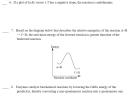
6. If a plot of In Kp versus 1/T has a negative slope, the reaction is endothermic. 7. Based on the diagram below that describes the relative energetics of the reaction A+B → C+D, the activation energy of the forward reaction is greater than that of the backward reaction. Energy A+B Reaction coordinate 8. Enzymes catalyze biochemical reactions by lowering the Gibbs energy of the product(s), thereby converting a non-spontaneous reaction into...
TRUE/FALSE Questions
please solve question 6-8
Thank you
6. If a plot of In Kp versus 1/T has a negative slope, the reaction is endothermic. 7. Based on the diagram below that describes the relative energetics of the reaction A+B → C+D, the activation energy of the forward reaction is greater than that of the backward reaction. Energy A+B Reaction coordinate 8. Enzymes catalyze biochemical reactions by lowering the Gibbs energy of the product(s), thereby converting a non-spontaneous reaction into...
Can someone please provide an explanation for why each one is faster than the other for...
 Can someone please provide an explanation for why each one is
faster than the other for SN1 reactions.
Chapter 7 Sheet1 Sn1 Reactions: Factors Effecting Rates Polar Protic solvents 1) For the following pairs of reactions, predict which will occur more quickly and provide an explanation. CH,OH chy07) X the best L.G. faster - I is most acidic and f is the worst la x ol voo r kom fester • Joan it do N o nto faster:
Can someone please provide an explanation for why each one is
faster than the other for SN1 reactions.
Chapter 7 Sheet1 Sn1 Reactions: Factors Effecting Rates Polar Protic solvents 1) For the following pairs of reactions, predict which will occur more quickly and provide an explanation. CH,OH chy07) X the best L.G. faster - I is most acidic and f is the worst la x ol voo r kom fester • Joan it do N o nto faster:
catalysts change the rates of reactions by changing… Select one or more: a. the ∆G of...
catalysts change the rates of reactions by changing… Select one or more: a. the ∆G of the reaction b. the ∆S of the reaction c. Catalysts change all of the above. d. the activation energy of the reaction e. the ∆H of the reaction. f. Catalysts change all of the above.
Which of the following reactions will undergo an E1 reaction faster? Question 2 Not yet answered...
 Which of the following reactions will undergo an E1 reaction faster? Question 2 Not yet answered Points out of 1.0 P Flag question (a) C (b) (c) (d) Select one: O a. (a) 1-bromopentane O b. (b) E-1-bromo-1-pentene c. (C) 3-methyl-3-bromopentane O d. (d) 3-methyl-3-bromo-1-pentene O e. The two fastest of these will have exactly the same rate constant. True or false: When both an SN2 and an E2 reaction are possible, increasing the temperature of the reaction will speed...
(1) The reaction the decomposition of ammonia is shown below. Calculate the total ∆H If bond...
(1) The reaction the decomposition of ammonia is shown below. Calculate the total ∆H If bond energies in K/J: N≡N is 944, H-H is 436 and N-H is 388 Reactions: 2 NH3→N_2+3H_2 Explain reason for your answer (2) Which of the following statements is FALSE and why? A) Entropy is a state function. B) Endothermic processes decrease the entropy of surroundings, at constant T and P. C) Endothermic processes are never spontaneous. D) Entropy of the surroundings depends on the...
which one of the following statements is true? A. an endothermic reaction is one in which...
which one of the following statements is true? A. an endothermic reaction is one in which energy is released from the system into the surroundings B. in an exothermic reaction the products are higher in energy than the reactants C. The total amount of energy in the universe is not a constant D. The change in enthalpy for exothermic chemical reactions is positive E. when energy is released from the system it is absorbed by the surroundings
If the reaction A + B → C has an equilibrium constant of 10-6. Which of...
If the reaction A + B → C has an equilibrium constant of 10-6. Which of the following statements are necessarily true? Make sure to select all of the correct responses At equilibrium there will be more products than reactants At equilibrium there will be more reactants than products the reaction is spontaneous the reaction is not spontaneous The reaction is fast The reaction is slow The chemical potential energy of the products is greater than that of the reactants...
 4. Hot packs. All reactions are spontaneous; note that some are exothermic and some are endothermic. How can a spontaneous reaction Increase in energy? Hot packs, exothermic: CaClas) → Calag) + 2CH(aq) 4,H=-81.35 kd/mol. MgSO4(s) → Mg?"(aq) +507(ag) AH-91.22 kJ/mol Just plain hot-watch out! NaOH(s) → Na'(aq) + OH'(aq) AH = -44.50 kJ/mol. a. Pick one of the above reactions and calculate how much 1.0 g of the solid would increase the temperature of 100 mL of water. Let your...
 2. Decide whether each of the following statements is true or false. If false, rewrite it to make it true. a. Entropy of the universe increases in all spontaneous reactions. wo False If entropy is bw enough it con be spontaneous, b. Reactions with a negative free energy change (A-Gº <0) are product-favored and occur with rapid transformation of reactants to products. True c. An exothermic reaction will always be spontaneous. I NO when AH is negative the reaction can...
 TRUE/FALSE Questions
please solve question 6-8
Thank you
6. If a plot of In Kp versus 1/T has a negative slope, the reaction is endothermic. 7. Based on the diagram below that describes the relative energetics of the reaction A+B → C+D, the activation energy of the forward reaction is greater than that of the backward reaction. Energy A+B Reaction coordinate 8. Enzymes catalyze biochemical reactions by lowering the Gibbs energy of the product(s), thereby converting a non-spontaneous reaction into...
TRUE/FALSE Questions
please solve question 6-8
Thank you
6. If a plot of In Kp versus 1/T has a negative slope, the reaction is endothermic. 7. Based on the diagram below that describes the relative energetics of the reaction A+B → C+D, the activation energy of the forward reaction is greater than that of the backward reaction. Energy A+B Reaction coordinate 8. Enzymes catalyze biochemical reactions by lowering the Gibbs energy of the product(s), thereby converting a non-spontaneous reaction into...
 Can someone please provide an explanation for why each one is
faster than the other for SN1 reactions.
Chapter 7 Sheet1 Sn1 Reactions: Factors Effecting Rates Polar Protic solvents 1) For the following pairs of reactions, predict which will occur more quickly and provide an explanation. CH,OH chy07) X the best L.G. faster - I is most acidic and f is the worst la x ol voo r kom fester • Joan it do N o nto faster:
Can someone please provide an explanation for why each one is
faster than the other for SN1 reactions.
Chapter 7 Sheet1 Sn1 Reactions: Factors Effecting Rates Polar Protic solvents 1) For the following pairs of reactions, predict which will occur more quickly and provide an explanation. CH,OH chy07) X the best L.G. faster - I is most acidic and f is the worst la x ol voo r kom fester • Joan it do N o nto faster:
 Which of the following reactions will undergo an E1 reaction faster? Question 2 Not yet answered Points out of 1.0 P Flag question (a) C (b) (c) (d) Select one: O a. (a) 1-bromopentane O b. (b) E-1-bromo-1-pentene c. (C) 3-methyl-3-bromopentane O d. (d) 3-methyl-3-bromo-1-pentene O e. The two fastest of these will have exactly the same rate constant. True or false: When both an SN2 and an E2 reaction are possible, increasing the temperature of the reaction will speed...
Most questions answered within 3 hours.
-
Where is the error in this code sequence?
String s1 = "Hello";
String s2 = "ello";...
asked 11 months ago -
Financial data for Joel de Paris, Inc., for last year
follow:
Joel de Paris, Inc.
Balance...
asked 11 months ago -
Consider this reaction:
Al2(SO4)3 (aq)+ BaCl3
(aq) Al2Cl6 (aq)- +
3BaSO4(s) . What is the...
asked 11 months ago -
Suppose that Savneet is considering increasing her
recent random sample from 20 car rentals to 40...
asked 11 months ago -
Trucks arrive at an unloading terminal at an average rate of 120
per hour.
Trucks arrive...
asked 11 months ago -
Why are methanol and ethanol completely soluble in water while
octanol is not very little soluble....
asked 11 months ago -
A facilities manager at a university reads in a research report
that the mean amount of...
asked 11 months ago -
When the CuSO4 is rehydrated by adding water to the anhydrous
compound, is this an endothermic...
asked 11 months ago -
A ray of sunlight is passing from diamond into crown glass; the
angle of incidence is...
asked 11 months ago -
A block of mass 0.249 kg is placed on top of a light, vertical
spring of...
asked 11 months ago -
how do the kidneys compensate in the presences of acidosis
a) trigger hyperventilate
b) reserve acid...
asked 11 months ago -
Question 501 pts
The rental rate of capital to the firm increases. Which of the
following...
asked 11 months ago