

![Composite n-1 -rez retros) a) 2n f(x) + i=1 Composite E1) + f(x)] I= (b-a) [f(x0) + 4 3n ****] f(x) + 2 f(x)) + f(x) i=1 iodd](http://img.homeworklib.com/questions/9d2b8800-f981-11ea-a69c-5deea9623da6.png?x-oss-process=image/resize,w_560)
Homework Answers
![b.) 113 Sim psons Rule nh I- (b-a) 3 n [ f(x) + 4 7 f(xi) +2 27 f(x;) + flor] j=1 Q-0, b=5 n= 2 I = (5-0) [ f(a.) +4f(ag) +](http://img.homeworklib.com/questions/4f8d9200-f982-11ea-ad03-bb9fe64527dd.png?x-oss-process=image/resize,w_560)
Add Answer to:
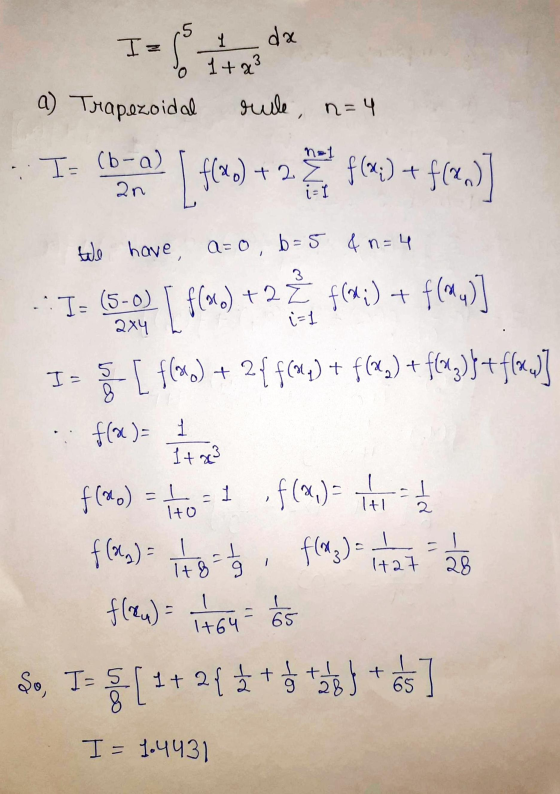
4. For: 1 + x3 dx a) Evaluate I using the trapezoidal rule with n= 4....
3. Evaluate the triple integral below (a) analytically, (b) using the composite trapezoidal rule ...
 3. Evaluate the triple integral below (a) analytically, (b) using the composite trapezoidal rule with n 2, (c) a single application of Simpson's 1/3 rule, and (d) for each approximation, determine the true percent relative error based on (a). 2yz)dx dy dz
3. Evaluate the triple integral below (a) analytically, (b) using the composite trapezoidal rule with n 2, (c) a single application of Simpson's 1/3 rule, and (d) for each approximation, determine the true percent relative error based on...
3. Evaluate the triple integral below (a) analytically, (b) using the composite trapezoidal rule with n 2, (c) a single application of Simpson's 1/3 rule, and (d) for each approximation, determine the true percent relative error based on (a). 2yz)dx dy dz
3. Evaluate the triple integral below (a) analytically, (b) using the composite trapezoidal rule with n 2, (c) a single application of Simpson's 1/3 rule, and (d) for each approximation, determine the true percent relative error based on...
(10 marks) Evaluate the integral [*r'e ce-dx; 1. Using Composite Trapezoidal rule with (n=4) 2. Estimate...
 (10 marks) Evaluate the integral [*r'e ce-dx; 1. Using Composite Trapezoidal rule with (n=4) 2. Estimate the error for the approximation in (a) 3. Using Composite 1/3 Simpson's Rule (n = 4).
2- Evaluate the following integral: 0.4 | Vcos(2x)dx a) By calculator, b) Composite trapezoidal rule (with...
 2- Evaluate the following integral: 0.4 | Vcos(2x)dx a) By calculator, b) Composite trapezoidal rule (with segment no. n=4) and determine the true relative error, c) Composite Simpson's 1/3 with n =4 and determine the true relative error, d) Simpson's 3/8 rule determine the true relative error, e) Composite Simpson's rule, with n =5, determine the true relative error.
2 Problem 3 (25 points) Let I = ïrdz. a) [by hand] Use a composite trapezoidal rule to evaluate 1 using N = 3 subintervals. b) MATLAB] Use a composite trapezoidal rule to evaluate I using N - 6 subin...
 2 Problem 3 (25 points) Let I = ïrdz. a) [by hand] Use a composite trapezoidal rule to evaluate 1 using N = 3 subintervals. b) MATLAB] Use a composite trapezoidal rule to evaluate I using N - 6 subinterval:s c) by hand] Use Romberg extrapolation to combine your results from a) and b) and obtain an improved approximation (you may want to compare with a numerical approximation of the exact value of the integral
2 Problem 3 (25 points)...
2 Problem 3 (25 points) Let I = ïrdz. a) [by hand] Use a composite trapezoidal rule to evaluate 1 using N = 3 subintervals. b) MATLAB] Use a composite trapezoidal rule to evaluate I using N - 6 subinterval:s c) by hand] Use Romberg extrapolation to combine your results from a) and b) and obtain an improved approximation (you may want to compare with a numerical approximation of the exact value of the integral
2 Problem 3 (25 points)...
Compare the formula for mutiple trapezoidal rule n=3 versus the addition of 3 single trapezoidal rule...
Compare the formula for mutiple trapezoidal rule n=3 versus the addition of 3 single trapezoidal rule for the same problem. Compare the answer, will it be the same and why? single trapezoidal rule : Multiple trapezoidal rule : EXAMPLE: f(x)=0.2+25x-200x2+675x3-900x4+400x5 a=0 b=0.8 Fа) + f(6) 1- (6 — а) Га) 2 f(x)) f(x,) I (b-a)o) + (2 2n Fа) + f(6) 1- (6 — а) Га) 2 f(x)) f(x,) I (b-a)o) + (2 2n
Let x In I dx. a) Find the exact value of 1 b) Use composite trapezoidal...
 Let x In I dx. a) Find the exact value of 1 b) Use composite trapezoidal rule with n = 4 subintervals to approximatel. Calculate the exact error c) Use composite simpson's rule with n = 4 subintervals to approximatel. Calculate the d) Use composite simpson's rule with n = 6 subintervals to approximate I. Calculate the exact error exact error
3. Evaluate the following double integral (a) analytically. (b) using multiple-application of the...
 3. Evaluate the following double integral (a) analytically. (b) using multiple-application of the trapezoidal rule with n 2 and compute the true relative error. (c) using single application of Simpson's 1/3 rule and compute the true relative erro.
3. Evaluate the following double integral (a) analytically. (b) using multiple-application of the trapezoidal rule with n 2 and compute the true relative error. (c) using single application of Simpson's 1/3 rule and compute the true relative erro.
3. Evaluate the following double integral (a) analytically. (b) using multiple-application of the trapezoidal rule with n 2 and compute the true relative error. (c) using single application of Simpson's 1/3 rule and compute the true relative erro.
4) (25 pts) Evaluate the integral d: +5 Using the following methods: a) Analytically b) Trapezoidal...
 4) (25 pts) Evaluate the integral d: +5 Using the following methods: a) Analytically b) Trapezoidal rule. Divide the whole interval into four subintervals (n 4) c) Simpson's 1/3 rule. Divide the whole interval into four subintervals (n 4). d) Simpson's 3/8 rule. Divide the whole interval into three subintervals (n 3) Compare the results in b), c), and d) with the true value obtained in a).
4) (25 pts) Evaluate the integral d: +5 Using the following methods: a)...
4) (25 pts) Evaluate the integral d: +5 Using the following methods: a) Analytically b) Trapezoidal rule. Divide the whole interval into four subintervals (n 4) c) Simpson's 1/3 rule. Divide the whole interval into four subintervals (n 4). d) Simpson's 3/8 rule. Divide the whole interval into three subintervals (n 3) Compare the results in b), c), and d) with the true value obtained in a).
4) (25 pts) Evaluate the integral d: +5 Using the following methods: a)...
Show work by hand and also using MATLAB code. Model 1 Given a polynomial f(x) Write a first-order approximation of f(x), given the value of f(x) at two points Plot the polynomial and the first-or...
 Show work by hand and also using MATLAB code.
Model 1 Given a polynomial f(x) Write a first-order approximation of f(x), given the value of f(x) at two points Plot the polynomial and the first-order approximation on a graph Write a second-order approximation of f(x), given the value at three points. Plot the polynomial, the first-order and second-order approximations on a graph Find the integral Exactly Using trapezoidal rule Using composite trapezoidal rule Using Simpson's 1/3 rule . Calculate the...
Show work by hand and also using MATLAB code.
Model 1 Given a polynomial f(x) Write a first-order approximation of f(x), given the value of f(x) at two points Plot the polynomial and the first-order approximation on a graph Write a second-order approximation of f(x), given the value at three points. Plot the polynomial, the first-order and second-order approximations on a graph Find the integral Exactly Using trapezoidal rule Using composite trapezoidal rule Using Simpson's 1/3 rule . Calculate the...
Evaluate the integral integral_0 15^2x dx analytically, using the Trapezoidal Rule (1-segment), and Simpson's 1/3 Rule...
 Evaluate the integral integral_0 15^2x dx analytically, using the Trapezoidal Rule (1-segment), and Simpson's 1/3 Rule (1-segment). Then use the Matlab trap() function presented in class to find a solution exact to 4 decimal places. How many segments were required for this accuracy?
 3. Evaluate the triple integral below (a) analytically, (b) using the composite trapezoidal rule with n 2, (c) a single application of Simpson's 1/3 rule, and (d) for each approximation, determine the true percent relative error based on (a). 2yz)dx dy dz
3. Evaluate the triple integral below (a) analytically, (b) using the composite trapezoidal rule with n 2, (c) a single application of Simpson's 1/3 rule, and (d) for each approximation, determine the true percent relative error based on...
3. Evaluate the triple integral below (a) analytically, (b) using the composite trapezoidal rule with n 2, (c) a single application of Simpson's 1/3 rule, and (d) for each approximation, determine the true percent relative error based on (a). 2yz)dx dy dz
3. Evaluate the triple integral below (a) analytically, (b) using the composite trapezoidal rule with n 2, (c) a single application of Simpson's 1/3 rule, and (d) for each approximation, determine the true percent relative error based on...
 (10 marks) Evaluate the integral [*r'e ce-dx; 1. Using Composite Trapezoidal rule with (n=4) 2. Estimate the error for the approximation in (a) 3. Using Composite 1/3 Simpson's Rule (n = 4).
 2- Evaluate the following integral: 0.4 | Vcos(2x)dx a) By calculator, b) Composite trapezoidal rule (with segment no. n=4) and determine the true relative error, c) Composite Simpson's 1/3 with n =4 and determine the true relative error, d) Simpson's 3/8 rule determine the true relative error, e) Composite Simpson's rule, with n =5, determine the true relative error.
 2 Problem 3 (25 points) Let I = ïrdz. a) [by hand] Use a composite trapezoidal rule to evaluate 1 using N = 3 subintervals. b) MATLAB] Use a composite trapezoidal rule to evaluate I using N - 6 subinterval:s c) by hand] Use Romberg extrapolation to combine your results from a) and b) and obtain an improved approximation (you may want to compare with a numerical approximation of the exact value of the integral
2 Problem 3 (25 points)...
2 Problem 3 (25 points) Let I = ïrdz. a) [by hand] Use a composite trapezoidal rule to evaluate 1 using N = 3 subintervals. b) MATLAB] Use a composite trapezoidal rule to evaluate I using N - 6 subinterval:s c) by hand] Use Romberg extrapolation to combine your results from a) and b) and obtain an improved approximation (you may want to compare with a numerical approximation of the exact value of the integral
2 Problem 3 (25 points)...
 Let x In I dx. a) Find the exact value of 1 b) Use composite trapezoidal rule with n = 4 subintervals to approximatel. Calculate the exact error c) Use composite simpson's rule with n = 4 subintervals to approximatel. Calculate the d) Use composite simpson's rule with n = 6 subintervals to approximate I. Calculate the exact error exact error
 3. Evaluate the following double integral (a) analytically. (b) using multiple-application of the trapezoidal rule with n 2 and compute the true relative error. (c) using single application of Simpson's 1/3 rule and compute the true relative erro.
3. Evaluate the following double integral (a) analytically. (b) using multiple-application of the trapezoidal rule with n 2 and compute the true relative error. (c) using single application of Simpson's 1/3 rule and compute the true relative erro.
3. Evaluate the following double integral (a) analytically. (b) using multiple-application of the trapezoidal rule with n 2 and compute the true relative error. (c) using single application of Simpson's 1/3 rule and compute the true relative erro.
 4) (25 pts) Evaluate the integral d: +5 Using the following methods: a) Analytically b) Trapezoidal rule. Divide the whole interval into four subintervals (n 4) c) Simpson's 1/3 rule. Divide the whole interval into four subintervals (n 4). d) Simpson's 3/8 rule. Divide the whole interval into three subintervals (n 3) Compare the results in b), c), and d) with the true value obtained in a).
4) (25 pts) Evaluate the integral d: +5 Using the following methods: a)...
4) (25 pts) Evaluate the integral d: +5 Using the following methods: a) Analytically b) Trapezoidal rule. Divide the whole interval into four subintervals (n 4) c) Simpson's 1/3 rule. Divide the whole interval into four subintervals (n 4). d) Simpson's 3/8 rule. Divide the whole interval into three subintervals (n 3) Compare the results in b), c), and d) with the true value obtained in a).
4) (25 pts) Evaluate the integral d: +5 Using the following methods: a)...
 Show work by hand and also using MATLAB code.
Model 1 Given a polynomial f(x) Write a first-order approximation of f(x), given the value of f(x) at two points Plot the polynomial and the first-order approximation on a graph Write a second-order approximation of f(x), given the value at three points. Plot the polynomial, the first-order and second-order approximations on a graph Find the integral Exactly Using trapezoidal rule Using composite trapezoidal rule Using Simpson's 1/3 rule . Calculate the...
Show work by hand and also using MATLAB code.
Model 1 Given a polynomial f(x) Write a first-order approximation of f(x), given the value of f(x) at two points Plot the polynomial and the first-order approximation on a graph Write a second-order approximation of f(x), given the value at three points. Plot the polynomial, the first-order and second-order approximations on a graph Find the integral Exactly Using trapezoidal rule Using composite trapezoidal rule Using Simpson's 1/3 rule . Calculate the...
 Evaluate the integral integral_0 15^2x dx analytically, using the Trapezoidal Rule (1-segment), and Simpson's 1/3 Rule (1-segment). Then use the Matlab trap() function presented in class to find a solution exact to 4 decimal places. How many segments were required for this accuracy?
Most questions answered within 3 hours.
-
Where is the error in this code sequence?
String s1 = "Hello";
String s2 = "ello";...
asked 10 months ago -
Financial data for Joel de Paris, Inc., for last year
follow:
Joel de Paris, Inc.
Balance...
asked 10 months ago -
Consider this reaction:
Al2(SO4)3 (aq)+ BaCl3
(aq) Al2Cl6 (aq)- +
3BaSO4(s) . What is the...
asked 10 months ago -
Suppose that Savneet is considering increasing her
recent random sample from 20 car rentals to 40...
asked 10 months ago -
Trucks arrive at an unloading terminal at an average rate of 120
per hour.
Trucks arrive...
asked 10 months ago -
Why are methanol and ethanol completely soluble in water while
octanol is not very little soluble....
asked 10 months ago -
A facilities manager at a university reads in a research report
that the mean amount of...
asked 10 months ago -
When the CuSO4 is rehydrated by adding water to the anhydrous
compound, is this an endothermic...
asked 10 months ago -
A ray of sunlight is passing from diamond into crown glass; the
angle of incidence is...
asked 10 months ago -
A block of mass 0.249 kg is placed on top of a light, vertical
spring of...
asked 10 months ago -
how do the kidneys compensate in the presences of acidosis
a) trigger hyperventilate
b) reserve acid...
asked 10 months ago -
Question 501 pts
The rental rate of capital to the firm increases. Which of the
following...
asked 10 months ago