
Homework Answers
All subdivisions are solved below.
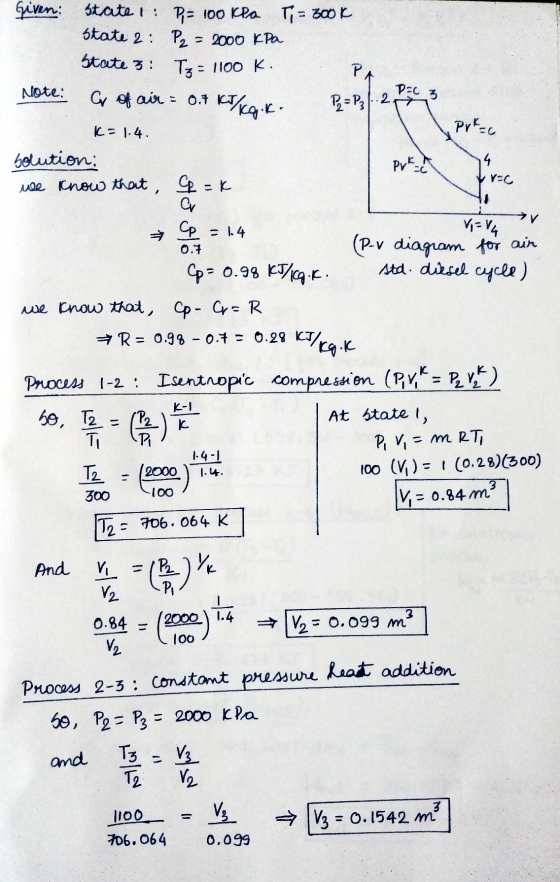
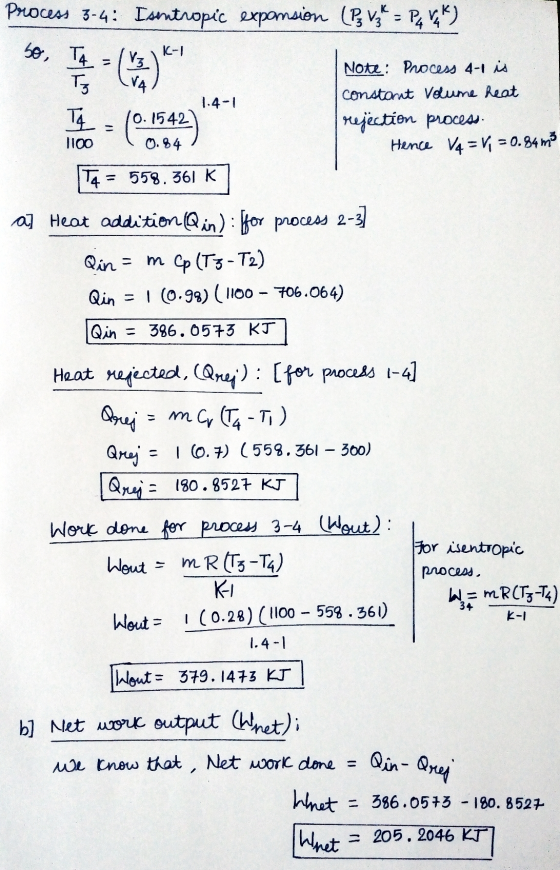
![c] Thormal efficiency (: Whet 205. 2046 n = Qin 386.0573 0.53154 = 53.154 % diesel cycle](http://img.homeworklib.com/questions/032f3cc0-f9c9-11ea-aeac-25b4d8c9042d.png?x-oss-process=image/resize,w_560)
Note:
- There will be no heat transfer in process 1-2 and 3-4, as they are reversible adiabatic process (isentropic process). Hence, the heat transfer values for process 1-2 and 3-4 are 0 KJ.
- There will be no work done in process 2-3 and 4-1, as they are purely heat addition and heat rejection process respectively. Hence, the work done values for process 2-3 and 4-1 are 0 KJ
Add Answer to:
7. The principal states in a cold air-standard Diesel cycle are given below. The mass of...
7. The principal states in a cold air-standard Diesel cycle are given below. The mass of...
 7. The principal states in a cold air-standard Diesel cycle are given below. The mass of air is 1 kg. The Cv of air is 0.7 kJ/kg.K and k=1.4. Determine: (a) the heat addition and work done in each process, in kJ. (b) the net work output, in kJ. (c) the thermal efficiency. State 1: p= 100 kPa: T = 300 K State 2: p = 2000 kPa State 3: T = 1100 K
7. The principal states in a cold air-standard Diesel cycle are given below. The mass of...
 7. The principal states in a cold air-standard Diesel cycle are given below. The mass of air is 1 kg. The Cv of air is 0.7 kJ/kg.K and k = 1.4. Determine: (a) the heat addition and work done in each process, in kJ. (b) the net work output, in kJ. (c) the thermal efficiency. State 1: p= 100 kPa; T = 300 K State 2: p = 2000 kPa State 3: T= 1100 K
7. The principal states in a cold air-standard Diesel cycle are given below. The mass of...
 7. The principal states in a cold air-standard Diesel cycle are given below. The mass of air is 1 kg. The Cv of air is 0.7 kJ/kg.K and k = 1.4. Determine: (a) the heat addition and work done in each process, in kJ. () the net work output, in kJ. (c) the thermal efficiency. State 1: p= 100 kPa; T = 300 K State 2: p = 2000 kPa State 3: T = 1100 K (35 points)
7. The principal states in a cold air-standard Diesel cycle are given below. The mass of...
 7. The principal states in a cold air-standard Diesel cycle are given below. The mass of air is 1 kg. The Cv of air is 0.7 kJ/kg.K and k=1.4. Determine: (a) the heat addition and work done in each process, in kJ. (b) the net work output, in kJ. (c) the thermal efficiency. State 1: p= 100 kPa; T = 300 K State 2: p= 2000 kPa State 3: T = 1100 K (35 points)
7. The principal states in a cold air-standard Diesel cycle are given below. The mass of...
 7. The principal states in a cold air-standard Diesel cycle are given below. The mass of air is 1 kg. The Cv of air is 0.7 kJ/kg.K and k=1.4. Determine: (a) the heat addition and work done in each process, in kJ. (b) the net work output, in kJ. (c) the thermal efficiency State 1: p= 100 kPa; T = 300 K State 2: p= 2000 kPa State 3: T = 1100 K (35 points)
7. The principal states in a cold air-standard Diesel cycle are given below. The mass of...
 7. The principal states in a cold air-standard Diesel cycle are given below. The mass of air is 1 kg. The Cv of air is 0.7 kJ/kg.K and k=1.4. Determine: (a) the heat addition and work done in each process, in kJ. (b) the net work output, in kJ. (c) the thermal efficiency. State 1: p= 100 kPa; T = 300 K State 2: p = 2000 kPa State 3: T= 1100 K (35 points)
7. The principal states in a cold air-standard Diesel cycle are given below. The mass of...
 7. The principal states in a cold air-standard Diesel cycle are given below. The mass of air is 1 kg. The Cv of air is 0.7 kJ/kg.K and k = 1.4. Determine: (a) the heat addition and work done in each process, in kJ. (b) the net work output, in kJ. (c) the thermal efficiency. State 1: p= 100 kPa; T = 300 K State 2: p= 2000 kPa State 3: T = 1100 K (35 points)
The principal states in a cold air-standard Diesel cycle are given below. The mass of air...
The principal states in a cold air-standard Diesel cycle are given below. The mass of air is 1 kg. The Cv of air is 0.7 kJ/kg.K and k = 1.4. Determine: (a) the heat addition and work done in each process, in kJ. (b) the net work output, in kJ. (c) the thermal efficiency. State 1: p = 100 kPa; T = 300 K State 2: p = 2000 kPa State 3: T = 1100 K
7. The principal states in a cold air-standard Diesel cycle are given below. The mass of...
 7. The principal states in a cold air-standard Diesel cycle are given below. The mass of air is 1 kg. The Cv of air is 0.7 kJ/kg.K and k = 1.4. Determine: (a) the heat addition and work done in each process, in kJ. (b) the net work output, in kl. (c) the thermal efficiency. State 1: p= 100 kPa; T = 300 K State 2: p= 2000 kPa State 3: T = 1100 K (35 points)
7. The principal states in a cold air-standard Diesel cycle are given below. The mass of...
 7. The principal states in a cold air-standard Diesel cycle are given below. The mass of air is 1 kg. The Cv of air is 0.7 kJ/kg.K and k = 1.4. Determine: (a) the heat addition and work done in each process, in kJ. (b) the net work output, in kl. (c) the thermal efficiency. State 1: p= 100 kPa; T = 300 K State 2: p= 2000 kPa State 3: T = 1100 K (35 points)
 7. The principal states in a cold air-standard Diesel cycle are given below. The mass of air is 1 kg. The Cv of air is 0.7 kJ/kg.K and k=1.4. Determine: (a) the heat addition and work done in each process, in kJ. (b) the net work output, in kJ. (c) the thermal efficiency. State 1: p= 100 kPa: T = 300 K State 2: p = 2000 kPa State 3: T = 1100 K
 7. The principal states in a cold air-standard Diesel cycle are given below. The mass of air is 1 kg. The Cv of air is 0.7 kJ/kg.K and k = 1.4. Determine: (a) the heat addition and work done in each process, in kJ. (b) the net work output, in kJ. (c) the thermal efficiency. State 1: p= 100 kPa; T = 300 K State 2: p = 2000 kPa State 3: T= 1100 K
 7. The principal states in a cold air-standard Diesel cycle are given below. The mass of air is 1 kg. The Cv of air is 0.7 kJ/kg.K and k = 1.4. Determine: (a) the heat addition and work done in each process, in kJ. () the net work output, in kJ. (c) the thermal efficiency. State 1: p= 100 kPa; T = 300 K State 2: p = 2000 kPa State 3: T = 1100 K (35 points)
 7. The principal states in a cold air-standard Diesel cycle are given below. The mass of air is 1 kg. The Cv of air is 0.7 kJ/kg.K and k=1.4. Determine: (a) the heat addition and work done in each process, in kJ. (b) the net work output, in kJ. (c) the thermal efficiency. State 1: p= 100 kPa; T = 300 K State 2: p= 2000 kPa State 3: T = 1100 K (35 points)
 7. The principal states in a cold air-standard Diesel cycle are given below. The mass of air is 1 kg. The Cv of air is 0.7 kJ/kg.K and k=1.4. Determine: (a) the heat addition and work done in each process, in kJ. (b) the net work output, in kJ. (c) the thermal efficiency State 1: p= 100 kPa; T = 300 K State 2: p= 2000 kPa State 3: T = 1100 K (35 points)
 7. The principal states in a cold air-standard Diesel cycle are given below. The mass of air is 1 kg. The Cv of air is 0.7 kJ/kg.K and k=1.4. Determine: (a) the heat addition and work done in each process, in kJ. (b) the net work output, in kJ. (c) the thermal efficiency. State 1: p= 100 kPa; T = 300 K State 2: p = 2000 kPa State 3: T= 1100 K (35 points)
 7. The principal states in a cold air-standard Diesel cycle are given below. The mass of air is 1 kg. The Cv of air is 0.7 kJ/kg.K and k = 1.4. Determine: (a) the heat addition and work done in each process, in kJ. (b) the net work output, in kJ. (c) the thermal efficiency. State 1: p= 100 kPa; T = 300 K State 2: p= 2000 kPa State 3: T = 1100 K (35 points)
 7. The principal states in a cold air-standard Diesel cycle are given below. The mass of air is 1 kg. The Cv of air is 0.7 kJ/kg.K and k = 1.4. Determine: (a) the heat addition and work done in each process, in kJ. (b) the net work output, in kl. (c) the thermal efficiency. State 1: p= 100 kPa; T = 300 K State 2: p= 2000 kPa State 3: T = 1100 K (35 points)
 7. The principal states in a cold air-standard Diesel cycle are given below. The mass of air is 1 kg. The Cv of air is 0.7 kJ/kg.K and k = 1.4. Determine: (a) the heat addition and work done in each process, in kJ. (b) the net work output, in kl. (c) the thermal efficiency. State 1: p= 100 kPa; T = 300 K State 2: p= 2000 kPa State 3: T = 1100 K (35 points)
Most questions answered within 3 hours.
-
Where is the error in this code sequence?
String s1 = "Hello";
String s2 = "ello";...
asked 11 months ago -
Financial data for Joel de Paris, Inc., for last year
follow:
Joel de Paris, Inc.
Balance...
asked 11 months ago -
Consider this reaction:
Al2(SO4)3 (aq)+ BaCl3
(aq) Al2Cl6 (aq)- +
3BaSO4(s) . What is the...
asked 11 months ago -
Suppose that Savneet is considering increasing her
recent random sample from 20 car rentals to 40...
asked 11 months ago -
Trucks arrive at an unloading terminal at an average rate of 120
per hour.
Trucks arrive...
asked 11 months ago -
Why are methanol and ethanol completely soluble in water while
octanol is not very little soluble....
asked 11 months ago -
A facilities manager at a university reads in a research report
that the mean amount of...
asked 11 months ago -
When the CuSO4 is rehydrated by adding water to the anhydrous
compound, is this an endothermic...
asked 11 months ago -
A ray of sunlight is passing from diamond into crown glass; the
angle of incidence is...
asked 11 months ago -
A block of mass 0.249 kg is placed on top of a light, vertical
spring of...
asked 11 months ago -
how do the kidneys compensate in the presences of acidosis
a) trigger hyperventilate
b) reserve acid...
asked 11 months ago -
Question 501 pts
The rental rate of capital to the firm increases. Which of the
following...
asked 11 months ago