
Homework Answers
Request Answer!
We need at least 10 more requests to produce the answer.
0 / 10 have requested this problem solution
The more requests, the faster the answer.
Add Answer to:
a) For the hydrogen atom, find the change in energy, AE in a transition of hydrogen...
Problem 1: (a) Find the wavelength of light emitted by a hydrogen atom for transition from...
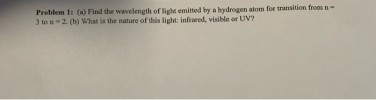 Problem 1: (a) Find the wavelength of light emitted by a hydrogen atom for transition from n = 3 to n - 2. (b) What is the nature of this light: infrared, visible or UV?
1. The energy of the electron in the lowest level of the hydrogen atom (n=1) is...
1. The energy of the electron in the lowest level of the hydrogen atom (n=1) is -2.179×10⁻¹⁸ J. What is the energy of the electron in level n=5? -8.716×10⁻²⁰ J (Answer is correct) 2. The electron in a hydrogen atom moves from level n=4 to level n=1. Is a photon emitted or absorbed? What is the wavelength of the photon? 3. An excited hydrogen atom emits a photon with a wavelength of 102.6 nm. In what region of the spectrum...
- White light spectrum – a. How does the spectrum of white light differ from the spectrum...
- White light spectrum – a. How does the spectrum of white light differ from the spectrum of hydrogen, neon and sodium? b. What color corresponds to 5.7 x 10⁻⁷ meters? _____________________________ - Hydrogen Emission Spectrum – There are several lines with colors and 3 lines which are white. The white lines are in the infrared region and not visible. a. Which line in the visible spectrum has the longest wavelength and lowest energy? ______________________ b. Figure 6.1 in the lab manual represents the Balmer...
Lyman & Balmer Lines a) Find the wavelength of the first Lyman line (Lya) in hydrogen...
Lyman & Balmer Lines a) Find the wavelength of the first Lyman line (Lya) in hydrogen of a transition between n = 2 and n = 1. In which region in the electromagnetic spectrum does this lie? b) Find the wavelength of light emitted when a hydrogen atom makes the transition from n = 6 to n = 2.
The Si- ion is stable with respect to the neutral atom and an electron. This is...
The Si- ion is stable with respect to the neutral atom and an electron. This is evident in the value of the electron affinity of silicon which is 133.6 kJ mol-1. What is the longest wavelength of light that could remove an electron from a Si- ion? In which region of the electromagnetic spectrum does this light fall? Wavelength = ? nm Region = ____?_____ultra violet/visible/infrared
A hydrogen atom bonded to a surface is acting as a harmonic oscillator with a classical...
 A hydrogen atom bonded to a surface is acting as a harmonic oscillator with a classical frequency of 6 x 10³ 1. GE=3.98x10-ROJ a. What is the energy difference in Joules between the different energy levels? b. Calculate the wavelength of light that must be absorbed in order for the hydrogen atom to go from one level to another. 2 = 5.00 *Loom C. Can you determine in what region of the electromagnetic spectrum such a wavelength belongs? IR
asap 6. (a) Calculate the difference in energy, AE, between the n=3 and n 2 energy...
 asap
6. (a) Calculate the difference in energy, AE, between the n=3 and n 2 energy levels in a Bohr hydrogen atom. I (b) Calculate the wavelength (in nm) of the light emitted when an electron drops from the n=3 to the n 2 energy level of a Bohr hydrogen atom. 7) Of the following transitions in the Bohr hydrogen atom, the results in the absorption of the highest-energy photon. A) n 1-n= 6 B) n-3n-6 C) n 1n=4 transition...
asap
6. (a) Calculate the difference in energy, AE, between the n=3 and n 2 energy levels in a Bohr hydrogen atom. I (b) Calculate the wavelength (in nm) of the light emitted when an electron drops from the n=3 to the n 2 energy level of a Bohr hydrogen atom. 7) Of the following transitions in the Bohr hydrogen atom, the results in the absorption of the highest-energy photon. A) n 1-n= 6 B) n-3n-6 C) n 1n=4 transition...
Please help with this chemistry lab question ATOMIC EMISSION SPECTROSCOPY ADVANCED STUDY ASSIGNMENT Name Section Date...
 Please help with this chemistry lab question
ATOMIC EMISSION SPECTROSCOPY ADVANCED STUDY ASSIGNMENT Name Section Date This assignment MUST be completed before the laboratory period begins. Wavelength values for the hydrogen emission spectrum are required for the experiment. A few answers have been provided for you. You may wish to verify some of these to ensure that your calculation methods and signifcant digits are correct. 1. Calculate energy values for the first SIX hydrogen energy levels usings En =-RH/n--(2.179 x10-18J/n2...
Please help with this chemistry lab question
ATOMIC EMISSION SPECTROSCOPY ADVANCED STUDY ASSIGNMENT Name Section Date This assignment MUST be completed before the laboratory period begins. Wavelength values for the hydrogen emission spectrum are required for the experiment. A few answers have been provided for you. You may wish to verify some of these to ensure that your calculation methods and signifcant digits are correct. 1. Calculate energy values for the first SIX hydrogen energy levels usings En =-RH/n--(2.179 x10-18J/n2...
Consider the transition from the energy levels n = 3 to n - 7. What is...
 Consider the transition from the energy levels n = 3 to n - 7. What is the wavelength associated with this transition, in nm? nm In what spectral region does this transition occur? this wavelength is in the ultraviolet this wavelength is in the visible this wavelength is in the infrared Is energy absorbed or released for this transition? O energy is absorbed O energy is released
Hydrogen atom electrons emit photos when the fall from higher energy levels to lower energ levels....
 Hydrogen atom electrons emit photos when the fall from higher energy levels to lower energ levels. For the n 4 1 transition, a) calculate the energy change, b) convert the energy to vavelength, and c) identify its place in the electromagnetic spectrum.
 Problem 1: (a) Find the wavelength of light emitted by a hydrogen atom for transition from n = 3 to n - 2. (b) What is the nature of this light: infrared, visible or UV?
 A hydrogen atom bonded to a surface is acting as a harmonic oscillator with a classical frequency of 6 x 10³ 1. GE=3.98x10-ROJ a. What is the energy difference in Joules between the different energy levels? b. Calculate the wavelength of light that must be absorbed in order for the hydrogen atom to go from one level to another. 2 = 5.00 *Loom C. Can you determine in what region of the electromagnetic spectrum such a wavelength belongs? IR
 asap
6. (a) Calculate the difference in energy, AE, between the n=3 and n 2 energy levels in a Bohr hydrogen atom. I (b) Calculate the wavelength (in nm) of the light emitted when an electron drops from the n=3 to the n 2 energy level of a Bohr hydrogen atom. 7) Of the following transitions in the Bohr hydrogen atom, the results in the absorption of the highest-energy photon. A) n 1-n= 6 B) n-3n-6 C) n 1n=4 transition...
asap
6. (a) Calculate the difference in energy, AE, between the n=3 and n 2 energy levels in a Bohr hydrogen atom. I (b) Calculate the wavelength (in nm) of the light emitted when an electron drops from the n=3 to the n 2 energy level of a Bohr hydrogen atom. 7) Of the following transitions in the Bohr hydrogen atom, the results in the absorption of the highest-energy photon. A) n 1-n= 6 B) n-3n-6 C) n 1n=4 transition...
 Please help with this chemistry lab question
ATOMIC EMISSION SPECTROSCOPY ADVANCED STUDY ASSIGNMENT Name Section Date This assignment MUST be completed before the laboratory period begins. Wavelength values for the hydrogen emission spectrum are required for the experiment. A few answers have been provided for you. You may wish to verify some of these to ensure that your calculation methods and signifcant digits are correct. 1. Calculate energy values for the first SIX hydrogen energy levels usings En =-RH/n--(2.179 x10-18J/n2...
Please help with this chemistry lab question
ATOMIC EMISSION SPECTROSCOPY ADVANCED STUDY ASSIGNMENT Name Section Date This assignment MUST be completed before the laboratory period begins. Wavelength values for the hydrogen emission spectrum are required for the experiment. A few answers have been provided for you. You may wish to verify some of these to ensure that your calculation methods and signifcant digits are correct. 1. Calculate energy values for the first SIX hydrogen energy levels usings En =-RH/n--(2.179 x10-18J/n2...
 Consider the transition from the energy levels n = 3 to n - 7. What is the wavelength associated with this transition, in nm? nm In what spectral region does this transition occur? this wavelength is in the ultraviolet this wavelength is in the visible this wavelength is in the infrared Is energy absorbed or released for this transition? O energy is absorbed O energy is released
 Hydrogen atom electrons emit photos when the fall from higher energy levels to lower energ levels. For the n 4 1 transition, a) calculate the energy change, b) convert the energy to vavelength, and c) identify its place in the electromagnetic spectrum.
Most questions answered within 3 hours.
-
Where is the error in this code sequence?
String s1 = "Hello";
String s2 = "ello";...
asked 11 months ago -
Financial data for Joel de Paris, Inc., for last year
follow:
Joel de Paris, Inc.
Balance...
asked 11 months ago -
Consider this reaction:
Al2(SO4)3 (aq)+ BaCl3
(aq) Al2Cl6 (aq)- +
3BaSO4(s) . What is the...
asked 11 months ago -
Suppose that Savneet is considering increasing her
recent random sample from 20 car rentals to 40...
asked 11 months ago -
Trucks arrive at an unloading terminal at an average rate of 120
per hour.
Trucks arrive...
asked 11 months ago -
Why are methanol and ethanol completely soluble in water while
octanol is not very little soluble....
asked 11 months ago -
A facilities manager at a university reads in a research report
that the mean amount of...
asked 11 months ago -
When the CuSO4 is rehydrated by adding water to the anhydrous
compound, is this an endothermic...
asked 11 months ago -
A ray of sunlight is passing from diamond into crown glass; the
angle of incidence is...
asked 11 months ago -
A block of mass 0.249 kg is placed on top of a light, vertical
spring of...
asked 11 months ago -
how do the kidneys compensate in the presences of acidosis
a) trigger hyperventilate
b) reserve acid...
asked 11 months ago -
Question 501 pts
The rental rate of capital to the firm increases. Which of the
following...
asked 11 months ago