
Homework Answers
Add Answer to:
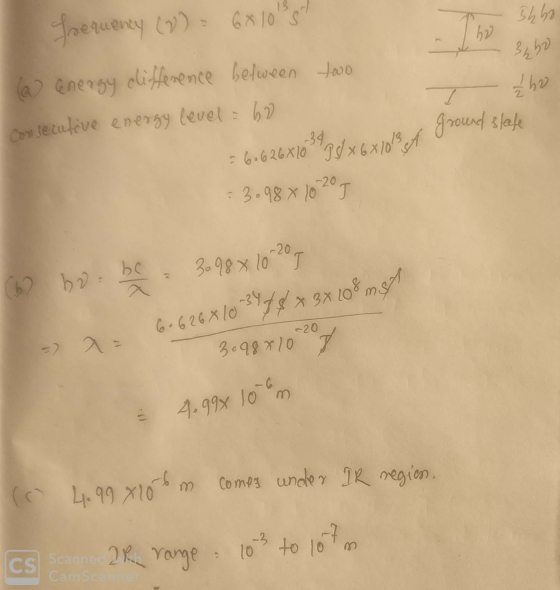
A hydrogen atom bonded to a surface is acting as a harmonic oscillator with a classical...
Hydrogen molecule bonded to a surface is acting as a quantized harmonic oscillator with a force...
Hydrogen molecule bonded to a surface is acting as a quantized harmonic oscillator with a force constant of 300 Nm^-1. a) What is the second to the lowest possible vibrational energy of this system? b) What is the wavefunction of the photon whose energy matches the difference between these two energy levels?
2. (10 pts) Hydrogen molecule bonded to a surface is acting as a quantized harmonic oscillator...
 2. (10 pts) Hydrogen molecule bonded to a surface is acting as a quantized harmonic oscillator with a force constant of 300 Nm! What is the wavefunction of the photon whose energy matches the difference between these two energy levels? (10 pts=5 points for correct work shown, 2 points for the correct units, and 3 points for correct answer)
a) For the hydrogen atom, find the change in energy, AE in a transition of hydrogen...
 a) For the hydrogen atom, find the change in energy, AE in a transition of hydrogen between the n=7 and n=1 energy levels. b) What is the wavelength of light that corresponds to this energy? c) Is it within the visible, infrared or ultra-violet region of the electromagnetic spectrum?
Find the frequency of revolution of the electron in the classical model of the hydrogen atom....
 Find the frequency of revolution of the electron in the classical model of the hydrogen atom. In what region of the spectrum are electromagnetic waves of this frequency?
3. The quantum harmonic oscillator is the quantum-mechanical analog of the classical harmonic oscillator. Because an...
 3. The quantum harmonic oscillator is the quantum-mechanical analog of the classical harmonic oscillator. Because an arbitrary potential can usually be approximated as a harmonic potential at the vicinity of a stable equilibrium point, it is one of the most important model systems in quantum mechanics. Consider an electron trapped by a one-dimensional harmonic potential V(x)=-5 mo?x” (where m is the electron mass, o is a constant angular frequency). In this case, the Schrödinger equation takes the following form, **...
Question no 6.1, statistical physics by Reif Volume 5 Problems 6.1 Phase space of a classical harmonic oscillator The en...
 Question no 6.1,
statistical physics by Reif Volume 5
Problems 6.1 Phase space of a classical harmonic oscillator The energy of a one-dimensional harmonic oscillator, whose position coordinate is x and whose momentum is p, is given by where the first term on the right is its kinetic and the second term its potential energy. Here m denotes the mass of the osellating particle and a the spring constant of the restoring force acting on the particle. Consider an ensemble...
Question no 6.1,
statistical physics by Reif Volume 5
Problems 6.1 Phase space of a classical harmonic oscillator The energy of a one-dimensional harmonic oscillator, whose position coordinate is x and whose momentum is p, is given by where the first term on the right is its kinetic and the second term its potential energy. Here m denotes the mass of the osellating particle and a the spring constant of the restoring force acting on the particle. Consider an ensemble...
What is the highest energy photon that can be absorbed by a ground state hydrogen atom...
 What is the highest energy photon that can be absorbed by a ground state hydrogen atom Without causing ionization? What is the wavelength of this radiation? What part of the electromagnetic spectrum does this photon belong?
The hydrogen atom can absorb light of wavelength 1094nm. (a) In what region of the electromagnetic...
The hydrogen atom can absorb light of wavelength 1094nm. (a) In what region of the electromagnetic spectrum is this absorption found? (b) Determine the initial and final values of n associated with this absorption.
(10 pts) The two calculations below pertain to the quantum harmonic oscillator (qho). Relevant expressions for...
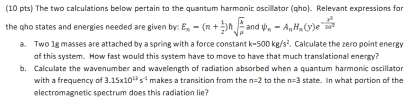 (10 pts) The two calculations below pertain to the quantum harmonic oscillator (qho). Relevant expressions for the qho states and energies needed are given by: En-(n +-)ћ1_ and n-AnHn(ye- Two 1g masses are attached by a spring with a force constant k-500 kg/s2. Calculate the zero point energy of this system. How fast would this system have to move to have that much translational energy? a. b. Calculate the wavenumber and wavelength of radiation absorbed when a quantum harmonic oscillator...
When an electron of an excited hydrogen atom descends, from an initial energy level (ni) to...
When an electron of an excited hydrogen atom descends, from an initial energy level (ni) to a lower (nf), characteristic electromagnetic radiation is emitted. The Bohr model of the H-atom allows the calculation of ?E for any pair of energy levels. ?E is related to the wavelength (?) of the radiation according to Einstein's equation ( ?E = [(hc)/?]). Distinct series of spectral lines have been classified according to nf: Lyman series:nf=1 (91<?<123 nm; near-UV). Balmer series:nf=2 (365<?<658 nm; visible)....
 2. (10 pts) Hydrogen molecule bonded to a surface is acting as a quantized harmonic oscillator with a force constant of 300 Nm! What is the wavefunction of the photon whose energy matches the difference between these two energy levels? (10 pts=5 points for correct work shown, 2 points for the correct units, and 3 points for correct answer)
 a) For the hydrogen atom, find the change in energy, AE in a transition of hydrogen between the n=7 and n=1 energy levels. b) What is the wavelength of light that corresponds to this energy? c) Is it within the visible, infrared or ultra-violet region of the electromagnetic spectrum?
 Find the frequency of revolution of the electron in the classical model of the hydrogen atom. In what region of the spectrum are electromagnetic waves of this frequency?
 3. The quantum harmonic oscillator is the quantum-mechanical analog of the classical harmonic oscillator. Because an arbitrary potential can usually be approximated as a harmonic potential at the vicinity of a stable equilibrium point, it is one of the most important model systems in quantum mechanics. Consider an electron trapped by a one-dimensional harmonic potential V(x)=-5 mo?x” (where m is the electron mass, o is a constant angular frequency). In this case, the Schrödinger equation takes the following form, **...
 Question no 6.1,
statistical physics by Reif Volume 5
Problems 6.1 Phase space of a classical harmonic oscillator The energy of a one-dimensional harmonic oscillator, whose position coordinate is x and whose momentum is p, is given by where the first term on the right is its kinetic and the second term its potential energy. Here m denotes the mass of the osellating particle and a the spring constant of the restoring force acting on the particle. Consider an ensemble...
Question no 6.1,
statistical physics by Reif Volume 5
Problems 6.1 Phase space of a classical harmonic oscillator The energy of a one-dimensional harmonic oscillator, whose position coordinate is x and whose momentum is p, is given by where the first term on the right is its kinetic and the second term its potential energy. Here m denotes the mass of the osellating particle and a the spring constant of the restoring force acting on the particle. Consider an ensemble...
 What is the highest energy photon that can be absorbed by a ground state hydrogen atom Without causing ionization? What is the wavelength of this radiation? What part of the electromagnetic spectrum does this photon belong?
 (10 pts) The two calculations below pertain to the quantum harmonic oscillator (qho). Relevant expressions for the qho states and energies needed are given by: En-(n +-)ћ1_ and n-AnHn(ye- Two 1g masses are attached by a spring with a force constant k-500 kg/s2. Calculate the zero point energy of this system. How fast would this system have to move to have that much translational energy? a. b. Calculate the wavenumber and wavelength of radiation absorbed when a quantum harmonic oscillator...
Most questions answered within 3 hours.
-
Where is the error in this code sequence?
String s1 = "Hello";
String s2 = "ello";...
asked 10 months ago -
Financial data for Joel de Paris, Inc., for last year
follow:
Joel de Paris, Inc.
Balance...
asked 10 months ago -
Consider this reaction:
Al2(SO4)3 (aq)+ BaCl3
(aq) Al2Cl6 (aq)- +
3BaSO4(s) . What is the...
asked 10 months ago -
Suppose that Savneet is considering increasing her
recent random sample from 20 car rentals to 40...
asked 10 months ago -
Trucks arrive at an unloading terminal at an average rate of 120
per hour.
Trucks arrive...
asked 10 months ago -
Why are methanol and ethanol completely soluble in water while
octanol is not very little soluble....
asked 10 months ago -
A facilities manager at a university reads in a research report
that the mean amount of...
asked 10 months ago -
When the CuSO4 is rehydrated by adding water to the anhydrous
compound, is this an endothermic...
asked 10 months ago -
A ray of sunlight is passing from diamond into crown glass; the
angle of incidence is...
asked 10 months ago -
A block of mass 0.249 kg is placed on top of a light, vertical
spring of...
asked 10 months ago -
how do the kidneys compensate in the presences of acidosis
a) trigger hyperventilate
b) reserve acid...
asked 10 months ago -
Question 501 pts
The rental rate of capital to the firm increases. Which of the
following...
asked 10 months ago