Ha Li Berries, a US-based Chinese agricultural company, has a pre-tax cost of long-term debt of...
Homework Answers
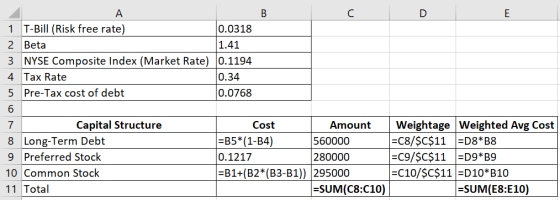
1) Cost of Equity = Risk Free Rate + [Beta * (Market Return -
Risk free Rate)]
= 3.18% * [1.41 * (11.94% - 3.18%)]
Cost of Equity = 0.155316 or 15.5316%
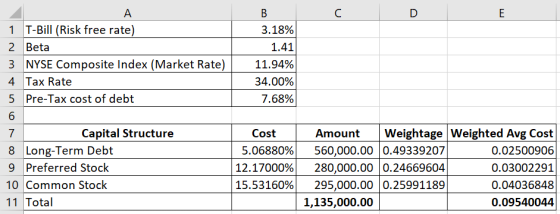
2) Weighted Average Cost of Capital = (Weightage of Debt *
Post-tax cost of debt) + (Weightage of equity * Cost of Equity) +
(Weightage of Preferred stock * Cost of preferred stock)
Weighted Average Cost of Capital = 0.09540044 or
9.54%
Add Answer to:
Ha
Li Berries, a US-based Chinese agricultural company, has a pre-tax
cost of long-term debt of...
A company has the option of offering long-term debt with an interest cost of 12.0%, or...
A company has the option of offering long-term debt with an interest cost of 12.0%, or preferred shares with an interest cost of 10.5%. Assume the corporate tax rate is 21%. Compare the before-tax and after-tax cost of both the long-term debt and the preferred shares. Which is less expensive in each case (before-tax and after-tax)? Justify your answer.
A firm has determined its target capital structure and it after-tax cost for each source of...
 A firm has determined its target capital structure and it after-tax cost for each source of capital. What is the firm's weighted average cost of capital (WACC)? (Enter your answers as a percentge rounded to 2 decimal places) Cost 49 Source of Capital Long-term Debt (after taxes) Preferred Stock Common Stock Proportion 30% 10% 60% 10% 16% Your Answer: Answer Hide hint for Question 11 Weight average cost of capital= weight of long-term debt cost of debt(after tax)+weight of preferred...
a. The after-tax cost of debt using the bond's yield to maturity (YTM) is The after-tax...
 a. The after-tax cost of debt using the bond's yield to
maturity (YTM) is
The after-tax cost of debt using the approximation formula
is
b. The cost of preferred stock is
c. The cost of retained earnings is
The cost of new common stock is
d. Using the cost of retained earnings, the firm's WACC
is
Using the cost of new common stock, the firm's WACC is
X P9-17 (similar to) Question Help Calculation of individual costs and WACC Dillon...
a. The after-tax cost of debt using the bond's yield to
maturity (YTM) is
The after-tax cost of debt using the approximation formula
is
b. The cost of preferred stock is
c. The cost of retained earnings is
The cost of new common stock is
d. Using the cost of retained earnings, the firm's WACC
is
Using the cost of new common stock, the firm's WACC is
X P9-17 (similar to) Question Help Calculation of individual costs and WACC Dillon...
A firm has determined its target capital structure and it after-tax cost for each source of...
 A firm has determined its target capital structure and it after-tax cost for each source of capital. What is the firm's weighted average cost of capital (WACC)? (Enter your answers as a percentge rounded to 2 decimal places) Cost Proportion 30% Source of Capital Long-term Debt (after taxes) Preferred Stock Common Stock 6096 Your Answer: Answer
Dickinson Company has $12,140,000 million in assets. Currently half of these assets are financed with long-term debt at...
 Dickinson Company has $12,140,000 million in assets. Currently half of these assets are financed with long-term debt at 10.7 percent and half with common stock having a par value of $8. Ms. Smith, Vice President of Finance, wishes to analyze two refinancing plans one with more debt (D) and one with more equity (E). The company earns a return on assets before interest and taxes of 10.7 percent. The tax rate is 40 percent. Tax loss carryover provisions apply, so...
A company's balance sheets show a total of $ 29 million long-term debt with a coupon...
A company's balance sheets show a total of $ 29 million long-term debt with a coupon rate of 10 percent. The yield to maturity on this debt is 9.61 percent, and the debt has a total current market value of $ 34 million. The balance sheets also show that that the company has 10 million shares of stock; the total of common stock and retained earnings is $30 million. The current stock price is $7.5 per share. The current return...
Dickinson Company has $11,940,000 million in assets. Currently half of these assets are financed with long-term...
 Dickinson Company has $11,940,000 million in assets. Currently half of these assets are financed with long-term debt at 9.7 percent and half with common stock having a par value of $8. Ms. Smith, Vice President of Finance, wishes to analyze two refinancing plans, one with more debt (D) and one with more equity (E). The company earns a return on assets before interest and taxes of 9.7 percent. The tax rate is 40 percent. Tax loss carryover provisions apply, so...
Question 6 (1 point) A firm has determined its target capital structure and it after-tax cost...
 Question 6 (1 point) A firm has determined its target capital structure and it after-tax cost for each source of capital. What is the firm's weighted average cost of capital (WACC) (Enter your answers as a percentge rounded to 2 decimal places) Proportion 30% Cost 38 Source of Capital Long-term Debt (after taxes) Preferred Stock Common Stock 109 60% Your Answer: Answer
Question 7 (1 point) A firm has determined its target capital structure and it after-tax cost...
 Question 7 (1 point) A firm has determined its target capital structure and it after-tax cost for each source of capital. What is the firm's weighted average cost of capital (WACC)? (Enter your answers as a percentge rounded to 2 decimal places) Source of Capital Proportion Cost Long-term Debt (after taxes) 30% 3% Preferred Stock 10% 9% Common Stock 60% 14% Your Answer: Answer Page 2 of 3 Next Page
Dickinson Company has $12,060,000 million in assets. Currently half of these assets are financed with long-term...
Dickinson Company has $12,060,000 million in assets. Currently half of these assets are financed with long-term debt at 10.3 percent and half with common stock having a par value of $8. Ms. Smith, Vice President of Finance, wishes to analyze two refinancing plans, one with more debt (D) and one with more equity (E). The company earns a return on assets before interest and taxes of 10.3 percent. The tax rate is 40 percent. Tax loss carryover provisions apply, so...
 A firm has determined its target capital structure and it after-tax cost for each source of capital. What is the firm's weighted average cost of capital (WACC)? (Enter your answers as a percentge rounded to 2 decimal places) Cost 49 Source of Capital Long-term Debt (after taxes) Preferred Stock Common Stock Proportion 30% 10% 60% 10% 16% Your Answer: Answer Hide hint for Question 11 Weight average cost of capital= weight of long-term debt cost of debt(after tax)+weight of preferred...
 a. The after-tax cost of debt using the bond's yield to
maturity (YTM) is
The after-tax cost of debt using the approximation formula
is
b. The cost of preferred stock is
c. The cost of retained earnings is
The cost of new common stock is
d. Using the cost of retained earnings, the firm's WACC
is
Using the cost of new common stock, the firm's WACC is
X P9-17 (similar to) Question Help Calculation of individual costs and WACC Dillon...
a. The after-tax cost of debt using the bond's yield to
maturity (YTM) is
The after-tax cost of debt using the approximation formula
is
b. The cost of preferred stock is
c. The cost of retained earnings is
The cost of new common stock is
d. Using the cost of retained earnings, the firm's WACC
is
Using the cost of new common stock, the firm's WACC is
X P9-17 (similar to) Question Help Calculation of individual costs and WACC Dillon...
 A firm has determined its target capital structure and it after-tax cost for each source of capital. What is the firm's weighted average cost of capital (WACC)? (Enter your answers as a percentge rounded to 2 decimal places) Cost Proportion 30% Source of Capital Long-term Debt (after taxes) Preferred Stock Common Stock 6096 Your Answer: Answer
 Dickinson Company has $12,140,000 million in assets. Currently half of these assets are financed with long-term debt at 10.7 percent and half with common stock having a par value of $8. Ms. Smith, Vice President of Finance, wishes to analyze two refinancing plans one with more debt (D) and one with more equity (E). The company earns a return on assets before interest and taxes of 10.7 percent. The tax rate is 40 percent. Tax loss carryover provisions apply, so...
 Dickinson Company has $11,940,000 million in assets. Currently half of these assets are financed with long-term debt at 9.7 percent and half with common stock having a par value of $8. Ms. Smith, Vice President of Finance, wishes to analyze two refinancing plans, one with more debt (D) and one with more equity (E). The company earns a return on assets before interest and taxes of 9.7 percent. The tax rate is 40 percent. Tax loss carryover provisions apply, so...
 Question 6 (1 point) A firm has determined its target capital structure and it after-tax cost for each source of capital. What is the firm's weighted average cost of capital (WACC) (Enter your answers as a percentge rounded to 2 decimal places) Proportion 30% Cost 38 Source of Capital Long-term Debt (after taxes) Preferred Stock Common Stock 109 60% Your Answer: Answer
 Question 7 (1 point) A firm has determined its target capital structure and it after-tax cost for each source of capital. What is the firm's weighted average cost of capital (WACC)? (Enter your answers as a percentge rounded to 2 decimal places) Source of Capital Proportion Cost Long-term Debt (after taxes) 30% 3% Preferred Stock 10% 9% Common Stock 60% 14% Your Answer: Answer Page 2 of 3 Next Page
Most questions answered within 3 hours.
-
Where is the error in this code sequence?
String s1 = "Hello";
String s2 = "ello";...
asked 10 months ago -
Financial data for Joel de Paris, Inc., for last year
follow:
Joel de Paris, Inc.
Balance...
asked 10 months ago -
Consider this reaction:
Al2(SO4)3 (aq)+ BaCl3
(aq) Al2Cl6 (aq)- +
3BaSO4(s) . What is the...
asked 10 months ago -
Suppose that Savneet is considering increasing her
recent random sample from 20 car rentals to 40...
asked 10 months ago -
Trucks arrive at an unloading terminal at an average rate of 120
per hour.
Trucks arrive...
asked 10 months ago -
Why are methanol and ethanol completely soluble in water while
octanol is not very little soluble....
asked 10 months ago -
A facilities manager at a university reads in a research report
that the mean amount of...
asked 10 months ago -
When the CuSO4 is rehydrated by adding water to the anhydrous
compound, is this an endothermic...
asked 10 months ago -
A ray of sunlight is passing from diamond into crown glass; the
angle of incidence is...
asked 10 months ago -
A block of mass 0.249 kg is placed on top of a light, vertical
spring of...
asked 10 months ago -
how do the kidneys compensate in the presences of acidosis
a) trigger hyperventilate
b) reserve acid...
asked 10 months ago -
Question 501 pts
The rental rate of capital to the firm increases. Which of the
following...
asked 10 months ago