
Homework Answers
Request Answer!
We need at least 10 more requests to produce the answer.
0 / 10 have requested this problem solution
The more requests, the faster the answer.
Add Answer to:
In the figure, determine the character of the collision. The masses of the blocks, and the...
.In the figure, determine the character of the collision. The masses of the blocks, and the...
 .In the figure, determine the character of the collision. The masses of the blocks, and the velocities efore and after are given. The collision is (Show your work - no work shown-ZERO POINTS) 1.8 m/s 0.2 m/s 0.6 m/s 1.4 m/s 4 kg 6 kg 4 kg 6 kg Before After A) perfectly elastic. artially inelastic. etely inelastic. 72-12 characterized by an increase-in kinetic energy E) not possible because momentum is not conserved.
Please answer all the questions if possible :) thank you 11- CONSERVATION OF UNEAR MOMENTUM IN...
 Please answer all the questions if possible :) thank
you
11- CONSERVATION OF UNEAR MOMENTUM IN 2-D Q1)(4) Performing this experiment, you get the following data: Mass of balls 30 g each Before collision: Speed of ball A 5.00 /s After collision: Ball A going at 3.0 m/s at 30 Calculate the speed at which ball B is going. Ball B is stationary. a) 2.40 m/s b) 1.50 m/s c) 2.83 m/s d) 2.05 m/s (1+1+1+1) Circle the correct answers:...
Please answer all the questions if possible :) thank
you
11- CONSERVATION OF UNEAR MOMENTUM IN 2-D Q1)(4) Performing this experiment, you get the following data: Mass of balls 30 g each Before collision: Speed of ball A 5.00 /s After collision: Ball A going at 3.0 m/s at 30 Calculate the speed at which ball B is going. Ball B is stationary. a) 2.40 m/s b) 1.50 m/s c) 2.83 m/s d) 2.05 m/s (1+1+1+1) Circle the correct answers:...
Two masses (marbles, clay, or kittens, whichever) 18 kg and 29 kg collide while traveling toward...
Two masses (marbles, clay, or kittens, whichever) 18 kg and 29 kg collide while traveling toward each other at 6 m/s each. If collision were elastic, the total kinetic energy before and after the collision would be the same. Compare the total kinetic energy before and after the collision if it were completely inelastic instead. How much is lost?
A Two-Body Collision with a Spring A block of mass m,-1.9 kg initially moving to the...
 A Two-Body Collision with a Spring A block of mass m,-1.9 kg initially moving to the right with a speed of 3.2 m/s on a frictionless, horizontal track collides with a spring attached to a second block of mass m2 - 3.9 kg initially moving to the left with a speed of 1.8 m/s as shown in figure (a). The spring constant is 505 N/m in A moving block collides with another moving block with a spring attached: (a) before...
One object is moving and one object is at rest. The two objects then collide in...
 One object is moving and one object is at rest. The two objects then collide in a dimensional, completely inelastic collision. So the two objects stick together after the collision and move off with a common velocity. Momentum of the two-object system is conserved. The masses of the two objects are 5.00 kg and 8.50 kg, respectively. The speed of the moving object masses 5.00 kg before the collision is 22.5 m/sec. Find the final speed of the two-object system...
Collisions are classified as elastic (kinetic energy is conserved), inelastic (kinetic energy is lost) or completely...
Collisions are classified as elastic (kinetic energy is conserved), inelastic (kinetic energy is lost) or completely inelastic (the objects stick together after collision). Give an example of each type of collision. Is momentum conserved in each case?
An experiment is performed aboard the International Space Station to verify that linear momentum is conserved...
 An experiment is performed aboard the International Space
Station to verify that linear momentum is conserved during
collisions in a zero-g environment. The experiment involves a 3-D
completely inelastic collision of three drops of honey. At the
moment just before they all collide, the masses and velocities of
the drops are
What is your prediction for the speed, V, of the combined honey
drop after the collision?
An experiment is performed aboard the International Space Station to verify that linear...
An experiment is performed aboard the International Space
Station to verify that linear momentum is conserved during
collisions in a zero-g environment. The experiment involves a 3-D
completely inelastic collision of three drops of honey. At the
moment just before they all collide, the masses and velocities of
the drops are
What is your prediction for the speed, V, of the combined honey
drop after the collision?
An experiment is performed aboard the International Space Station to verify that linear...
Cart 1, with m1= 5.5 kg, is moving on a frictionless linear air track at an...
Cart 1, with m1= 5.5 kg, is moving on a frictionless linear air track at an initial speed of 1.7 m/s. It undergoes an elastic collision with an initially stationary cart 2, with m2, an unknown mass. After the collision, cart 1 continues in its original direction at 0.6 m/s. 1) The horizontal component of the momentum is conserved for A. cart 1. B. cart 2. C. the system of cart 1 and cart 2. D. Momentum is not conserved...
Contrast and compare elastic and inelastic collisions. Question 4 options: Both elastic and inelastic collisions have...
 Contrast and compare elastic and inelastic collisions.
Question 4 options:
Both elastic and inelastic collisions have conservation of
momentum if there are no outside forces. They are different in that
elastic collisions bounce and inelastic collisions stick, and
kinetic energy is conserved in inelastic collisions.
They are basically the same thing, except the units are
different.
Elastic collisions do not have conservation of momentum and
inelastic collisions have conservation of momentum if there are no
outside forces. They are different...
Contrast and compare elastic and inelastic collisions.
Question 4 options:
Both elastic and inelastic collisions have conservation of
momentum if there are no outside forces. They are different in that
elastic collisions bounce and inelastic collisions stick, and
kinetic energy is conserved in inelastic collisions.
They are basically the same thing, except the units are
different.
Elastic collisions do not have conservation of momentum and
inelastic collisions have conservation of momentum if there are no
outside forces. They are different...
Figure 8.11 21 m/s 0.6m/s 1.5m/ 1.5m/s 9 kg 3 Before 9 kg 3 kg After...
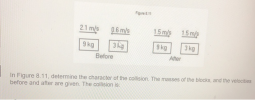 Figure 8.11 21 m/s 0.6m/s 1.5m/ 1.5m/s 9 kg 3 Before 9 kg 3 kg After In Figure 8.11, determine the character of the collision. The masses of the blocks, and the velocities before and after are given. The collision is:
 .In the figure, determine the character of the collision. The masses of the blocks, and the velocities efore and after are given. The collision is (Show your work - no work shown-ZERO POINTS) 1.8 m/s 0.2 m/s 0.6 m/s 1.4 m/s 4 kg 6 kg 4 kg 6 kg Before After A) perfectly elastic. artially inelastic. etely inelastic. 72-12 characterized by an increase-in kinetic energy E) not possible because momentum is not conserved.
 Please answer all the questions if possible :) thank
you
11- CONSERVATION OF UNEAR MOMENTUM IN 2-D Q1)(4) Performing this experiment, you get the following data: Mass of balls 30 g each Before collision: Speed of ball A 5.00 /s After collision: Ball A going at 3.0 m/s at 30 Calculate the speed at which ball B is going. Ball B is stationary. a) 2.40 m/s b) 1.50 m/s c) 2.83 m/s d) 2.05 m/s (1+1+1+1) Circle the correct answers:...
Please answer all the questions if possible :) thank
you
11- CONSERVATION OF UNEAR MOMENTUM IN 2-D Q1)(4) Performing this experiment, you get the following data: Mass of balls 30 g each Before collision: Speed of ball A 5.00 /s After collision: Ball A going at 3.0 m/s at 30 Calculate the speed at which ball B is going. Ball B is stationary. a) 2.40 m/s b) 1.50 m/s c) 2.83 m/s d) 2.05 m/s (1+1+1+1) Circle the correct answers:...
 A Two-Body Collision with a Spring A block of mass m,-1.9 kg initially moving to the right with a speed of 3.2 m/s on a frictionless, horizontal track collides with a spring attached to a second block of mass m2 - 3.9 kg initially moving to the left with a speed of 1.8 m/s as shown in figure (a). The spring constant is 505 N/m in A moving block collides with another moving block with a spring attached: (a) before...
 One object is moving and one object is at rest. The two objects then collide in a dimensional, completely inelastic collision. So the two objects stick together after the collision and move off with a common velocity. Momentum of the two-object system is conserved. The masses of the two objects are 5.00 kg and 8.50 kg, respectively. The speed of the moving object masses 5.00 kg before the collision is 22.5 m/sec. Find the final speed of the two-object system...
 An experiment is performed aboard the International Space
Station to verify that linear momentum is conserved during
collisions in a zero-g environment. The experiment involves a 3-D
completely inelastic collision of three drops of honey. At the
moment just before they all collide, the masses and velocities of
the drops are
What is your prediction for the speed, V, of the combined honey
drop after the collision?
An experiment is performed aboard the International Space Station to verify that linear...
An experiment is performed aboard the International Space
Station to verify that linear momentum is conserved during
collisions in a zero-g environment. The experiment involves a 3-D
completely inelastic collision of three drops of honey. At the
moment just before they all collide, the masses and velocities of
the drops are
What is your prediction for the speed, V, of the combined honey
drop after the collision?
An experiment is performed aboard the International Space Station to verify that linear...
 Contrast and compare elastic and inelastic collisions.
Question 4 options:
Both elastic and inelastic collisions have conservation of
momentum if there are no outside forces. They are different in that
elastic collisions bounce and inelastic collisions stick, and
kinetic energy is conserved in inelastic collisions.
They are basically the same thing, except the units are
different.
Elastic collisions do not have conservation of momentum and
inelastic collisions have conservation of momentum if there are no
outside forces. They are different...
Contrast and compare elastic and inelastic collisions.
Question 4 options:
Both elastic and inelastic collisions have conservation of
momentum if there are no outside forces. They are different in that
elastic collisions bounce and inelastic collisions stick, and
kinetic energy is conserved in inelastic collisions.
They are basically the same thing, except the units are
different.
Elastic collisions do not have conservation of momentum and
inelastic collisions have conservation of momentum if there are no
outside forces. They are different...
 Figure 8.11 21 m/s 0.6m/s 1.5m/ 1.5m/s 9 kg 3 Before 9 kg 3 kg After In Figure 8.11, determine the character of the collision. The masses of the blocks, and the velocities before and after are given. The collision is:
Most questions answered within 3 hours.
-
Where is the error in this code sequence?
String s1 = "Hello";
String s2 = "ello";...
asked 10 months ago -
Financial data for Joel de Paris, Inc., for last year
follow:
Joel de Paris, Inc.
Balance...
asked 10 months ago -
Consider this reaction:
Al2(SO4)3 (aq)+ BaCl3
(aq) Al2Cl6 (aq)- +
3BaSO4(s) . What is the...
asked 10 months ago -
Suppose that Savneet is considering increasing her
recent random sample from 20 car rentals to 40...
asked 10 months ago -
Trucks arrive at an unloading terminal at an average rate of 120
per hour.
Trucks arrive...
asked 10 months ago -
Why are methanol and ethanol completely soluble in water while
octanol is not very little soluble....
asked 10 months ago -
A facilities manager at a university reads in a research report
that the mean amount of...
asked 10 months ago -
When the CuSO4 is rehydrated by adding water to the anhydrous
compound, is this an endothermic...
asked 10 months ago -
A ray of sunlight is passing from diamond into crown glass; the
angle of incidence is...
asked 10 months ago -
A block of mass 0.249 kg is placed on top of a light, vertical
spring of...
asked 10 months ago -
how do the kidneys compensate in the presences of acidosis
a) trigger hyperventilate
b) reserve acid...
asked 10 months ago -
Question 501 pts
The rental rate of capital to the firm increases. Which of the
following...
asked 10 months ago