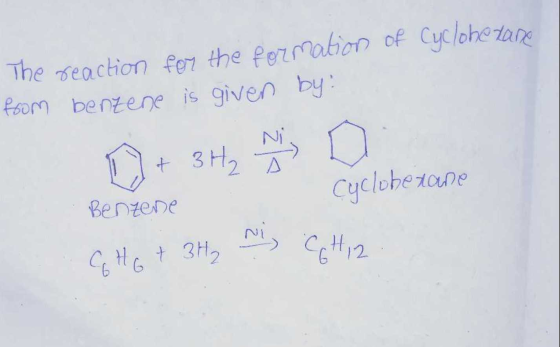
c6h6+3h6 --> c6h12 equilibrium equation
c6h6+3h6 --> c6h12 equilibrium equation
Homework Answers
70 g of benzene (C6H6) is reacted with extess hydroach to produce tyclohexane (C6H12) according to...
 70 g of benzene (C6H6) is reacted with extess hydroach to produce tyclohexane (C6H12) according to the reaction below. 42 g of cyclohexane is produced. What is the percent yield? C6H6 + 3 H2 → C6H12 a) 40% b) 45% c) 50% d) 54% e) 60% Theoretic Actual
Benzene (C6H6) and cyclohexane (C6H12) form an ideal solution at 25°C. The density of benzene is...
Benzene (C6H6) and cyclohexane (C6H12) form an ideal solution at 25°C. The density of benzene is 0.876 g/cm 3 and the density of cyclohexane is unknown.A liquid mixture is prepared by mixing 357 mL of benzene and 643 mL of cyclohexane. The vapor in equilibrium with this liquid has a mole fraction of benzene of 0.4. What is the density of cyclohexane in units of g/cm3? Data: Vapor pressure of benzene = 99 mmHg, at 25°C Vapor pressure of cyclohexane...
Cyclohexane is manufactured from the reaction of benzene with hydrogen: C6H6(g) + 3 H2(g) → C6H12(g)...
Cyclohexane is manufactured from the reaction of benzene with hydrogen: C6H6(g) + 3 H2(g) → C6H12(g) If the initial concentration of hydrogen was 1.5 M and 5 minutes later the hydrogen concentration is 0.34 M, what is the average rate of appearance of cyclohexane? 0.39 M/min 7.7 x 10⁻²M/min 4.6 M/s 3.9 x 10- 2M/hr 2.3 M/min
Determine the equilibrium constant Kp,1 and the enthalpy at 400 K for reaction (1): C6H11CH3 +...
Determine the equilibrium constant Kp,1 and the enthalpy at 400 K for reaction (1): C6H11CH3 + C6H6 <---> C6H5CH3 + C6H12 (1) C6H6 + 3H2 <----> C6H12 (2) C6H5CH3+ 3H2 <----> C6H11CH3 (3) It is known that the equilibrium constants for reaction (2) and (3) depend on temperature according to the following two equation’s: lg Kp,2 = (9590/T) – 9.9194 lg T + 0.002285T + 8.566 lgKp,3 = (10970/T) – 20.387
Cyclohexane, C6H12, undergoes a molecular rearrangement in the presence of AlCl3 to form methylcyclopentane, CH3C5H9, according...
Cyclohexane, C6H12, undergoes a molecular rearrangement in the presence of AlCl3 to form methylcyclopentane, CH3C5H9, according to the equation: C6H12 → CH3C5H9 If Kc = 0.143 at 25°C for this reaction, find the equilibrium concentrations of C6H12 and CH3C5H9 if the initial concentrations are 0.200 M and 0.050 M, respectively. Cyclohexane, C6H12, undergoes a molecular rearrangement in the presence of AlCl3 to form methylcyclopentane, CH3C5H9, according to the equation: C6H12 → CH3C5H9 If Kc = 0.143 at 25°C for this...
37. Which of these formulas is/are) not theoretically possible? A. C6H6 B. CH10 C. C6H12 D....
 37. Which of these formulas is/are) not theoretically possible? A. C6H6 B. CH10 C. C6H12 D. C6H14 E. C6H16 15. This is a double displacement reaction. A. H2SO4 + Zn → ZnSO4 + H2 B. CaCO3) CaO + CO2 C. C+ O2 + CO2 D. CH4 + 202 → CO2 + 2H2O E. AgNO3 + NaCl → NaNO3 + Agci 16. When combining with other elements, alkaline earth metals tend to form A. anions with 2 charges B. anions with...
Part A Part complete Cyclohexane, C6H12, undergoes a molecular rearrangement in the presence of AlCl3 to...
Part A Part complete Cyclohexane, C6H12, undergoes a molecular rearrangement in the presence of AlCl3 to form methylcyclopentane, CH3C5H9, according to the equation: C6H12 ↔ CH3C5H9 If K c = 0.143 at 25°C for this reaction, find the equilibrium concentrations of C6H12 and CH3C5H9 if the initial concentrations are 0.200 M and 0.050 M, respectively. [C6H12] = 0.181 M, [CH3C5H9] = 0.069 M [C6H12] = 0.224 M, [CH3C5H9] = 0.026 M [C6H12] = 0.019 M, [CH3C5H9] = 0.019 M [C6H12]...
Question 1 (5 points) Cyclohexane, C6H12, undergoes a molecular rearrangement in the presence of a catalyst...
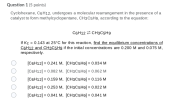 Question 1 (5 points) Cyclohexane, C6H12, undergoes a molecular rearrangement in the presence of a catalyst to form methylcyclopentane, CH3C5H9, according to the equation: C6H12 - CH3C5H9 If Kc = 0.143 at 25°C for this reaction, find the equilibrium concentrations of C6H12 and CH3C5H9 if the initial concentrations are 0.200 M and 0.075 M, respectively. [C6H12] = 0.241 M, [CH3C5H9] = 0.034 M (C6H12] = 0.082 M, [CH3C5H9] = 0.062 M [C6H12] = 0.159 M, [CH3C5H9] = 0.116 M [C6H12]...
Question 9 (5 points) Cyclohexane, C6H12, undergoes a molecular rearrangement in the presence of a catalyst...
 Question 9 (5 points) Cyclohexane, C6H12, undergoes a molecular rearrangement in the presence of a catalyst to form methylcyclopentane, CH3C5H9, according to the equation: C6H12 = CH3C5H9 If Kc = 0.143 at 25°C for this reaction, find the equilibrium concentrations of C6H12 and CH3C5Hg if the initial concentrations are 0.200 M and 0.075 M, respectively. [C6H12] = 0.253 M, [CH3C5H9] = 0.022 M [C6H12] = 0.041 M, [CH3C5H9] = 0.041 M [C6H12] = 0.241 M, [CH3C5H9] = 0.034 M [C6H12]...
A 3.314−g sample of a mixture of cyclohexane (C6H12) and naphthalene (C10H8) is dissolved in 45.40...
A 3.314−g sample of a mixture of cyclohexane (C6H12) and naphthalene (C10H8) is dissolved in 45.40 g of benzene (C6H6). The freezing point of the solution is 2.00 ° C. Calculate the mass percent of the mixture.
 70 g of benzene (C6H6) is reacted with extess hydroach to produce tyclohexane (C6H12) according to the reaction below. 42 g of cyclohexane is produced. What is the percent yield? C6H6 + 3 H2 → C6H12 a) 40% b) 45% c) 50% d) 54% e) 60% Theoretic Actual
 37. Which of these formulas is/are) not theoretically possible? A. C6H6 B. CH10 C. C6H12 D. C6H14 E. C6H16 15. This is a double displacement reaction. A. H2SO4 + Zn → ZnSO4 + H2 B. CaCO3) CaO + CO2 C. C+ O2 + CO2 D. CH4 + 202 → CO2 + 2H2O E. AgNO3 + NaCl → NaNO3 + Agci 16. When combining with other elements, alkaline earth metals tend to form A. anions with 2 charges B. anions with...
 Question 1 (5 points) Cyclohexane, C6H12, undergoes a molecular rearrangement in the presence of a catalyst to form methylcyclopentane, CH3C5H9, according to the equation: C6H12 - CH3C5H9 If Kc = 0.143 at 25°C for this reaction, find the equilibrium concentrations of C6H12 and CH3C5H9 if the initial concentrations are 0.200 M and 0.075 M, respectively. [C6H12] = 0.241 M, [CH3C5H9] = 0.034 M (C6H12] = 0.082 M, [CH3C5H9] = 0.062 M [C6H12] = 0.159 M, [CH3C5H9] = 0.116 M [C6H12]...
 Question 9 (5 points) Cyclohexane, C6H12, undergoes a molecular rearrangement in the presence of a catalyst to form methylcyclopentane, CH3C5H9, according to the equation: C6H12 = CH3C5H9 If Kc = 0.143 at 25°C for this reaction, find the equilibrium concentrations of C6H12 and CH3C5Hg if the initial concentrations are 0.200 M and 0.075 M, respectively. [C6H12] = 0.253 M, [CH3C5H9] = 0.022 M [C6H12] = 0.041 M, [CH3C5H9] = 0.041 M [C6H12] = 0.241 M, [CH3C5H9] = 0.034 M [C6H12]...
Most questions answered within 3 hours.
-
Where is the error in this code sequence?
String s1 = "Hello";
String s2 = "ello";...
asked 10 months ago -
Financial data for Joel de Paris, Inc., for last year
follow:
Joel de Paris, Inc.
Balance...
asked 10 months ago -
Consider this reaction:
Al2(SO4)3 (aq)+ BaCl3
(aq) Al2Cl6 (aq)- +
3BaSO4(s) . What is the...
asked 10 months ago -
Suppose that Savneet is considering increasing her
recent random sample from 20 car rentals to 40...
asked 10 months ago -
Trucks arrive at an unloading terminal at an average rate of 120
per hour.
Trucks arrive...
asked 10 months ago -
Why are methanol and ethanol completely soluble in water while
octanol is not very little soluble....
asked 10 months ago -
A facilities manager at a university reads in a research report
that the mean amount of...
asked 10 months ago -
When the CuSO4 is rehydrated by adding water to the anhydrous
compound, is this an endothermic...
asked 10 months ago -
A ray of sunlight is passing from diamond into crown glass; the
angle of incidence is...
asked 10 months ago -
A block of mass 0.249 kg is placed on top of a light, vertical
spring of...
asked 10 months ago -
how do the kidneys compensate in the presences of acidosis
a) trigger hyperventilate
b) reserve acid...
asked 10 months ago -
Question 501 pts
The rental rate of capital to the firm increases. Which of the
following...
asked 10 months ago