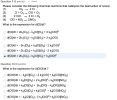
![Question 8 (5 points) Consider the following information to answer the questions: [5T] The mechanism for the destruction of o](http://img.homeworklib.com/questions/db73fb20-fcfd-11ea-802a-f77846dde5a0.png?x-oss-process=image/resize,w_560)

Homework Answers
1. In the reaction of depletion of ozone layer,NO2 and atomic oxygen (in the fast step) are the intermediates formed.
2.Fast reactions requires less energy.In the given reactions step 2 reaction is fast and the combination of intermediates(unstable species)occurs ,hence it requires lower activation energy.
3.Catalyst is a substance which is not consumed in the reaction. In the given reactions NO is reacted in step 1 and produced in step 2 with overall no change, Hence NO is the catalyst.
4.Rate of a reaction depends upon the slowest step.Rate law can be written from the slowest step.
In the given reaction, step 1 is the slowest, hence Rate law is,
Rate = k[O3][NO]
Order is the sum of the powers of concentration terms,hence the order is 2.(with respect to ozone is 1 and with respect to NO is 1).
5. Since O3 and NO are unstable species, reaction between them will liberated energy, Hence the reaction is Exothermic in nature(Chemiluminescence).
Add Answer to:
URGENT PLEASE
Question 8 (5 points) Consider the following information to answer the questions: [5T] The...
15. Consider the reaction 2 NO2(g) N2O4(g) . (a) Using Gf N2O4(g) = 97.79 kJ/mol and...
 15. Consider the reaction 2 NO2(g)
N2O4(g) .
(a) Using Gf
N2O4(g) = 97.79 kJ/mol and Gf NO2(g)
= 51.3 kJ/mol, calculate G° at 298 K.
kJ
(b) Calculate G at 298 K if the partial pressures of
NO2 and N2O4 are 0.35 atm and 1.60
atm, respectively.
kJ
16. Consider the reaction given below.
H2(g) + F2(g)
2 HF(g)
(a) Using thermodynamic data from the course website, calculate
G° at 298 K.
kJ
(b) Calculate G at 298 K...
15. Consider the reaction 2 NO2(g)
N2O4(g) .
(a) Using Gf
N2O4(g) = 97.79 kJ/mol and Gf NO2(g)
= 51.3 kJ/mol, calculate G° at 298 K.
kJ
(b) Calculate G at 298 K if the partial pressures of
NO2 and N2O4 are 0.35 atm and 1.60
atm, respectively.
kJ
16. Consider the reaction given below.
H2(g) + F2(g)
2 HF(g)
(a) Using thermodynamic data from the course website, calculate
G° at 298 K.
kJ
(b) Calculate G at 298 K...
Overall rate In the question below the correct answer is B, how does that show agreement...
 Overall rate
In the question below the correct answer is B, how does that
show agreement with the overall reaction which does not have any
concentration of CL present?
Questions 42-44 refer to the following information. When free Cl(g) atoms encounter O(8) molecules in the upper atmosphere, the following reaction mechanism is proposed to occur. Cl(g) +03(g) → C10(g) +02(g) CIO(g) + 03(g) → Cl(g) + 2 O2(g) 203(g) → 302(g) slow step fast step overall reaction AH-285 kJ/mol 42....
Overall rate
In the question below the correct answer is B, how does that
show agreement with the overall reaction which does not have any
concentration of CL present?
Questions 42-44 refer to the following information. When free Cl(g) atoms encounter O(8) molecules in the upper atmosphere, the following reaction mechanism is proposed to occur. Cl(g) +03(g) → C10(g) +02(g) CIO(g) + 03(g) → Cl(g) + 2 O2(g) 203(g) → 302(g) slow step fast step overall reaction AH-285 kJ/mol 42....
Given the following electrolytic cell: The current is discharged into the electrolytic cell containing the solution CuS...
 Given the following electrolytic cell:
The current is discharged into the electrolytic cell containing
the solution CuSO4(aq) 1.0M at 25 oC. During
the operation of the cell, copper Cu(s) is deposited on
one electrode and oxygen O2(g) gas is released, near the
second electrode.
O2(g) + 4H3O+(aq) +
4e-
6H2O(l) Eo= 1.23V
Cu2+(aq) + 2e- Cu(s)
Eo= 0.34V
A. The current in the cell is 1.5 amperes. The current is
streamed in 40 minutes.
i. Calculate the mass of copper...
Given the following electrolytic cell:
The current is discharged into the electrolytic cell containing
the solution CuSO4(aq) 1.0M at 25 oC. During
the operation of the cell, copper Cu(s) is deposited on
one electrode and oxygen O2(g) gas is released, near the
second electrode.
O2(g) + 4H3O+(aq) +
4e-
6H2O(l) Eo= 1.23V
Cu2+(aq) + 2e- Cu(s)
Eo= 0.34V
A. The current in the cell is 1.5 amperes. The current is
streamed in 40 minutes.
i. Calculate the mass of copper...
Question 3 of 10 Submit Balance the following chemical equation (if necessary): Na3PO4(aq) + NiCiz (aq)...
 Question 3 of 10 Submit Balance the following chemical equation (if necessary): Na3PO4(aq) + NiCiz (aq) → Ni3(PO4)2 (s) + NaCl(aq) Reset 30,2 Reset 60 @ 1 2 3 4 5 6 800 (s) 0 (g) (aq) Nis(POA)2 Nacı Na PO. Niclz • x H20 Question 4 of 10 Submit Balance the following chemical equation (if necessary): C3H6(g) + O2(g) + CO2(g) + H2O(g) Reset 30,2 Reset 60 @ 123460089 (aq) (s) CO2 (1) H20 (g) Oz CsHo • «...
8. (20 points) Consider the following mechanism, with the accompanying energy diagram, which has been suggested...
 8. (20 points) Consider the following mechanism, with the accompanying energy diagram, which has been suggested for the following overall reaction in the presence of a Cl catalyst: 03 +0 202 Step 1: Step 2: 03 + Cl → OCl + O2 OCl + 0 + 02 + Cl +---Ea, Energy - - - - AHrxn --- - Reaction progress- A. Based on the energy diagram, which step is rate limiting? Which step is the fastest? (4 Points) B. Identify...
PLEASE ANSWER ALL THE POINTS AND WRITE CLEARLY AND EXPLAIN THANK YOUU!! 1. Consider the following...
 PLEASE ANSWER ALL THE POINTS AND WRITE CLEARLY AND EXPLAIN THANK
YOUU!!
1. Consider the following linear regression model: (a) which assumptions are needed to Inake the A i unbiased estimators for the ßi? (b) Explain how one can test the hypothesis that +A-0 by means of a t-test. We were unable to transcribe this image(d) Suppose that r is an irrelevant explanatory variable in the population model and that you estimate the model including both r1 and r2. What...
PLEASE ANSWER ALL THE POINTS AND WRITE CLEARLY AND EXPLAIN THANK
YOUU!!
1. Consider the following linear regression model: (a) which assumptions are needed to Inake the A i unbiased estimators for the ßi? (b) Explain how one can test the hypothesis that +A-0 by means of a t-test. We were unable to transcribe this image(d) Suppose that r is an irrelevant explanatory variable in the population model and that you estimate the model including both r1 and r2. What...
PLEASE ANSWER ALL THE POINTS CLEARLY AND EXPLAIN writing also the formulas and everything THANKS 3. Consider...
 PLEASE ANSWER ALL THE POINTS CLEARLY AND EXPLAIN writing also
the formulas and everything THANKS
3. Consider the following model that relates labor force participation (LFP) to unemployment rate UNR) and average hourly earnings (AHE), measured in 1982 dollars, in the US over a period of 28 years: The OLS regression output is as follows: Model 1: OLS, using observations 1-28 Dependent variable: lfp coefficient std. error t-ratio 81.2267 0.6384 1.4449 3.4040 const unr ahe 8.929 3.493 О. 4148 R-squared 0.767adj....
PLEASE ANSWER ALL THE POINTS CLEARLY AND EXPLAIN writing also
the formulas and everything THANKS
3. Consider the following model that relates labor force participation (LFP) to unemployment rate UNR) and average hourly earnings (AHE), measured in 1982 dollars, in the US over a period of 28 years: The OLS regression output is as follows: Model 1: OLS, using observations 1-28 Dependent variable: lfp coefficient std. error t-ratio 81.2267 0.6384 1.4449 3.4040 const unr ahe 8.929 3.493 О. 4148 R-squared 0.767adj....
please 6. The decomposition of ozone in the upper atmosphere is catalyzed by NO. The overall...
 please
6. The decomposition of ozone in the upper atmosphere is catalyzed by NO. The overall reaction and rate law are: O(g) + O(g) 20(8): rate-k[O][NO] Write a possible mechanism that is consistent with rate law and identify an intermediate in the reaction. 7. A possible mechanism for the iodide ion catalyzed decomposition of hydrogen peroxide in aqueous solution is: H:Os(aq) + (aq) → H2O(1) Ol(aq) --- -slow H2O2(aq) + Ol'(aq) → H2O(1) + O2(g) + l'(aq) ------fast What is:...
please
6. The decomposition of ozone in the upper atmosphere is catalyzed by NO. The overall reaction and rate law are: O(g) + O(g) 20(8): rate-k[O][NO] Write a possible mechanism that is consistent with rate law and identify an intermediate in the reaction. 7. A possible mechanism for the iodide ion catalyzed decomposition of hydrogen peroxide in aqueous solution is: H:Os(aq) + (aq) → H2O(1) Ol(aq) --- -slow H2O2(aq) + Ol'(aq) → H2O(1) + O2(g) + l'(aq) ------fast What is:...
Question 9 (8 points) Saved Please consider the following chemical reactions that catalyzes the destruction of...
 Question 9 (8 points) Saved Please consider the following chemical reactions that catalyzes the destruction of ozone: Cl2 -> 2 CI (3) 2 CIO (4) CiO+NO2CINO3 What is the expression for d[CI|/dt? Question 10 (8 points) What is the expression for d[CIO]/dt'?
just need step 5 25 Question (6 points) See pese 1069 Provide a mechanism for the...
 just need step 5
25 Question (6 points) See pese 1069 Provide a mechanism for the Dieckmann condensation shown here by providing the missing structures (including the final product) and curved arrows. Your structures should include all nonzero formal charges and lone pairs of electrons. When drawing the enolate, place the negative charge on the carbon not the oxygen. 20th attempt See Periodic Table See Hint the missing curved arrow notation VIEW SOLUTION We were unable to transcribe this image
just need step 5
25 Question (6 points) See pese 1069 Provide a mechanism for the Dieckmann condensation shown here by providing the missing structures (including the final product) and curved arrows. Your structures should include all nonzero formal charges and lone pairs of electrons. When drawing the enolate, place the negative charge on the carbon not the oxygen. 20th attempt See Periodic Table See Hint the missing curved arrow notation VIEW SOLUTION We were unable to transcribe this image
 15. Consider the reaction 2 NO2(g)
N2O4(g) .
(a) Using Gf
N2O4(g) = 97.79 kJ/mol and Gf NO2(g)
= 51.3 kJ/mol, calculate G° at 298 K.
kJ
(b) Calculate G at 298 K if the partial pressures of
NO2 and N2O4 are 0.35 atm and 1.60
atm, respectively.
kJ
16. Consider the reaction given below.
H2(g) + F2(g)
2 HF(g)
(a) Using thermodynamic data from the course website, calculate
G° at 298 K.
kJ
(b) Calculate G at 298 K...
15. Consider the reaction 2 NO2(g)
N2O4(g) .
(a) Using Gf
N2O4(g) = 97.79 kJ/mol and Gf NO2(g)
= 51.3 kJ/mol, calculate G° at 298 K.
kJ
(b) Calculate G at 298 K if the partial pressures of
NO2 and N2O4 are 0.35 atm and 1.60
atm, respectively.
kJ
16. Consider the reaction given below.
H2(g) + F2(g)
2 HF(g)
(a) Using thermodynamic data from the course website, calculate
G° at 298 K.
kJ
(b) Calculate G at 298 K...
 Overall rate
In the question below the correct answer is B, how does that
show agreement with the overall reaction which does not have any
concentration of CL present?
Questions 42-44 refer to the following information. When free Cl(g) atoms encounter O(8) molecules in the upper atmosphere, the following reaction mechanism is proposed to occur. Cl(g) +03(g) → C10(g) +02(g) CIO(g) + 03(g) → Cl(g) + 2 O2(g) 203(g) → 302(g) slow step fast step overall reaction AH-285 kJ/mol 42....
Overall rate
In the question below the correct answer is B, how does that
show agreement with the overall reaction which does not have any
concentration of CL present?
Questions 42-44 refer to the following information. When free Cl(g) atoms encounter O(8) molecules in the upper atmosphere, the following reaction mechanism is proposed to occur. Cl(g) +03(g) → C10(g) +02(g) CIO(g) + 03(g) → Cl(g) + 2 O2(g) 203(g) → 302(g) slow step fast step overall reaction AH-285 kJ/mol 42....
 Given the following electrolytic cell:
The current is discharged into the electrolytic cell containing
the solution CuSO4(aq) 1.0M at 25 oC. During
the operation of the cell, copper Cu(s) is deposited on
one electrode and oxygen O2(g) gas is released, near the
second electrode.
O2(g) + 4H3O+(aq) +
4e-
6H2O(l) Eo= 1.23V
Cu2+(aq) + 2e- Cu(s)
Eo= 0.34V
A. The current in the cell is 1.5 amperes. The current is
streamed in 40 minutes.
i. Calculate the mass of copper...
Given the following electrolytic cell:
The current is discharged into the electrolytic cell containing
the solution CuSO4(aq) 1.0M at 25 oC. During
the operation of the cell, copper Cu(s) is deposited on
one electrode and oxygen O2(g) gas is released, near the
second electrode.
O2(g) + 4H3O+(aq) +
4e-
6H2O(l) Eo= 1.23V
Cu2+(aq) + 2e- Cu(s)
Eo= 0.34V
A. The current in the cell is 1.5 amperes. The current is
streamed in 40 minutes.
i. Calculate the mass of copper...
 Question 3 of 10 Submit Balance the following chemical equation (if necessary): Na3PO4(aq) + NiCiz (aq) → Ni3(PO4)2 (s) + NaCl(aq) Reset 30,2 Reset 60 @ 1 2 3 4 5 6 800 (s) 0 (g) (aq) Nis(POA)2 Nacı Na PO. Niclz • x H20 Question 4 of 10 Submit Balance the following chemical equation (if necessary): C3H6(g) + O2(g) + CO2(g) + H2O(g) Reset 30,2 Reset 60 @ 123460089 (aq) (s) CO2 (1) H20 (g) Oz CsHo • «...
 8. (20 points) Consider the following mechanism, with the accompanying energy diagram, which has been suggested for the following overall reaction in the presence of a Cl catalyst: 03 +0 202 Step 1: Step 2: 03 + Cl → OCl + O2 OCl + 0 + 02 + Cl +---Ea, Energy - - - - AHrxn --- - Reaction progress- A. Based on the energy diagram, which step is rate limiting? Which step is the fastest? (4 Points) B. Identify...
 PLEASE ANSWER ALL THE POINTS AND WRITE CLEARLY AND EXPLAIN THANK
YOUU!!
1. Consider the following linear regression model: (a) which assumptions are needed to Inake the A i unbiased estimators for the ßi? (b) Explain how one can test the hypothesis that +A-0 by means of a t-test. We were unable to transcribe this image(d) Suppose that r is an irrelevant explanatory variable in the population model and that you estimate the model including both r1 and r2. What...
PLEASE ANSWER ALL THE POINTS AND WRITE CLEARLY AND EXPLAIN THANK
YOUU!!
1. Consider the following linear regression model: (a) which assumptions are needed to Inake the A i unbiased estimators for the ßi? (b) Explain how one can test the hypothesis that +A-0 by means of a t-test. We were unable to transcribe this image(d) Suppose that r is an irrelevant explanatory variable in the population model and that you estimate the model including both r1 and r2. What...
 PLEASE ANSWER ALL THE POINTS CLEARLY AND EXPLAIN writing also
the formulas and everything THANKS
3. Consider the following model that relates labor force participation (LFP) to unemployment rate UNR) and average hourly earnings (AHE), measured in 1982 dollars, in the US over a period of 28 years: The OLS regression output is as follows: Model 1: OLS, using observations 1-28 Dependent variable: lfp coefficient std. error t-ratio 81.2267 0.6384 1.4449 3.4040 const unr ahe 8.929 3.493 О. 4148 R-squared 0.767adj....
PLEASE ANSWER ALL THE POINTS CLEARLY AND EXPLAIN writing also
the formulas and everything THANKS
3. Consider the following model that relates labor force participation (LFP) to unemployment rate UNR) and average hourly earnings (AHE), measured in 1982 dollars, in the US over a period of 28 years: The OLS regression output is as follows: Model 1: OLS, using observations 1-28 Dependent variable: lfp coefficient std. error t-ratio 81.2267 0.6384 1.4449 3.4040 const unr ahe 8.929 3.493 О. 4148 R-squared 0.767adj....
 please
6. The decomposition of ozone in the upper atmosphere is catalyzed by NO. The overall reaction and rate law are: O(g) + O(g) 20(8): rate-k[O][NO] Write a possible mechanism that is consistent with rate law and identify an intermediate in the reaction. 7. A possible mechanism for the iodide ion catalyzed decomposition of hydrogen peroxide in aqueous solution is: H:Os(aq) + (aq) → H2O(1) Ol(aq) --- -slow H2O2(aq) + Ol'(aq) → H2O(1) + O2(g) + l'(aq) ------fast What is:...
please
6. The decomposition of ozone in the upper atmosphere is catalyzed by NO. The overall reaction and rate law are: O(g) + O(g) 20(8): rate-k[O][NO] Write a possible mechanism that is consistent with rate law and identify an intermediate in the reaction. 7. A possible mechanism for the iodide ion catalyzed decomposition of hydrogen peroxide in aqueous solution is: H:Os(aq) + (aq) → H2O(1) Ol(aq) --- -slow H2O2(aq) + Ol'(aq) → H2O(1) + O2(g) + l'(aq) ------fast What is:...
 Question 9 (8 points) Saved Please consider the following chemical reactions that catalyzes the destruction of ozone: Cl2 -> 2 CI (3) 2 CIO (4) CiO+NO2CINO3 What is the expression for d[CI|/dt? Question 10 (8 points) What is the expression for d[CIO]/dt'?
 just need step 5
25 Question (6 points) See pese 1069 Provide a mechanism for the Dieckmann condensation shown here by providing the missing structures (including the final product) and curved arrows. Your structures should include all nonzero formal charges and lone pairs of electrons. When drawing the enolate, place the negative charge on the carbon not the oxygen. 20th attempt See Periodic Table See Hint the missing curved arrow notation VIEW SOLUTION We were unable to transcribe this image
just need step 5
25 Question (6 points) See pese 1069 Provide a mechanism for the Dieckmann condensation shown here by providing the missing structures (including the final product) and curved arrows. Your structures should include all nonzero formal charges and lone pairs of electrons. When drawing the enolate, place the negative charge on the carbon not the oxygen. 20th attempt See Periodic Table See Hint the missing curved arrow notation VIEW SOLUTION We were unable to transcribe this image
Most questions answered within 3 hours.
-
Where is the error in this code sequence?
String s1 = "Hello";
String s2 = "ello";...
asked 10 months ago -
Financial data for Joel de Paris, Inc., for last year
follow:
Joel de Paris, Inc.
Balance...
asked 10 months ago -
Consider this reaction:
Al2(SO4)3 (aq)+ BaCl3
(aq) Al2Cl6 (aq)- +
3BaSO4(s) . What is the...
asked 10 months ago -
Suppose that Savneet is considering increasing her
recent random sample from 20 car rentals to 40...
asked 10 months ago -
Trucks arrive at an unloading terminal at an average rate of 120
per hour.
Trucks arrive...
asked 10 months ago -
Why are methanol and ethanol completely soluble in water while
octanol is not very little soluble....
asked 10 months ago -
A facilities manager at a university reads in a research report
that the mean amount of...
asked 10 months ago -
When the CuSO4 is rehydrated by adding water to the anhydrous
compound, is this an endothermic...
asked 10 months ago -
A ray of sunlight is passing from diamond into crown glass; the
angle of incidence is...
asked 10 months ago -
A block of mass 0.249 kg is placed on top of a light, vertical
spring of...
asked 10 months ago -
how do the kidneys compensate in the presences of acidosis
a) trigger hyperventilate
b) reserve acid...
asked 10 months ago -
Question 501 pts
The rental rate of capital to the firm increases. Which of the
following...
asked 10 months ago