Homework Answers
Add Answer to:
ive
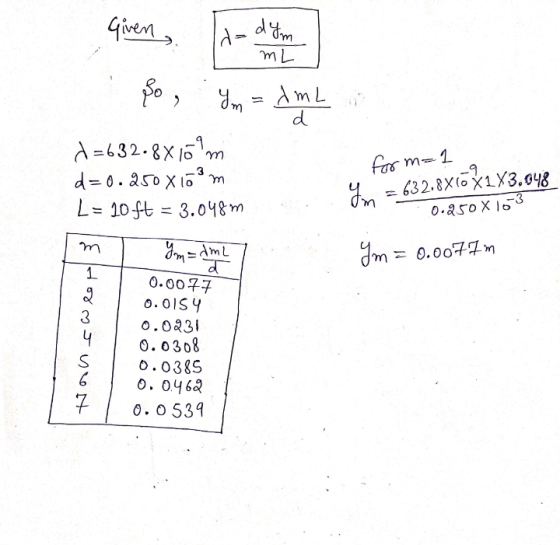
attached the results to the experiment help me how to find ym in
oder to...
help solve for x and y Below is an image from a double slit experiment obtained...
 help
solve for x and y
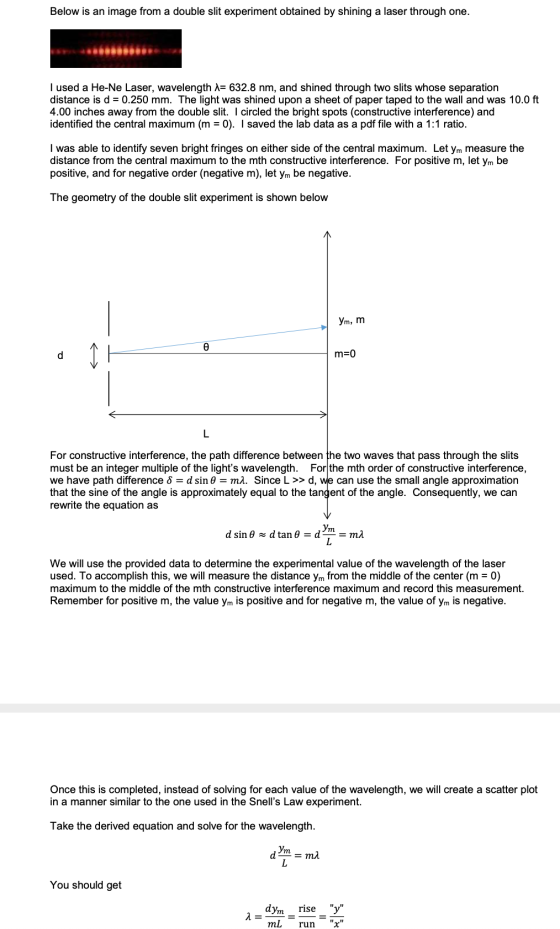
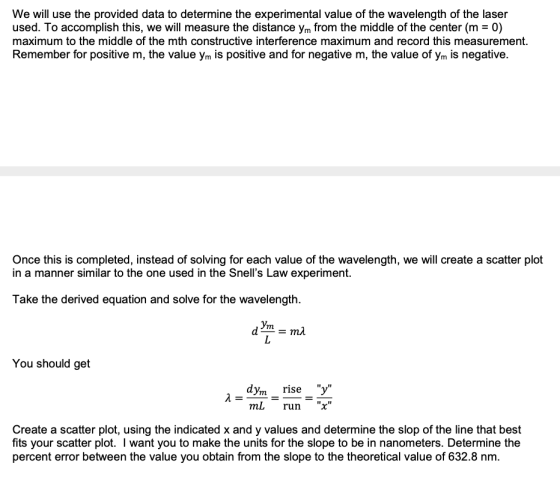
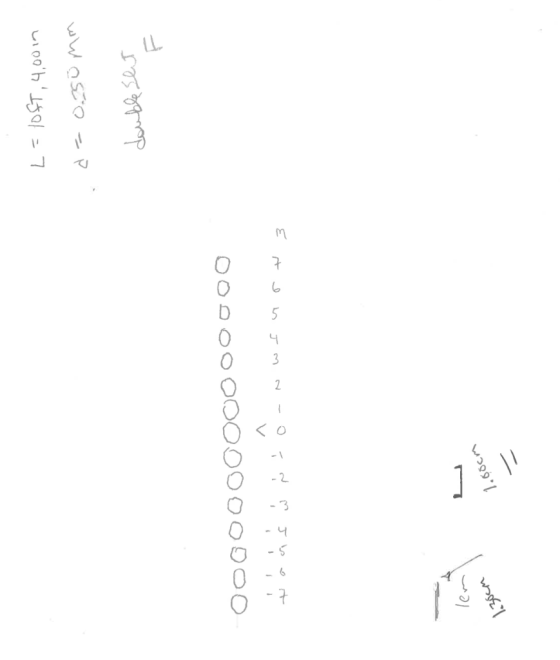
Below is an image from a double slit experiment obtained by shining a laser through one. I used a He-Ne Laser, wavelength = 632.8 nm, and shined through two slits whose separation distance is d = 0.250 mm. The light was shined upon a sheet of paper taped to the wall and was 10.0 ft 4.00 inches away from the double slit. I circled the bright spots (constructive interference) and identified the central maximum...
help
solve for x and y
Below is an image from a double slit experiment obtained by shining a laser through one. I used a He-Ne Laser, wavelength = 632.8 nm, and shined through two slits whose separation distance is d = 0.250 mm. The light was shined upon a sheet of paper taped to the wall and was 10.0 ft 4.00 inches away from the double slit. I circled the bright spots (constructive interference) and identified the central maximum...
Below is an image from a double slit experiment obtained by shining a laser through one....
 Below is an image from a double slit experiment obtained by shining a laser through one. I used a He-Ne Laser, wavelength = 632.8 nm, and shined through two slits whose separation distance is d = 0.250 mm. The light was shined upon a sheet of paper taped to the wall and was 10.0 ft 4.00 inches away from the double slit. I circled the bright spots (constructive interference) and identified the central maximum (m = 0). I saved the...
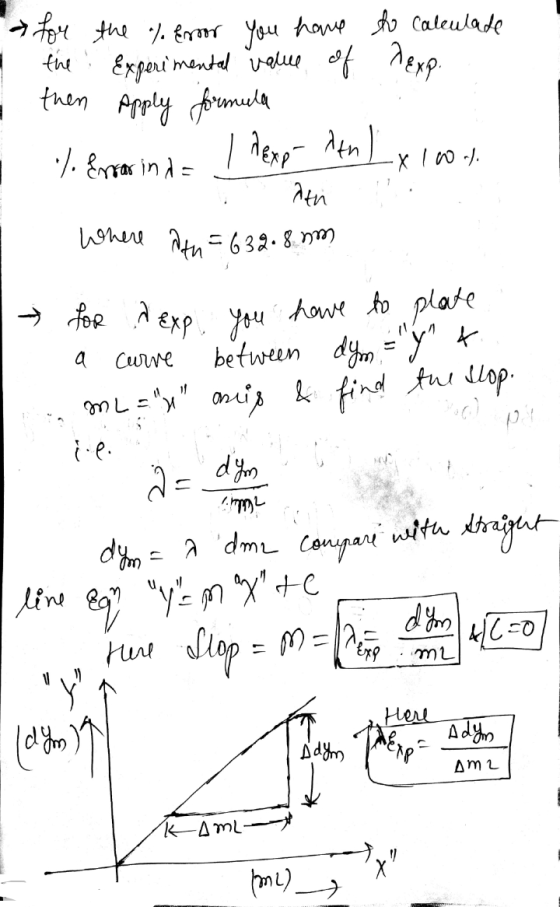
Please Help! can someone walk me through how O actually come up with slope? i inderstand...
 Please Help! can someone walk me through how O actually come
up with slope? i inderstand that dym is the y values and ml is the
x, but I cant figure out what those values are.
I used a He-Ne Laser, wavelength = 632.8 nm, and shined through two slits whose separation distance is d = 0.250 mm. The light was shined upon a sheet of paper taped to the wall and was 10.0 ft 4.00 inches away from the...
Please Help! can someone walk me through how O actually come
up with slope? i inderstand that dym is the y values and ml is the
x, but I cant figure out what those values are.
I used a He-Ne Laser, wavelength = 632.8 nm, and shined through two slits whose separation distance is d = 0.250 mm. The light was shined upon a sheet of paper taped to the wall and was 10.0 ft 4.00 inches away from the...
Question 3: Calibrating the Double Slit You are attempting to perform a double slit experiment (see...
 Question 3: Calibrating the Double Slit You are attempting to perform a double slit experiment (see Figure 2): the distance between slits is 0.1 mm, the distance from the barrier to the screen is L = 2 m, and the distance from the coherent) laser light source to the barrier is t = 0.4 m. You are using red light, with a wavelength = 660 nm. You are worried that you have not perfectly centred the laser halfway between the...
5. Fig. 9.2 shows the geometry of a double-slit interference experiment. If the light beam is...
 5. Fig. 9.2 shows the geometry of a double-slit interference experiment. If the light beam is a laser beam with a wavelength of 500 nm, the slit separation is d 0.3 mm, and the distance to the screen is L-0.7m, what is the value of x at the first minimum of the interference pattern (first minimum to the x side of the central maximum)? What is the value ofx at the first maximum of the interference pattern? What is the...
What causes the bright and dark fringes to appear on the screen in a double slit...
 What causes the bright and dark fringes to appear on the screen
in a double slit interference experiment?
m#2 m-1 m 2 mA screen igure 2. Description of a double slit interference pattern. Peaks represent bright spots. The constructive interference when the distances from the first slit to the screen and the second slit to the screen differ by a whole wavel ength than The two angles labeled theta can be considered equal when the distance to the screen, D,...
What causes the bright and dark fringes to appear on the screen
in a double slit interference experiment?
m#2 m-1 m 2 mA screen igure 2. Description of a double slit interference pattern. Peaks represent bright spots. The constructive interference when the distances from the first slit to the screen and the second slit to the screen differ by a whole wavel ength than The two angles labeled theta can be considered equal when the distance to the screen, D,...
In a double-slit interference experiment the slit separation is 8.40 x 10⁻⁶ m and the slits...
In a double-slit interference experiment the slit separation is 8.40 x 10⁻⁶ m and the slits are 2.80 m from the screen. Each slit has a width of 1.20 x 10⁻⁶ m. a) An interference pattern is formed when light with a wavelength of 450 nm is shined on the slits. How far (in meters) from the center of the interference pattern on the screen do the third order (m = 3) bright fringes occur? (1.5 pts) b) If a...
m-2 m= 1 m=2 mA screen Figure 2. Description of a double slit interference pattern. Peaks...
 m-2 m= 1 m=2 mA screen Figure 2. Description of a double slit interference pattern. Peaks represent bright spots. Th when the distances from the first slit to the screen and the second slit to the screen differ by a e constructive interference nd slit to the screen differ by a whole wavelength to the screen, D, is much greater than le. The two angles labeled theta can be considered equal when the distance whole wave multipl the slit separation....
Question 1 (1.5 points) This assignment is set up for sequential assessment. Complete each question and...
 Question 1 (1.5 points) This assignment is set up for sequential assessment. Complete each question and submit the answer before moving on to the next question. Correct answers for each question will be made available once the maximum number of attempts have been made for each submission. Double Slit Interference 1 Double Slit Interference Double Slit Screen Interference y=Ltane y 10 y = 0 L (destructive). L bright fringes: sine m=0, 11, 12,...(constructive) Dark fringes: above central: sin 8 =...
(1) Derive the equation that relates the wavelength λ to the distance Ym=1 of the m=1...
 (1) Derive the equation that relates the wavelength λ to the
distance Ym=1 of the m=1 line.
You must provide the justification for your derivation.
(2) Describe, step by step, how the experimental data has to be
analysed to determine the
unknown wavelength λ3. You must be brief but clear in your
description of the method.
**You can just show me the working, I will provide explanations
on my own**
Aim Diffraction grating is used to determine the wavelengths of...
(1) Derive the equation that relates the wavelength λ to the
distance Ym=1 of the m=1 line.
You must provide the justification for your derivation.
(2) Describe, step by step, how the experimental data has to be
analysed to determine the
unknown wavelength λ3. You must be brief but clear in your
description of the method.
**You can just show me the working, I will provide explanations
on my own**
Aim Diffraction grating is used to determine the wavelengths of...
 help
solve for x and y
Below is an image from a double slit experiment obtained by shining a laser through one. I used a He-Ne Laser, wavelength = 632.8 nm, and shined through two slits whose separation distance is d = 0.250 mm. The light was shined upon a sheet of paper taped to the wall and was 10.0 ft 4.00 inches away from the double slit. I circled the bright spots (constructive interference) and identified the central maximum...
help
solve for x and y
Below is an image from a double slit experiment obtained by shining a laser through one. I used a He-Ne Laser, wavelength = 632.8 nm, and shined through two slits whose separation distance is d = 0.250 mm. The light was shined upon a sheet of paper taped to the wall and was 10.0 ft 4.00 inches away from the double slit. I circled the bright spots (constructive interference) and identified the central maximum...
 Below is an image from a double slit experiment obtained by shining a laser through one. I used a He-Ne Laser, wavelength = 632.8 nm, and shined through two slits whose separation distance is d = 0.250 mm. The light was shined upon a sheet of paper taped to the wall and was 10.0 ft 4.00 inches away from the double slit. I circled the bright spots (constructive interference) and identified the central maximum (m = 0). I saved the...
 Please Help! can someone walk me through how O actually come
up with slope? i inderstand that dym is the y values and ml is the
x, but I cant figure out what those values are.
I used a He-Ne Laser, wavelength = 632.8 nm, and shined through two slits whose separation distance is d = 0.250 mm. The light was shined upon a sheet of paper taped to the wall and was 10.0 ft 4.00 inches away from the...
Please Help! can someone walk me through how O actually come
up with slope? i inderstand that dym is the y values and ml is the
x, but I cant figure out what those values are.
I used a He-Ne Laser, wavelength = 632.8 nm, and shined through two slits whose separation distance is d = 0.250 mm. The light was shined upon a sheet of paper taped to the wall and was 10.0 ft 4.00 inches away from the...
 Question 3: Calibrating the Double Slit You are attempting to perform a double slit experiment (see Figure 2): the distance between slits is 0.1 mm, the distance from the barrier to the screen is L = 2 m, and the distance from the coherent) laser light source to the barrier is t = 0.4 m. You are using red light, with a wavelength = 660 nm. You are worried that you have not perfectly centred the laser halfway between the...
 5. Fig. 9.2 shows the geometry of a double-slit interference experiment. If the light beam is a laser beam with a wavelength of 500 nm, the slit separation is d 0.3 mm, and the distance to the screen is L-0.7m, what is the value of x at the first minimum of the interference pattern (first minimum to the x side of the central maximum)? What is the value ofx at the first maximum of the interference pattern? What is the...
 What causes the bright and dark fringes to appear on the screen
in a double slit interference experiment?
m#2 m-1 m 2 mA screen igure 2. Description of a double slit interference pattern. Peaks represent bright spots. The constructive interference when the distances from the first slit to the screen and the second slit to the screen differ by a whole wavel ength than The two angles labeled theta can be considered equal when the distance to the screen, D,...
What causes the bright and dark fringes to appear on the screen
in a double slit interference experiment?
m#2 m-1 m 2 mA screen igure 2. Description of a double slit interference pattern. Peaks represent bright spots. The constructive interference when the distances from the first slit to the screen and the second slit to the screen differ by a whole wavel ength than The two angles labeled theta can be considered equal when the distance to the screen, D,...
 m-2 m= 1 m=2 mA screen Figure 2. Description of a double slit interference pattern. Peaks represent bright spots. Th when the distances from the first slit to the screen and the second slit to the screen differ by a e constructive interference nd slit to the screen differ by a whole wavelength to the screen, D, is much greater than le. The two angles labeled theta can be considered equal when the distance whole wave multipl the slit separation....
 Question 1 (1.5 points) This assignment is set up for sequential assessment. Complete each question and submit the answer before moving on to the next question. Correct answers for each question will be made available once the maximum number of attempts have been made for each submission. Double Slit Interference 1 Double Slit Interference Double Slit Screen Interference y=Ltane y 10 y = 0 L (destructive). L bright fringes: sine m=0, 11, 12,...(constructive) Dark fringes: above central: sin 8 =...
 (1) Derive the equation that relates the wavelength λ to the
distance Ym=1 of the m=1 line.
You must provide the justification for your derivation.
(2) Describe, step by step, how the experimental data has to be
analysed to determine the
unknown wavelength λ3. You must be brief but clear in your
description of the method.
**You can just show me the working, I will provide explanations
on my own**
Aim Diffraction grating is used to determine the wavelengths of...
(1) Derive the equation that relates the wavelength λ to the
distance Ym=1 of the m=1 line.
You must provide the justification for your derivation.
(2) Describe, step by step, how the experimental data has to be
analysed to determine the
unknown wavelength λ3. You must be brief but clear in your
description of the method.
**You can just show me the working, I will provide explanations
on my own**
Aim Diffraction grating is used to determine the wavelengths of...
Most questions answered within 3 hours.
-
Where is the error in this code sequence?
String s1 = "Hello";
String s2 = "ello";...
asked 10 months ago -
Financial data for Joel de Paris, Inc., for last year
follow:
Joel de Paris, Inc.
Balance...
asked 10 months ago -
Consider this reaction:
Al2(SO4)3 (aq)+ BaCl3
(aq) Al2Cl6 (aq)- +
3BaSO4(s) . What is the...
asked 10 months ago -
Suppose that Savneet is considering increasing her
recent random sample from 20 car rentals to 40...
asked 10 months ago -
Trucks arrive at an unloading terminal at an average rate of 120
per hour.
Trucks arrive...
asked 10 months ago -
Why are methanol and ethanol completely soluble in water while
octanol is not very little soluble....
asked 10 months ago -
A facilities manager at a university reads in a research report
that the mean amount of...
asked 10 months ago -
When the CuSO4 is rehydrated by adding water to the anhydrous
compound, is this an endothermic...
asked 10 months ago -
A ray of sunlight is passing from diamond into crown glass; the
angle of incidence is...
asked 10 months ago -
A block of mass 0.249 kg is placed on top of a light, vertical
spring of...
asked 10 months ago -
how do the kidneys compensate in the presences of acidosis
a) trigger hyperventilate
b) reserve acid...
asked 10 months ago -
Question 501 pts
The rental rate of capital to the firm increases. Which of the
following...
asked 10 months ago