
Homework Answers
Add Answer to:
Please Help! can someone walk me through how O actually come
up with slope? i inderstand...
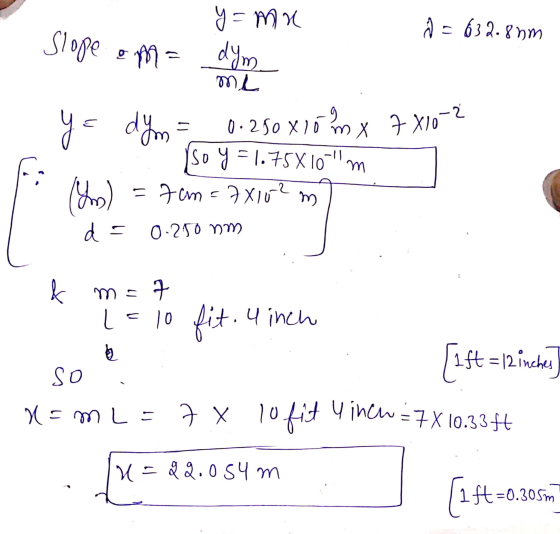
ive attached the results to the experiment help me how to find ym in oder to...
 ive
attached the results to the experiment help me how to find ym in
oder to get the y values to plot the data and get the slope
Below is an image from a double slit experiment obtained by shining a laser through one. I used a He-Ne Laser, wavelength = 632.8 nm, and shined through two slits whose separation distance is d = 0.250 mm. The light was shined upon a sheet of paper taped to the wall and...
ive
attached the results to the experiment help me how to find ym in
oder to get the y values to plot the data and get the slope
Below is an image from a double slit experiment obtained by shining a laser through one. I used a He-Ne Laser, wavelength = 632.8 nm, and shined through two slits whose separation distance is d = 0.250 mm. The light was shined upon a sheet of paper taped to the wall and...
Below is an image from a double slit experiment obtained by shining a laser through one....
 Below is an image from a double slit experiment obtained by shining a laser through one. I used a He-Ne Laser, wavelength = 632.8 nm, and shined through two slits whose separation distance is d = 0.250 mm. The light was shined upon a sheet of paper taped to the wall and was 10.0 ft 4.00 inches away from the double slit. I circled the bright spots (constructive interference) and identified the central maximum (m = 0). I saved the...
help solve for x and y Below is an image from a double slit experiment obtained...
 help
solve for x and y
Below is an image from a double slit experiment obtained by shining a laser through one. I used a He-Ne Laser, wavelength = 632.8 nm, and shined through two slits whose separation distance is d = 0.250 mm. The light was shined upon a sheet of paper taped to the wall and was 10.0 ft 4.00 inches away from the double slit. I circled the bright spots (constructive interference) and identified the central maximum...
help
solve for x and y
Below is an image from a double slit experiment obtained by shining a laser through one. I used a He-Ne Laser, wavelength = 632.8 nm, and shined through two slits whose separation distance is d = 0.250 mm. The light was shined upon a sheet of paper taped to the wall and was 10.0 ft 4.00 inches away from the double slit. I circled the bright spots (constructive interference) and identified the central maximum...
Question 1 (1.5 points) This assignment is set up for sequential assessment. Complete each question and...
 Question 1 (1.5 points) This assignment is set up for sequential assessment. Complete each question and submit the answer before moving on to the next question. Correct answers for each question will be made available once the maximum number of attempts have been made for each submission. Double Slit Interference 1 Double Slit Interference Double Slit Screen Interference y=Ltane y 10 y = 0 L (destructive). L bright fringes: sine m=0, 11, 12,...(constructive) Dark fringes: above central: sin 8 =...
Someone please help me on the second part to this question... thanks in advance! A physicist...
 Someone please help me on the second part to this question...
thanks in advance!
A physicist illuminates a 0.56 mm-wide slit with light characterized by i = 540 nm, and this results in a diffraction pattern forming upon a screen located 124 cm from the slit assembly. Compute the width of the first and second maxima (or bright fringes) on one side of the central peak. (Enter your answer in mm.) W1 = 1.20 ✓ mm (1st maxima) W2 =...
Someone please help me on the second part to this question...
thanks in advance!
A physicist illuminates a 0.56 mm-wide slit with light characterized by i = 540 nm, and this results in a diffraction pattern forming upon a screen located 124 cm from the slit assembly. Compute the width of the first and second maxima (or bright fringes) on one side of the central peak. (Enter your answer in mm.) W1 = 1.20 ✓ mm (1st maxima) W2 =...
hi if you could please help that would be appreciated Part A If a diffraction grating...
 hi if you could please help that would be appreciated
Part A If a diffraction grating produces a third-order bright spot for red light (of wavelength 690 nm )at 67.0 from the central maximum, at what angle will the second-order bright spot be for violet light (of wavelength 445 nm)? VA ? Submit Request Answer Constants A slit 0.330 mm wide is illuminated by parallel rays of light that have a wavelength of 560 nm. The diffraction pattern is observed...
hi if you could please help that would be appreciated
Part A If a diffraction grating produces a third-order bright spot for red light (of wavelength 690 nm )at 67.0 from the central maximum, at what angle will the second-order bright spot be for violet light (of wavelength 445 nm)? VA ? Submit Request Answer Constants A slit 0.330 mm wide is illuminated by parallel rays of light that have a wavelength of 560 nm. The diffraction pattern is observed...
Can you please explain step by step how to solve these type of questions please. White...
 Can you please explain step by step how to solve these type of
questions please.
White light is a mixture of all colors with wavelengths between 400 and 700m. If we shine white light on two narrow slits spaced 1 x 10 m apart and place a screen 3 m behind the slits, we will see sn interference pattern a little different from the one we saw in DL. Notice that every wavelenght of light has its n = 0...
Can you please explain step by step how to solve these type of
questions please.
White light is a mixture of all colors with wavelengths between 400 and 700m. If we shine white light on two narrow slits spaced 1 x 10 m apart and place a screen 3 m behind the slits, we will see sn interference pattern a little different from the one we saw in DL. Notice that every wavelenght of light has its n = 0...
can somebody please help me with these questions, thank you very much 10. In Young's double-slit...
 can
somebody please help me with these questions, thank you very
much
10. In Young's double-slit apparatus the slits are senerated by a distance of 0.55 x 10 m. A screen 15 located 4 m from the plane of the slits. When light of wavelength 550 nm illuminates the slits, the distance on the screen between the central bright fringe and the third bright fringe on either side is a 4x 10mb. 8x 10-m c. 12 x 10 m d...
can
somebody please help me with these questions, thank you very
much
10. In Young's double-slit apparatus the slits are senerated by a distance of 0.55 x 10 m. A screen 15 located 4 m from the plane of the slits. When light of wavelength 550 nm illuminates the slits, the distance on the screen between the central bright fringe and the third bright fringe on either side is a 4x 10mb. 8x 10-m c. 12 x 10 m d...
Please help me out with this questions. Thank you. Neutrons can be produced at low temperatures...
 Please help me out with this questions. Thank you.
Neutrons can be produced at low temperatures to serve as probes of molecular structure. When the de Broglie wavelength of a neutron is on the order of the dimensions of chemical bond lengths, the diffraction patterns are especially important for molecular structure. If the speed of a thermal neutron is given by the expression v = (3k_BT/m)^1/2, at what temperature will neutrons have a de Broglie wavelength of 50 pm =...
Please help me out with this questions. Thank you.
Neutrons can be produced at low temperatures to serve as probes of molecular structure. When the de Broglie wavelength of a neutron is on the order of the dimensions of chemical bond lengths, the diffraction patterns are especially important for molecular structure. If the speed of a thermal neutron is given by the expression v = (3k_BT/m)^1/2, at what temperature will neutrons have a de Broglie wavelength of 50 pm =...
Question 5: How would dust and oil on the glass plates affect the results? EXPERIMENT 10 THIN FILM I...
 Question 5:
How would dust and oil on the glass plates affect the
results?
EXPERIMENT 10 THIN FILM INTERFERENCE Light from a monochromatic source is shined downward on two glass plates that are separated at one end by a hair. Light that is reflected from the top and bottom surfaces of the wedge-shaped thin film of air undergoes interference, and a series of dark and light lines are seen. By counting the number of dark or light lines over a...
Question 5:
How would dust and oil on the glass plates affect the
results?
EXPERIMENT 10 THIN FILM INTERFERENCE Light from a monochromatic source is shined downward on two glass plates that are separated at one end by a hair. Light that is reflected from the top and bottom surfaces of the wedge-shaped thin film of air undergoes interference, and a series of dark and light lines are seen. By counting the number of dark or light lines over a...
 ive
attached the results to the experiment help me how to find ym in
oder to get the y values to plot the data and get the slope
Below is an image from a double slit experiment obtained by shining a laser through one. I used a He-Ne Laser, wavelength = 632.8 nm, and shined through two slits whose separation distance is d = 0.250 mm. The light was shined upon a sheet of paper taped to the wall and...
ive
attached the results to the experiment help me how to find ym in
oder to get the y values to plot the data and get the slope
Below is an image from a double slit experiment obtained by shining a laser through one. I used a He-Ne Laser, wavelength = 632.8 nm, and shined through two slits whose separation distance is d = 0.250 mm. The light was shined upon a sheet of paper taped to the wall and...
 Below is an image from a double slit experiment obtained by shining a laser through one. I used a He-Ne Laser, wavelength = 632.8 nm, and shined through two slits whose separation distance is d = 0.250 mm. The light was shined upon a sheet of paper taped to the wall and was 10.0 ft 4.00 inches away from the double slit. I circled the bright spots (constructive interference) and identified the central maximum (m = 0). I saved the...
 help
solve for x and y
Below is an image from a double slit experiment obtained by shining a laser through one. I used a He-Ne Laser, wavelength = 632.8 nm, and shined through two slits whose separation distance is d = 0.250 mm. The light was shined upon a sheet of paper taped to the wall and was 10.0 ft 4.00 inches away from the double slit. I circled the bright spots (constructive interference) and identified the central maximum...
help
solve for x and y
Below is an image from a double slit experiment obtained by shining a laser through one. I used a He-Ne Laser, wavelength = 632.8 nm, and shined through two slits whose separation distance is d = 0.250 mm. The light was shined upon a sheet of paper taped to the wall and was 10.0 ft 4.00 inches away from the double slit. I circled the bright spots (constructive interference) and identified the central maximum...
 Question 1 (1.5 points) This assignment is set up for sequential assessment. Complete each question and submit the answer before moving on to the next question. Correct answers for each question will be made available once the maximum number of attempts have been made for each submission. Double Slit Interference 1 Double Slit Interference Double Slit Screen Interference y=Ltane y 10 y = 0 L (destructive). L bright fringes: sine m=0, 11, 12,...(constructive) Dark fringes: above central: sin 8 =...
 Someone please help me on the second part to this question...
thanks in advance!
A physicist illuminates a 0.56 mm-wide slit with light characterized by i = 540 nm, and this results in a diffraction pattern forming upon a screen located 124 cm from the slit assembly. Compute the width of the first and second maxima (or bright fringes) on one side of the central peak. (Enter your answer in mm.) W1 = 1.20 ✓ mm (1st maxima) W2 =...
Someone please help me on the second part to this question...
thanks in advance!
A physicist illuminates a 0.56 mm-wide slit with light characterized by i = 540 nm, and this results in a diffraction pattern forming upon a screen located 124 cm from the slit assembly. Compute the width of the first and second maxima (or bright fringes) on one side of the central peak. (Enter your answer in mm.) W1 = 1.20 ✓ mm (1st maxima) W2 =...
 hi if you could please help that would be appreciated
Part A If a diffraction grating produces a third-order bright spot for red light (of wavelength 690 nm )at 67.0 from the central maximum, at what angle will the second-order bright spot be for violet light (of wavelength 445 nm)? VA ? Submit Request Answer Constants A slit 0.330 mm wide is illuminated by parallel rays of light that have a wavelength of 560 nm. The diffraction pattern is observed...
hi if you could please help that would be appreciated
Part A If a diffraction grating produces a third-order bright spot for red light (of wavelength 690 nm )at 67.0 from the central maximum, at what angle will the second-order bright spot be for violet light (of wavelength 445 nm)? VA ? Submit Request Answer Constants A slit 0.330 mm wide is illuminated by parallel rays of light that have a wavelength of 560 nm. The diffraction pattern is observed...
 Can you please explain step by step how to solve these type of
questions please.
White light is a mixture of all colors with wavelengths between 400 and 700m. If we shine white light on two narrow slits spaced 1 x 10 m apart and place a screen 3 m behind the slits, we will see sn interference pattern a little different from the one we saw in DL. Notice that every wavelenght of light has its n = 0...
Can you please explain step by step how to solve these type of
questions please.
White light is a mixture of all colors with wavelengths between 400 and 700m. If we shine white light on two narrow slits spaced 1 x 10 m apart and place a screen 3 m behind the slits, we will see sn interference pattern a little different from the one we saw in DL. Notice that every wavelenght of light has its n = 0...
 can
somebody please help me with these questions, thank you very
much
10. In Young's double-slit apparatus the slits are senerated by a distance of 0.55 x 10 m. A screen 15 located 4 m from the plane of the slits. When light of wavelength 550 nm illuminates the slits, the distance on the screen between the central bright fringe and the third bright fringe on either side is a 4x 10mb. 8x 10-m c. 12 x 10 m d...
can
somebody please help me with these questions, thank you very
much
10. In Young's double-slit apparatus the slits are senerated by a distance of 0.55 x 10 m. A screen 15 located 4 m from the plane of the slits. When light of wavelength 550 nm illuminates the slits, the distance on the screen between the central bright fringe and the third bright fringe on either side is a 4x 10mb. 8x 10-m c. 12 x 10 m d...
 Please help me out with this questions. Thank you.
Neutrons can be produced at low temperatures to serve as probes of molecular structure. When the de Broglie wavelength of a neutron is on the order of the dimensions of chemical bond lengths, the diffraction patterns are especially important for molecular structure. If the speed of a thermal neutron is given by the expression v = (3k_BT/m)^1/2, at what temperature will neutrons have a de Broglie wavelength of 50 pm =...
Please help me out with this questions. Thank you.
Neutrons can be produced at low temperatures to serve as probes of molecular structure. When the de Broglie wavelength of a neutron is on the order of the dimensions of chemical bond lengths, the diffraction patterns are especially important for molecular structure. If the speed of a thermal neutron is given by the expression v = (3k_BT/m)^1/2, at what temperature will neutrons have a de Broglie wavelength of 50 pm =...
 Question 5:
How would dust and oil on the glass plates affect the
results?
EXPERIMENT 10 THIN FILM INTERFERENCE Light from a monochromatic source is shined downward on two glass plates that are separated at one end by a hair. Light that is reflected from the top and bottom surfaces of the wedge-shaped thin film of air undergoes interference, and a series of dark and light lines are seen. By counting the number of dark or light lines over a...
Question 5:
How would dust and oil on the glass plates affect the
results?
EXPERIMENT 10 THIN FILM INTERFERENCE Light from a monochromatic source is shined downward on two glass plates that are separated at one end by a hair. Light that is reflected from the top and bottom surfaces of the wedge-shaped thin film of air undergoes interference, and a series of dark and light lines are seen. By counting the number of dark or light lines over a...
Most questions answered within 3 hours.
-
Where is the error in this code sequence?
String s1 = "Hello";
String s2 = "ello";...
asked 10 months ago -
Financial data for Joel de Paris, Inc., for last year
follow:
Joel de Paris, Inc.
Balance...
asked 10 months ago -
Consider this reaction:
Al2(SO4)3 (aq)+ BaCl3
(aq) Al2Cl6 (aq)- +
3BaSO4(s) . What is the...
asked 10 months ago -
Suppose that Savneet is considering increasing her
recent random sample from 20 car rentals to 40...
asked 10 months ago -
Trucks arrive at an unloading terminal at an average rate of 120
per hour.
Trucks arrive...
asked 10 months ago -
Why are methanol and ethanol completely soluble in water while
octanol is not very little soluble....
asked 10 months ago -
A facilities manager at a university reads in a research report
that the mean amount of...
asked 10 months ago -
When the CuSO4 is rehydrated by adding water to the anhydrous
compound, is this an endothermic...
asked 10 months ago -
A ray of sunlight is passing from diamond into crown glass; the
angle of incidence is...
asked 10 months ago -
A block of mass 0.249 kg is placed on top of a light, vertical
spring of...
asked 10 months ago -
how do the kidneys compensate in the presences of acidosis
a) trigger hyperventilate
b) reserve acid...
asked 10 months ago -
Question 501 pts
The rental rate of capital to the firm increases. Which of the
following...
asked 10 months ago