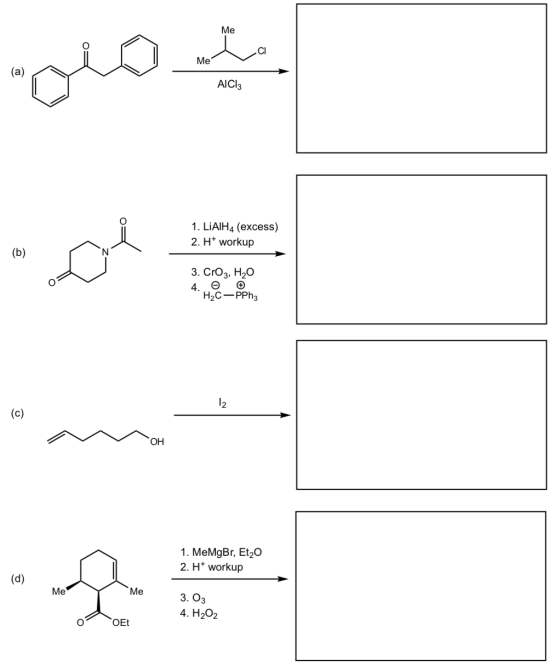
Fill in each box with the single major product of the indicated transformation with sterochem
Homework Answers
Add Answer to:
Fill in each box with the single major product of the indicated
transformation with sterochem
Me...
Fill in each box with the single major product of the indicated transformation. Be sure to...
 Fill in each box with the single major product of the indicated
transformation. Be sure to indicate stereochemistry.
Me CI Me (a) واAIC 1. LIAIH4 (excess) 2. H* workup (b) لي 3. CrO3, H20 4 0 وH2C - PPh ,ا (c) OH 1. MeMgBr, Et20 2. H* workup (d) Me Me 3. 03 4. H20 OEt
Fill in each box with the single major product of the indicated
transformation. Be sure to indicate stereochemistry.
Me CI Me (a) واAIC 1. LIAIH4 (excess) 2. H* workup (b) لي 3. CrO3, H20 4 0 وH2C - PPh ,ا (c) OH 1. MeMgBr, Et20 2. H* workup (d) Me Me 3. 03 4. H20 OEt
Fill in each box with a starting material or product as required for each transformation, or...
 Fill in each box with a starting material or product as required
for each transformation, or the reagentsrequired for each step.
Indicate stereochemistryclearly
if it is relevant.
(b) 1. SOCI2, pyr 2. KOME, HOME Me Et Me 3. Zn(Cu), CH212 (single enantiomer) 1. (c) N Me Me 3. (+/-) 1. OH (d) 2. 3.
Fill in each box with a starting material or product as required
for each transformation, or the reagentsrequired for each step.
Indicate stereochemistryclearly
if it is relevant.
(b) 1. SOCI2, pyr 2. KOME, HOME Me Et Me 3. Zn(Cu), CH212 (single enantiomer) 1. (c) N Me Me 3. (+/-) 1. OH (d) 2. 3.
Slide appropriate reactants into the boxes to conduct the following synthetic transformation. You don't need to...
 Slide appropriate reactants into the boxes to conduct the following synthetic transformation. You don't need to necessarily fill all the boxes, but if you don't use them all, fill from the top down. Unused boxes can be left empty. Br CH3CH2CH2Li 1. BH3-THF; 2. NaOH, H2O2, H2o Hg2+, H2O, H+ KCN, HCN H20, H+ CH3OH, H+ NaOH, H2O 1. (Sia 2BH; 2. NaOH, H2O2, H2O PhLi HOCH2CH2OH, H+ Nothing Needed PCC PhMgBr CH3CH2NH2, H+ H2Cr04 KCN NaBH4, MeOH (CH3CH2CH2)2Culi CH3CH2MgBr...
A1 A 42 NH, OEt B1 OH B B2 ОН Me Me ОН C1 Ph C2...
 A1 A 42 NH, OEt B1 OH B B2 ОН Me Me ОН C1 Ph C2 C OH Give the proper reagent for each of these two-step reaction sequences. Pick the reagent from the table below. (Assume aqueous workup when needed.) 1. Br2 / uv light 2. SOCI2 / THE 3. Mg/Et20 4. Meli/hexane 5. CH3CH2MgCI 6. PhMgBr 7. NaBH4 8. LIAIH4 9. BH3 / 0x 10. POCI3/pyridine / THE 11. CrO3 / THE 12. PCC / CH2Cl2 13. H...
2. Predict the major organic product(s) of the reactions below. Assume 1 equivalent of reagent unless...
 2. Predict the major organic product(s) of the
reactions below. Assume 1 equivalent of reagent unless otherwise
stated, it's a solvent, or an oxidizing/reducing agent. Do consider
stereochemistry and regioselectivity.
2. Predict the major organic product(s) of the reactions below. Assume 1 equivalent of reagent unless otherwise stated, it's a solvent, or an oxidizing/reducing agent. Do consider stereochemistry and regioselectivity. (3 points each; 15 points total) A. Me 1. HNO3 2. O3 3. DMS 1. mCPBA, DCM (1 equiv) 2....
2. Predict the major organic product(s) of the
reactions below. Assume 1 equivalent of reagent unless otherwise
stated, it's a solvent, or an oxidizing/reducing agent. Do consider
stereochemistry and regioselectivity.
2. Predict the major organic product(s) of the reactions below. Assume 1 equivalent of reagent unless otherwise stated, it's a solvent, or an oxidizing/reducing agent. Do consider stereochemistry and regioselectivity. (3 points each; 15 points total) A. Me 1. HNO3 2. O3 3. DMS 1. mCPBA, DCM (1 equiv) 2....
What's the major product in each step of the reaction? e) 1. NaOEt, EtOH dilute OEt...
 What's the major product in each step of the reaction?
e) 1. NaOEt, EtOH dilute OEt Eto 2. HyO*, heat 1. LiAIH4, ether 1. DIBAL, THF 2. H', H2O h) 1.2 eq. CH,CH2MgBr, ether 2. D3O OCH, 1) OH, H20 3) EtOH, H,o* 2) H,o 4) excess CHMgBr 5) H,O
What's the major product in each step of the reaction?
e) 1. NaOEt, EtOH dilute OEt Eto 2. HyO*, heat 1. LiAIH4, ether 1. DIBAL, THF 2. H', H2O h) 1.2 eq. CH,CH2MgBr, ether 2. D3O OCH, 1) OH, H20 3) EtOH, H,o* 2) H,o 4) excess CHMgBr 5) H,O
2) Fill in each of the following boxes with the structure of the major reaction product(s)...
 2) Fill in each of the following boxes with the structure of the major reaction product(s) from each of the following reactions. (28 points total). a) Pd(PPhale NaOH b) + Pd(OA) (CH CHN CN 1. NaBH 2. H2O HH OH но -н H- OH HH OH CH,OH HNO, но NH,OH trace of acid 1. CHI (excess 2. Ag,0 H2O, heat CI 1 CRUS POY Grubbs catalyst) Page 2 of 5
Match each reaction to its single most likely major product or outcome in the box. Place...
 Match each reaction to its single most likely major product or outcome in the box. Place the Roman numeral of your choice on the line by the reaction. No answer may be used more than oncents) ОН CH3OH H2SO4 cat. OH a.) Lan i. -NH2 но ни b.) iii. HO^ iv. H NaOCHE CH3OH Lo c.) V. OH vi. 1. LIAIH4, ether 2. H300 d.) toi toi vii. HO NH2 -NH2 viii. e.)
please help 3. Draw the major product of the final step of the following scheme in...
 please help
3. Draw the major product of the final step of the following scheme in the box provided. 1. NBS, ROOR or NBS, cat AIBN, CCls, heat 2. DBN 3. Hydroboration-oxidation 4. PBr3 5. Mg, Et2o 6. PhCHO, then workup 7. Jones reagent 8. PhLi, Et O, then H30 9. TsOH, heat 10. NBS, HOH 11. NaOH (intramolecular SN2) 12. MeMgBr (excess), then workup 13. E2 14. HBr 15. Mg, ether 16. dry ice, then workup 17. LiAlH4, ether,...
please help
3. Draw the major product of the final step of the following scheme in the box provided. 1. NBS, ROOR or NBS, cat AIBN, CCls, heat 2. DBN 3. Hydroboration-oxidation 4. PBr3 5. Mg, Et2o 6. PhCHO, then workup 7. Jones reagent 8. PhLi, Et O, then H30 9. TsOH, heat 10. NBS, HOH 11. NaOH (intramolecular SN2) 12. MeMgBr (excess), then workup 13. E2 14. HBr 15. Mg, ether 16. dry ice, then workup 17. LiAlH4, ether,...
Practice Worksheer 8: Alkynes 4. Draw the major product for each transformation. Draw the major regioisomer and ster...
 Practice Worksheer 8: Alkynes 4. Draw the major product for each transformation. Draw the major regioisomer and sterosome where appropriate. CI, CHCI HgSO4, H,SO a. B He, diglyme b, HD, NaOH H2 (excess), Pd/C CHE Hz (excess), Pd/CaCO3 quinoline, Pb(OAC) CH₃ Na”, NH3(1), -196 °C Page 3 of 4
 Fill in each box with the single major product of the indicated
transformation. Be sure to indicate stereochemistry.
Me CI Me (a) واAIC 1. LIAIH4 (excess) 2. H* workup (b) لي 3. CrO3, H20 4 0 وH2C - PPh ,ا (c) OH 1. MeMgBr, Et20 2. H* workup (d) Me Me 3. 03 4. H20 OEt
Fill in each box with the single major product of the indicated
transformation. Be sure to indicate stereochemistry.
Me CI Me (a) واAIC 1. LIAIH4 (excess) 2. H* workup (b) لي 3. CrO3, H20 4 0 وH2C - PPh ,ا (c) OH 1. MeMgBr, Et20 2. H* workup (d) Me Me 3. 03 4. H20 OEt
 Fill in each box with a starting material or product as required
for each transformation, or the reagentsrequired for each step.
Indicate stereochemistryclearly
if it is relevant.
(b) 1. SOCI2, pyr 2. KOME, HOME Me Et Me 3. Zn(Cu), CH212 (single enantiomer) 1. (c) N Me Me 3. (+/-) 1. OH (d) 2. 3.
Fill in each box with a starting material or product as required
for each transformation, or the reagentsrequired for each step.
Indicate stereochemistryclearly
if it is relevant.
(b) 1. SOCI2, pyr 2. KOME, HOME Me Et Me 3. Zn(Cu), CH212 (single enantiomer) 1. (c) N Me Me 3. (+/-) 1. OH (d) 2. 3.
 Slide appropriate reactants into the boxes to conduct the following synthetic transformation. You don't need to necessarily fill all the boxes, but if you don't use them all, fill from the top down. Unused boxes can be left empty. Br CH3CH2CH2Li 1. BH3-THF; 2. NaOH, H2O2, H2o Hg2+, H2O, H+ KCN, HCN H20, H+ CH3OH, H+ NaOH, H2O 1. (Sia 2BH; 2. NaOH, H2O2, H2O PhLi HOCH2CH2OH, H+ Nothing Needed PCC PhMgBr CH3CH2NH2, H+ H2Cr04 KCN NaBH4, MeOH (CH3CH2CH2)2Culi CH3CH2MgBr...
 A1 A 42 NH, OEt B1 OH B B2 ОН Me Me ОН C1 Ph C2 C OH Give the proper reagent for each of these two-step reaction sequences. Pick the reagent from the table below. (Assume aqueous workup when needed.) 1. Br2 / uv light 2. SOCI2 / THE 3. Mg/Et20 4. Meli/hexane 5. CH3CH2MgCI 6. PhMgBr 7. NaBH4 8. LIAIH4 9. BH3 / 0x 10. POCI3/pyridine / THE 11. CrO3 / THE 12. PCC / CH2Cl2 13. H...
 2. Predict the major organic product(s) of the
reactions below. Assume 1 equivalent of reagent unless otherwise
stated, it's a solvent, or an oxidizing/reducing agent. Do consider
stereochemistry and regioselectivity.
2. Predict the major organic product(s) of the reactions below. Assume 1 equivalent of reagent unless otherwise stated, it's a solvent, or an oxidizing/reducing agent. Do consider stereochemistry and regioselectivity. (3 points each; 15 points total) A. Me 1. HNO3 2. O3 3. DMS 1. mCPBA, DCM (1 equiv) 2....
2. Predict the major organic product(s) of the
reactions below. Assume 1 equivalent of reagent unless otherwise
stated, it's a solvent, or an oxidizing/reducing agent. Do consider
stereochemistry and regioselectivity.
2. Predict the major organic product(s) of the reactions below. Assume 1 equivalent of reagent unless otherwise stated, it's a solvent, or an oxidizing/reducing agent. Do consider stereochemistry and regioselectivity. (3 points each; 15 points total) A. Me 1. HNO3 2. O3 3. DMS 1. mCPBA, DCM (1 equiv) 2....
 What's the major product in each step of the reaction?
e) 1. NaOEt, EtOH dilute OEt Eto 2. HyO*, heat 1. LiAIH4, ether 1. DIBAL, THF 2. H', H2O h) 1.2 eq. CH,CH2MgBr, ether 2. D3O OCH, 1) OH, H20 3) EtOH, H,o* 2) H,o 4) excess CHMgBr 5) H,O
What's the major product in each step of the reaction?
e) 1. NaOEt, EtOH dilute OEt Eto 2. HyO*, heat 1. LiAIH4, ether 1. DIBAL, THF 2. H', H2O h) 1.2 eq. CH,CH2MgBr, ether 2. D3O OCH, 1) OH, H20 3) EtOH, H,o* 2) H,o 4) excess CHMgBr 5) H,O
 2) Fill in each of the following boxes with the structure of the major reaction product(s) from each of the following reactions. (28 points total). a) Pd(PPhale NaOH b) + Pd(OA) (CH CHN CN 1. NaBH 2. H2O HH OH но -н H- OH HH OH CH,OH HNO, но NH,OH trace of acid 1. CHI (excess 2. Ag,0 H2O, heat CI 1 CRUS POY Grubbs catalyst) Page 2 of 5
 Match each reaction to its single most likely major product or outcome in the box. Place the Roman numeral of your choice on the line by the reaction. No answer may be used more than oncents) ОН CH3OH H2SO4 cat. OH a.) Lan i. -NH2 но ни b.) iii. HO^ iv. H NaOCHE CH3OH Lo c.) V. OH vi. 1. LIAIH4, ether 2. H300 d.) toi toi vii. HO NH2 -NH2 viii. e.)
 please help
3. Draw the major product of the final step of the following scheme in the box provided. 1. NBS, ROOR or NBS, cat AIBN, CCls, heat 2. DBN 3. Hydroboration-oxidation 4. PBr3 5. Mg, Et2o 6. PhCHO, then workup 7. Jones reagent 8. PhLi, Et O, then H30 9. TsOH, heat 10. NBS, HOH 11. NaOH (intramolecular SN2) 12. MeMgBr (excess), then workup 13. E2 14. HBr 15. Mg, ether 16. dry ice, then workup 17. LiAlH4, ether,...
please help
3. Draw the major product of the final step of the following scheme in the box provided. 1. NBS, ROOR or NBS, cat AIBN, CCls, heat 2. DBN 3. Hydroboration-oxidation 4. PBr3 5. Mg, Et2o 6. PhCHO, then workup 7. Jones reagent 8. PhLi, Et O, then H30 9. TsOH, heat 10. NBS, HOH 11. NaOH (intramolecular SN2) 12. MeMgBr (excess), then workup 13. E2 14. HBr 15. Mg, ether 16. dry ice, then workup 17. LiAlH4, ether,...
 Practice Worksheer 8: Alkynes 4. Draw the major product for each transformation. Draw the major regioisomer and sterosome where appropriate. CI, CHCI HgSO4, H,SO a. B He, diglyme b, HD, NaOH H2 (excess), Pd/C CHE Hz (excess), Pd/CaCO3 quinoline, Pb(OAC) CH₃ Na”, NH3(1), -196 °C Page 3 of 4
Most questions answered within 3 hours.
-
Where is the error in this code sequence?
String s1 = "Hello";
String s2 = "ello";...
asked 11 months ago -
Financial data for Joel de Paris, Inc., for last year
follow:
Joel de Paris, Inc.
Balance...
asked 11 months ago -
Consider this reaction:
Al2(SO4)3 (aq)+ BaCl3
(aq) Al2Cl6 (aq)- +
3BaSO4(s) . What is the...
asked 11 months ago -
Suppose that Savneet is considering increasing her
recent random sample from 20 car rentals to 40...
asked 11 months ago -
Trucks arrive at an unloading terminal at an average rate of 120
per hour.
Trucks arrive...
asked 11 months ago -
Why are methanol and ethanol completely soluble in water while
octanol is not very little soluble....
asked 11 months ago -
A facilities manager at a university reads in a research report
that the mean amount of...
asked 11 months ago -
When the CuSO4 is rehydrated by adding water to the anhydrous
compound, is this an endothermic...
asked 11 months ago -
A ray of sunlight is passing from diamond into crown glass; the
angle of incidence is...
asked 11 months ago -
A block of mass 0.249 kg is placed on top of a light, vertical
spring of...
asked 11 months ago -
how do the kidneys compensate in the presences of acidosis
a) trigger hyperventilate
b) reserve acid...
asked 11 months ago -
Question 501 pts
The rental rate of capital to the firm increases. Which of the
following...
asked 11 months ago