
Homework Answers

[3] 5. Suppose that f: D[0, 1] → D[0, 1] is holomorphic, prove that \f'(x) <...
 [3] 5. Suppose that f: D[0, 1] → D[0, 1] is holomorphic, prove that \f'(x) < 1/(1 - 1z| for all z e D[0, 1]. [3] 5. Suppose that f: D[0, 1] → D[0, 1] is holomorphic, prove that f'(x) < 1/(1-1-12 for all z e D[0, 1]
Prove the statement is true. (b) Qn(0, 0) <RR
 Prove the statement is true.
(b) Qn(0, 0) <RR
Prove the statement is true.
(b) Qn(0, 0) <RR
(a) (4 marks) Consider the function S(x) = x-cos(x). 1) Prove that S has at least...
 (a) (4 marks) Consider the function S(x) = x-cos(x). 1) Prove that S has at least one zero in the interval [0, ) f(0)f(x) <0. (O)f(x) > 0 and is continuous f(0)f(x) < 0 and is continuous. ii) Prove that S has at most one zero in the interval [0, x) f' <0 on (0,#] so that is strictly increasing on (0,r)- 1'>0 on (0,#] so that f is strictly increasing on (0, #) 1'>on (0,r) so that is strictly...
1. Let x, a € R. Prove that if a <a, then -a < x <a.
 1. Let x, a € R. Prove that if a <a, then -a < x <a.
1/2 76. For 0 < x < l cotx d(cos x) equals to 1/72 (a) 15,712...
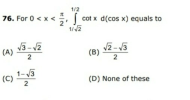 1/2 76. For 0 < x < l cotx d(cos x) equals to 1/72 (a) 15,712 12-13 (B) 2 (c) ?>23 (D) None of these
n=0 4. Using the power series cos(x) = { (-1)",2 (-0<x<0), to find a power (2n)!...
 n=0 4. Using the power series cos(x) = { (-1)",2 (-0<x<0), to find a power (2n)! series for the function f(x) = sin(x) sin(3x) and its interval of convergence. 23 Find the power series representation for the function f(2) and its interval (3x - 2) of convergence. 5. +
Let A, B, C be subsets of U. Prove that If C – B=0 then AN...
 Let A, B, C be subsets of U. Prove that If C – B=0 then AN (BUC) < ((A-C)) UB
Prove X, Y, Z, JER. XKY Prove Z <# X AND Y<j, if and only if...
 Prove
X, Y, Z, JER. XKY Prove Z <# X AND Y<j, if and only if (x,y) [z,j]
Prove
X, Y, Z, JER. XKY Prove Z <# X AND Y<j, if and only if (x,y) [z,j]
(3) 5. Suppose that f : D[0, 1] → D[0, 1] is holomorphic, prove that f'(2)...
 (3) 5. Suppose that f : D[0, 1] → D[0, 1] is holomorphic, prove that f'(2) < 1/(1 - 121) for all z e D[0,1].
Prove for allm ε Ν. Σέ < 2 - Α.
 Prove for allm ε Ν. Σέ < 2 - Α.
 [3] 5. Suppose that f: D[0, 1] → D[0, 1] is holomorphic, prove that \f'(x) < 1/(1 - 1z| for all z e D[0, 1]. [3] 5. Suppose that f: D[0, 1] → D[0, 1] is holomorphic, prove that f'(x) < 1/(1-1-12 for all z e D[0, 1]
 Prove the statement is true.
(b) Qn(0, 0) <RR
Prove the statement is true.
(b) Qn(0, 0) <RR
 (a) (4 marks) Consider the function S(x) = x-cos(x). 1) Prove that S has at least one zero in the interval [0, ) f(0)f(x) <0. (O)f(x) > 0 and is continuous f(0)f(x) < 0 and is continuous. ii) Prove that S has at most one zero in the interval [0, x) f' <0 on (0,#] so that is strictly increasing on (0,r)- 1'>0 on (0,#] so that f is strictly increasing on (0, #) 1'>on (0,r) so that is strictly...
 1. Let x, a € R. Prove that if a <a, then -a < x <a.
 1/2 76. For 0 < x < l cotx d(cos x) equals to 1/72 (a) 15,712 12-13 (B) 2 (c) ?>23 (D) None of these
 n=0 4. Using the power series cos(x) = { (-1)",2 (-0<x<0), to find a power (2n)! series for the function f(x) = sin(x) sin(3x) and its interval of convergence. 23 Find the power series representation for the function f(2) and its interval (3x - 2) of convergence. 5. +
 Let A, B, C be subsets of U. Prove that If C – B=0 then AN (BUC) < ((A-C)) UB
 Prove
X, Y, Z, JER. XKY Prove Z <# X AND Y<j, if and only if (x,y) [z,j]
Prove
X, Y, Z, JER. XKY Prove Z <# X AND Y<j, if and only if (x,y) [z,j]
 (3) 5. Suppose that f : D[0, 1] → D[0, 1] is holomorphic, prove that f'(2) < 1/(1 - 121) for all z e D[0,1].
 Prove for allm ε Ν. Σέ < 2 - Α.
Most questions answered within 3 hours.
-
Where is the error in this code sequence?
String s1 = "Hello";
String s2 = "ello";...
asked 10 months ago -
Financial data for Joel de Paris, Inc., for last year
follow:
Joel de Paris, Inc.
Balance...
asked 10 months ago -
Consider this reaction:
Al2(SO4)3 (aq)+ BaCl3
(aq) Al2Cl6 (aq)- +
3BaSO4(s) . What is the...
asked 10 months ago -
Suppose that Savneet is considering increasing her
recent random sample from 20 car rentals to 40...
asked 10 months ago -
Trucks arrive at an unloading terminal at an average rate of 120
per hour.
Trucks arrive...
asked 10 months ago -
Why are methanol and ethanol completely soluble in water while
octanol is not very little soluble....
asked 10 months ago -
A facilities manager at a university reads in a research report
that the mean amount of...
asked 10 months ago -
When the CuSO4 is rehydrated by adding water to the anhydrous
compound, is this an endothermic...
asked 10 months ago -
A ray of sunlight is passing from diamond into crown glass; the
angle of incidence is...
asked 10 months ago -
A block of mass 0.249 kg is placed on top of a light, vertical
spring of...
asked 10 months ago -
how do the kidneys compensate in the presences of acidosis
a) trigger hyperventilate
b) reserve acid...
asked 10 months ago -
Question 501 pts
The rental rate of capital to the firm increases. Which of the
following...
asked 10 months ago