
Homework Answers
Slow reactions have high activation energies. ... An endothermic reaction always has a greater activation energy and a slower rate than the opposing exothermic reaction. An increase in the temperature affects the rate of the endothermic reaction more than that of the exothermic reaction.
Reaction A and C is exothermic reaction
Reaction B is endothermic reaction
so the slowest reaction is Reaction B. 
Add Answer to:
icture.com/courses/1691313/quizzes/3173441/take Consider reactions A, B, and C, which have the potential energy profiles shown. Assuming that...
Based on the activation energies and frequency factors, rank the following reactions from fastest to slowest...
 Based on the activation energies and frequency factors, rank the
following reactions from fastest to slowest reaction rate, assuming
they are all at the same temperature and that each starts with the
same initial concentration.
Rank from fastest to slowest reaction rate. To rank items as
equivalent, overlap them.
Fraction of molecules
The exponential term in the Arrhenius equation is equal to the
fraction of molecules, f, with kinetic energy greater than or equal
to the activation energy:
f=e−Ea/(R⋅T)
Most...
Based on the activation energies and frequency factors, rank the
following reactions from fastest to slowest reaction rate, assuming
they are all at the same temperature and that each starts with the
same initial concentration.
Rank from fastest to slowest reaction rate. To rank items as
equivalent, overlap them.
Fraction of molecules
The exponential term in the Arrhenius equation is equal to the
fraction of molecules, f, with kinetic energy greater than or equal
to the activation energy:
f=e−Ea/(R⋅T)
Most...
4. Suppose that a reaction R → P proceeded according to the energy diagram shown. a....
 4. Suppose that a reaction R → P proceeded according to the energy diagram shown. a. [4 pts] A catalyst lowers the activation barrier of a reaction from 125 kJ/mol to 55 kJ/mol. Write out a reaction mechanism for the catalyzed reaction. b. [6 pts] Sketch what the catalyzed reaction pathway would look like on an energy diagram. All relative heights should make sense for catalyzed pathways for full credit. c. [6 pts] By what factor would you expect the...
A set of three nucleophilic displacement reactions is shown below: Which reaction (A, B, or C)...
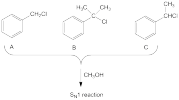 A set of three nucleophilic displacement reactions is shown
below:
Which reaction (A, B, or C) proceeds the fastest?
Which reaction (A, B, or C) proceeds the slowest?
A set of three nucleophilic displacement reactions is shown below:Which reaction (A, B, or C) proceeds the fastest? Which reaction (A, B, or C) proceeds the slowest?
A set of three nucleophilic displacement reactions is shown
below:
Which reaction (A, B, or C) proceeds the fastest?
Which reaction (A, B, or C) proceeds the slowest?
A set of three nucleophilic displacement reactions is shown below:Which reaction (A, B, or C) proceeds the fastest? Which reaction (A, B, or C) proceeds the slowest?
Model 1 - Potential Energy Diagrams 1) The energy (enthalpy) change of a reaction can be...
 Model 1 - Potential Energy Diagrams 1) The energy (enthalpy) change of a reaction can be determined by the following expression: Activated Complex Transition State AH = Energy products - Energy reactants Activation Energy, E Reactants Consider the energy change for the reaction in Model 1 (the graph to the left). Potential Energy (kJ/mol) Energy change (AH) Products a) The energy change shown is (positive/negative). b) This reaction is (endothermic / exothermic). c) These (reactants / transition state) has more...
25) Objects can possess energy as (a) endothermic energy (b) potential energy (c) kinetic energy A) a only B) b...
 25) Objects can possess energy as (a) endothermic energy (b) potential energy (c) kinetic energy A) a only B) b only C) c only D) bandc E) a and 33) The value of AH' for the reaction below is - 790 kl. The enthalpy change accompanying the reaction of 0.95 g of Sis_ k 33) 25 (s) + 302 (9) -2503 (9) A) 12 B) 23 C) -23 D) - 790 E) -12 34) The value of AH' for the...
6. Consider the reactions in which the elements A, B, C, and D are elements in...
 6. Consider the reactions in which the elements A, B, C, and D are elements in their most stable states: a. Draw out a thermodynamic cycle to describe the formation of E. b. Using the following table of ΔG° values, what is the value of Δ(G" for the formation of E? AG (kJ/mol) reaction 100 120 40
Wall LU ICVICW SUHL llalla 10 UNPLUI 2. MATHEMATICAL Consider the reaction A B + C,...
 Wall LU ICVICW SUHL llalla 10 UNPLUI 2. MATHEMATICAL Consider the reaction A B + C, where AG = 0.00. (a) What is the value of AG (not AG”) when the initial concentra- tions of A, B, and Care 1 M, 10-3 M, and 10-6 M? (b) Try the same calculations for the reaction D + E= F, for the same relative order of concentrations. (c) Try the same calculations for the reaction G =H, if the con- centrations are...
1.. Which statement is correct about the changes in potential energy and kinetic energy when two...
1.. Which statement is correct about the changes in potential energy and kinetic energy when two N atoms combine to form an N2 molecule? Group of answer choices a. The potential energy becomes more negative and the kinetic energy increases. b. The potential energy becomes more positive and the kinetic energy decreases. c. The potential energy becomes more positive and the kinetic energy increases. d. The potential energy becomes more negative and the kinetic energy decreases. 2.. You take solid...
Consider two related reactions with the following Gibbs free energy profiles. In Reaction (A), the reactant has four energetically similar conformers, while in Reaction (B) there is only 1 predominant reactant conformer. In each case, the lowest energy re
 Consider two related reactions with the following Gibbs free energy profiles. In Reaction (A), the reactant has four energetically similar conformers, while in Reaction (B) there is only 1 predominant reactant conformer. In each case, the lowest energy reactant (R) and product (P) conformers are indicated by a red circle. Which of the following statement is true about the equilibrium constants [P]/[R] for the two reactions?a. Reaction A would have a larger equilibrium constant because the reactant state is characterised by...
(b) Construct the hypothetical ternary system A-B-C which represents the following conditions assuming A-B-C system does...
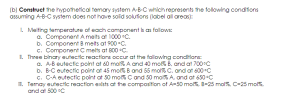 (b) Construct the hypothetical ternary system A-B-C which represents the following conditions assuming A-B-C system does not have solid solutions (label all areas): i. Melting temperature of each component is as follows: a. Component Amelts at 1000 °C. b. Component B melts at 900 °C. c. Component C melts at 800 °C. ii. Three binary eutectic reactions occur at the following conditions: a. A-B eutectic point at 60 mol% A and 40 mol% B, and at 700C b. B-C eutectic...
 Based on the activation energies and frequency factors, rank the
following reactions from fastest to slowest reaction rate, assuming
they are all at the same temperature and that each starts with the
same initial concentration.
Rank from fastest to slowest reaction rate. To rank items as
equivalent, overlap them.
Fraction of molecules
The exponential term in the Arrhenius equation is equal to the
fraction of molecules, f, with kinetic energy greater than or equal
to the activation energy:
f=e−Ea/(R⋅T)
Most...
Based on the activation energies and frequency factors, rank the
following reactions from fastest to slowest reaction rate, assuming
they are all at the same temperature and that each starts with the
same initial concentration.
Rank from fastest to slowest reaction rate. To rank items as
equivalent, overlap them.
Fraction of molecules
The exponential term in the Arrhenius equation is equal to the
fraction of molecules, f, with kinetic energy greater than or equal
to the activation energy:
f=e−Ea/(R⋅T)
Most...
 4. Suppose that a reaction R → P proceeded according to the energy diagram shown. a. [4 pts] A catalyst lowers the activation barrier of a reaction from 125 kJ/mol to 55 kJ/mol. Write out a reaction mechanism for the catalyzed reaction. b. [6 pts] Sketch what the catalyzed reaction pathway would look like on an energy diagram. All relative heights should make sense for catalyzed pathways for full credit. c. [6 pts] By what factor would you expect the...
 A set of three nucleophilic displacement reactions is shown
below:
Which reaction (A, B, or C) proceeds the fastest?
Which reaction (A, B, or C) proceeds the slowest?
A set of three nucleophilic displacement reactions is shown below:Which reaction (A, B, or C) proceeds the fastest? Which reaction (A, B, or C) proceeds the slowest?
A set of three nucleophilic displacement reactions is shown
below:
Which reaction (A, B, or C) proceeds the fastest?
Which reaction (A, B, or C) proceeds the slowest?
A set of three nucleophilic displacement reactions is shown below:Which reaction (A, B, or C) proceeds the fastest? Which reaction (A, B, or C) proceeds the slowest?
 Model 1 - Potential Energy Diagrams 1) The energy (enthalpy) change of a reaction can be determined by the following expression: Activated Complex Transition State AH = Energy products - Energy reactants Activation Energy, E Reactants Consider the energy change for the reaction in Model 1 (the graph to the left). Potential Energy (kJ/mol) Energy change (AH) Products a) The energy change shown is (positive/negative). b) This reaction is (endothermic / exothermic). c) These (reactants / transition state) has more...
 25) Objects can possess energy as (a) endothermic energy (b) potential energy (c) kinetic energy A) a only B) b only C) c only D) bandc E) a and 33) The value of AH' for the reaction below is - 790 kl. The enthalpy change accompanying the reaction of 0.95 g of Sis_ k 33) 25 (s) + 302 (9) -2503 (9) A) 12 B) 23 C) -23 D) - 790 E) -12 34) The value of AH' for the...
 6. Consider the reactions in which the elements A, B, C, and D are elements in their most stable states: a. Draw out a thermodynamic cycle to describe the formation of E. b. Using the following table of ΔG° values, what is the value of Δ(G" for the formation of E? AG (kJ/mol) reaction 100 120 40
 Wall LU ICVICW SUHL llalla 10 UNPLUI 2. MATHEMATICAL Consider the reaction A B + C, where AG = 0.00. (a) What is the value of AG (not AG”) when the initial concentra- tions of A, B, and Care 1 M, 10-3 M, and 10-6 M? (b) Try the same calculations for the reaction D + E= F, for the same relative order of concentrations. (c) Try the same calculations for the reaction G =H, if the con- centrations are...
 (b) Construct the hypothetical ternary system A-B-C which represents the following conditions assuming A-B-C system does not have solid solutions (label all areas): i. Melting temperature of each component is as follows: a. Component Amelts at 1000 °C. b. Component B melts at 900 °C. c. Component C melts at 800 °C. ii. Three binary eutectic reactions occur at the following conditions: a. A-B eutectic point at 60 mol% A and 40 mol% B, and at 700C b. B-C eutectic...
Most questions answered within 3 hours.
-
Where is the error in this code sequence?
String s1 = "Hello";
String s2 = "ello";...
asked 11 months ago -
Financial data for Joel de Paris, Inc., for last year
follow:
Joel de Paris, Inc.
Balance...
asked 11 months ago -
Consider this reaction:
Al2(SO4)3 (aq)+ BaCl3
(aq) Al2Cl6 (aq)- +
3BaSO4(s) . What is the...
asked 11 months ago -
Suppose that Savneet is considering increasing her
recent random sample from 20 car rentals to 40...
asked 11 months ago -
Trucks arrive at an unloading terminal at an average rate of 120
per hour.
Trucks arrive...
asked 11 months ago -
Why are methanol and ethanol completely soluble in water while
octanol is not very little soluble....
asked 11 months ago -
A facilities manager at a university reads in a research report
that the mean amount of...
asked 11 months ago -
When the CuSO4 is rehydrated by adding water to the anhydrous
compound, is this an endothermic...
asked 11 months ago -
A ray of sunlight is passing from diamond into crown glass; the
angle of incidence is...
asked 11 months ago -
A block of mass 0.249 kg is placed on top of a light, vertical
spring of...
asked 11 months ago -
how do the kidneys compensate in the presences of acidosis
a) trigger hyperventilate
b) reserve acid...
asked 11 months ago -
Question 501 pts
The rental rate of capital to the firm increases. Which of the
following...
asked 11 months ago