
Homework Answers
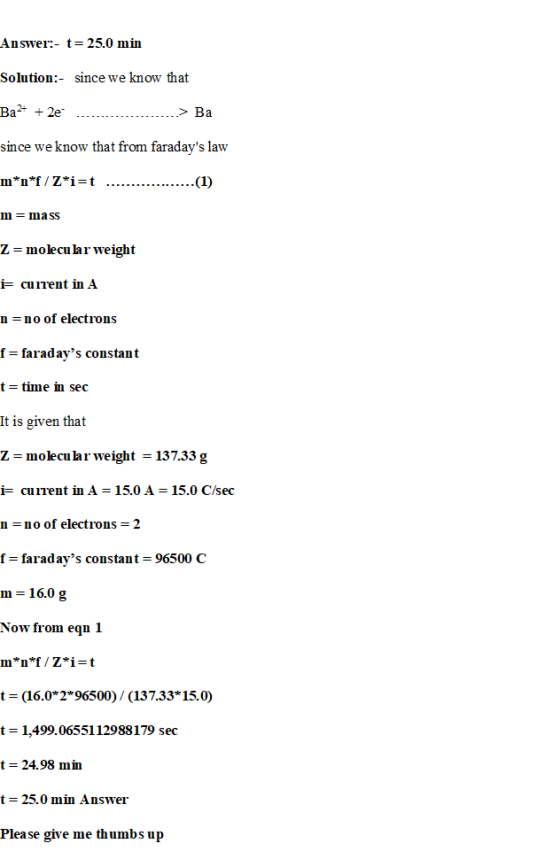
Note:- answer may vary because in some places people uses 96500 or 96485.33
so use whatever is in your textbook
hope it helps
Add Answer to:
urgent
7) Small amounts of the metal barium (Ba, MW = 137.33 g/mol) can be produced...
7) Small amounts of the metal barium (Ba, MW = 137.33 g/mol) can be produced by...
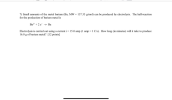 7) Small amounts of the metal barium (Ba, MW = 137.33 g/mol) can be produced by electrolysis. The half-reaction for the production of barium metal is Ba²+ + 2e Ba Electrolysis is carried out using a current i = 15.0 amp (1 amp - 1 C/s). How long (in minutes) will it take to produce 16.0 g of barium metal? [12 points)
7) Small amounts of the metal barium (Ba, MW = 137.33 g/mol) can be produced by...
 7) Small amounts of the metal barium (Ba, MW = 137.33 g/mol) can be produced by electrolysis. The half-reaction for the production of barium metal is Ba2+ + 2 e → Ba Electrolysis is carried out using a current i = 15.0 amp (1 amp = 1 C/s). How long (in minutes) will it take to produce 16.0 g of barium metal? [12 points]
7) Small amounts of the metal strontium (Sr, MW = 87.62 g/mol) can be produced by...
 7) Small amounts of the metal strontium (Sr, MW = 87.62 g/mol) can be produced by electrolysis. The half-reaction for the production of strontium metal is Sr?+ +2e Sr Electrolysis is carried out using a current i = 15.0 amp (1 amp - 1 C/s). How long in minutes) will it take to produce 25.0 g of strontium metal? [12 points)
7) Small amounts of the metal strontium (Sr, MW = 87.62 g/mol) can be produced by...
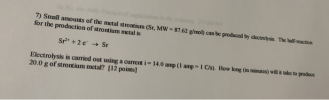 7) Small amounts of the metal strontium (Sr, MW = 87.62 g/mol) can be produced by electrolysis. The half-reaction for the production of strontium metal is Sr?+ +2 → Sr Electrolysis is carried out using a current i = 14.0 amp (1 amp = 1 C/s). How long (in minutes) will it take to produce 20.0 g of strontium metal? [12 points)
I 7) Small amounts of the metal strontium (Sr, MW - 87.62 g/mol) can be produced...
 I 7) Small amounts of the metal strontium (Sr, MW - 87.62 g/mol) can be produced by electrolysis. The half-reaction for the production of strontium metal is Sr+ + 2 e Sr Electrolysis is carried out using a current i - 12.0 amp (1 amp = 1 C/s). How long in minutes) will it take to produce 12.0 g of strontium metal? [12 points)
4) For each of the following questions circle the correct answer. There is one and only...
 4) For each of the following questions circle the correct answer. There is one and only one correct answer per problem. [5 points each] a) A colligative property whose value depends directly on the mole fraction of solute particles osmotic pressure boiling point freezing point vapor pressure elevation depression lowering b) An example of a strong soluble base Pb(OH) Ba(OH)2 Cu(OH)2 AgOH c) A cation that is expected to act as a weak acid in water Mg? (aq) Pb?"(aq) Ag...
1. Small amounts of oxygen gas can be produced for laboratory use by heating potassium chlorate,...
1. Small amounts of oxygen gas can be produced for laboratory use by heating potassium chlorate, which causes it to decompose by the following reaction: ___KClO3(s) → ____KCl(s) + ___O2(g) (unbalanced) Balance the equation, and determine the mass of oxygen that will be formed if 15.0 g of potassium chlorate decomposes. a. 11.7 g b. 57.5 g c. 173 g d. 5.88 g e. 86.1 g
Problen 1 1. For production of penicillin (CIGHsO4N S, molecular weight 334.4 g/mol), glucose CoHr2O) is...
 Problen 1 1. For production of penicillin (CIGHsO4N S, molecular weight 334.4 g/mol), glucose CoHr2O) is used as substrate and phenylacetic acid (C H O2) is added as precursor. The stoichiometry for overall synthesis is: A supply of 100 mol/hr of glucose is fed to a continuous stirred-tank reactor for the production of penicillin, along with 200 mol/hr of ammonia (NHs),130 mol/hr of oxygen, 125 mol/hr of sulfuric acid and 100 mol/hr of phenylacetic acid. a. Determine the limiting reactant...
Microscale techniques: In today's experiment we will be using very small amounts of chemical reactants. This...
 Microscale techniques: In today's experiment we will be using very small amounts of chemical reactants. This method is generally less expensive and more environmentally-friendly than traditional "test tube" chemistry. Some of the waste products produced in today's experiment, particularly those containing lead and barium, are harmful to the environment. By using such small amounts of chemical reactants we generate far less waste than by using larger scale methods. Procedure 1. Put on your safety goggles. Be sure to wear them...
Preparation of Benzoic Acid using a Grignard Reagent URGENT 1. During your Grignard formation, a small...
Preparation of Benzoic Acid using a Grignard Reagent URGENT 1. During your Grignard formation, a small amount of benzene is formed. Provide a brief explanation and mechanism to explain this observation. 2. During your Grignard formation, a small amount of biphenyl is formed. Provide a brief explanation and mechanism to explain this observation. 3. What mass of water would be required to destroy the phenylmagnesium bromide that you prepared in this experiment? What volume does this represent? 4. Why is...
 7) Small amounts of the metal barium (Ba, MW = 137.33 g/mol) can be produced by electrolysis. The half-reaction for the production of barium metal is Ba²+ + 2e Ba Electrolysis is carried out using a current i = 15.0 amp (1 amp - 1 C/s). How long (in minutes) will it take to produce 16.0 g of barium metal? [12 points)
 7) Small amounts of the metal barium (Ba, MW = 137.33 g/mol) can be produced by electrolysis. The half-reaction for the production of barium metal is Ba2+ + 2 e → Ba Electrolysis is carried out using a current i = 15.0 amp (1 amp = 1 C/s). How long (in minutes) will it take to produce 16.0 g of barium metal? [12 points]
 7) Small amounts of the metal strontium (Sr, MW = 87.62 g/mol) can be produced by electrolysis. The half-reaction for the production of strontium metal is Sr?+ +2e Sr Electrolysis is carried out using a current i = 15.0 amp (1 amp - 1 C/s). How long in minutes) will it take to produce 25.0 g of strontium metal? [12 points)
 7) Small amounts of the metal strontium (Sr, MW = 87.62 g/mol) can be produced by electrolysis. The half-reaction for the production of strontium metal is Sr?+ +2 → Sr Electrolysis is carried out using a current i = 14.0 amp (1 amp = 1 C/s). How long (in minutes) will it take to produce 20.0 g of strontium metal? [12 points)
 I 7) Small amounts of the metal strontium (Sr, MW - 87.62 g/mol) can be produced by electrolysis. The half-reaction for the production of strontium metal is Sr+ + 2 e Sr Electrolysis is carried out using a current i - 12.0 amp (1 amp = 1 C/s). How long in minutes) will it take to produce 12.0 g of strontium metal? [12 points)
 4) For each of the following questions circle the correct answer. There is one and only one correct answer per problem. [5 points each] a) A colligative property whose value depends directly on the mole fraction of solute particles osmotic pressure boiling point freezing point vapor pressure elevation depression lowering b) An example of a strong soluble base Pb(OH) Ba(OH)2 Cu(OH)2 AgOH c) A cation that is expected to act as a weak acid in water Mg? (aq) Pb?"(aq) Ag...
 Problen 1 1. For production of penicillin (CIGHsO4N S, molecular weight 334.4 g/mol), glucose CoHr2O) is used as substrate and phenylacetic acid (C H O2) is added as precursor. The stoichiometry for overall synthesis is: A supply of 100 mol/hr of glucose is fed to a continuous stirred-tank reactor for the production of penicillin, along with 200 mol/hr of ammonia (NHs),130 mol/hr of oxygen, 125 mol/hr of sulfuric acid and 100 mol/hr of phenylacetic acid. a. Determine the limiting reactant...
 Microscale techniques: In today's experiment we will be using very small amounts of chemical reactants. This method is generally less expensive and more environmentally-friendly than traditional "test tube" chemistry. Some of the waste products produced in today's experiment, particularly those containing lead and barium, are harmful to the environment. By using such small amounts of chemical reactants we generate far less waste than by using larger scale methods. Procedure 1. Put on your safety goggles. Be sure to wear them...
Most questions answered within 3 hours.
-
Where is the error in this code sequence?
String s1 = "Hello";
String s2 = "ello";...
asked 11 months ago -
Financial data for Joel de Paris, Inc., for last year
follow:
Joel de Paris, Inc.
Balance...
asked 11 months ago -
Consider this reaction:
Al2(SO4)3 (aq)+ BaCl3
(aq) Al2Cl6 (aq)- +
3BaSO4(s) . What is the...
asked 11 months ago -
Suppose that Savneet is considering increasing her
recent random sample from 20 car rentals to 40...
asked 11 months ago -
Trucks arrive at an unloading terminal at an average rate of 120
per hour.
Trucks arrive...
asked 11 months ago -
Why are methanol and ethanol completely soluble in water while
octanol is not very little soluble....
asked 11 months ago -
A facilities manager at a university reads in a research report
that the mean amount of...
asked 11 months ago -
When the CuSO4 is rehydrated by adding water to the anhydrous
compound, is this an endothermic...
asked 11 months ago -
A ray of sunlight is passing from diamond into crown glass; the
angle of incidence is...
asked 11 months ago -
A block of mass 0.249 kg is placed on top of a light, vertical
spring of...
asked 11 months ago -
how do the kidneys compensate in the presences of acidosis
a) trigger hyperventilate
b) reserve acid...
asked 11 months ago -
Question 501 pts
The rental rate of capital to the firm increases. Which of the
following...
asked 11 months ago