
Homework Answers
ANSWER-
Correct statements are;
1) The rate increases with the use of platinum catalyst.
2) The rate doubles when [F2] is doubled and [NO2] is held constant.
3) The rate doubles when [NO2] is doubled and [F2] is held constant.
6) The rate quadruples when [F2] and [NO2] are both doubled.
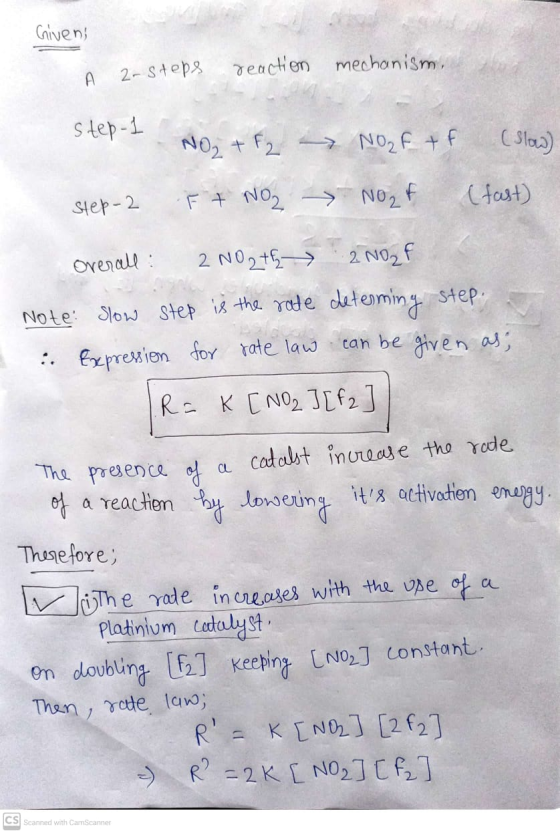
![-> R?=2 R On doubling y un The rate doubles when [52] is coobled and [NO2] is held constant [NO2 and keeping [f₂] constant Ra](http://img.homeworklib.com/questions/3b884f00-fea8-11ea-9e1f-0dce915fe346.png?x-oss-process=image/resize,w_560)
![On doubling both [fa] and [NO₂]. Rate law R = = K [2 NO2] [2f2 R² = 2x2 K [Na] [f2] R?= 4 K [ NOZ If2] R² = 4 R y vi the rate](http://img.homeworklib.com/questions/3c83a830-fea8-11ea-b4f3-976de9506259.png?x-oss-process=image/resize,w_560)
Add Answer to:
D Question 9 1 pts A two-step mechanism has been proposed for the reaction between NO,...
The pH of two separate solutions, 1.0 M HNO3 and 1.0M HC H302, are measured. Which...
 The pH of two separate solutions, 1.0 M HNO3 and 1.0M HC H302, are measured. Which statement is true? The HNO3 has a higher pH because it is a strong acid. The HC2H302 has a higher pH because it is a weak acid, The HC2H302 has a higher pH because it has more acidic hydrogen atoms. The HC H30, has a lower pH because it has more acidic hydrogen atoms. The two solutions have the same pH because the concentrations...
A student proposed the following mechanism for the gas phase reaction of fluorine with chlorine dioxide....
 A student proposed the following mechanism for the gas phase reaction of fluorine with chlorine dioxide. step 1 fast: 2 CIO, 2 C104 step 2 slow: C1204 +F2 ——2 FCIO2 (1) What is the equation for the overall reaction? Use the smallest integer coefficients possible. If a box is not needed, leave it blank. 20102 + F2 - 2FC10, + (2) Enter the formula of any species that acts as a reaction intermediate? If none leave box blank: (3) Complete...
A mechanism for the gas phase reaction of fluorine with chlorine dioxide that is consistent with...
 A mechanism for the gas phase reaction of fluorine with chlorine dioxide that is consistent with the observed rate law is: step slow: F2+CIO, FCIO, + F step 2 fast: F+CIO, FCIO, (1) What is the equation for the overall reaction? Use the smallest integer coefficients possible. If a box is not needed, leave it blank. (2) Which species acts as a catalyst? Enter formula. If none, leave box blank (3) Which species acts as a reaction intermediate? Enter formula....
1. The following mechanism has been proposed for the pas-phase reaction of chloroform and chlorine Ch> 20 (fast)...
 1. The following mechanism has been proposed for the pas-phase reaction of chloroform and chlorine Ch> 20 (fast) CI + CHCI, - HCI +CCI, (slow) Cl + CCI - CCI (fast) a) Identify any intermediate(s): b) Identify any catalyst(s): b) Write the balanced equation for the overall reaction: c) Molecularity of each step: step 1. step 2. step 3 d) rds (circle): 1 2 3 d) What is the observable rate law predicted by this mechanism? e) What is the...
A student proposed the following mechanism for the gas phase reaction of fluorine with chlorine dioxide....
 A student proposed the following mechanism for the gas phase reaction of fluorine with chlorine dioxide. step 1 fast: 2C10, C1,04 step 2 slow: Cl,04 + F2 — 2 FCIO2 (1) What is the equation for the overall reaction? Use the smallest integer coefficients possible. If a box is not needed, leave it blank. (2) Enter the formula of any species that acts as a reaction intermediate? If none leave box blank: (3) Complete the rate law for the overall...
4. Below is a proposed mechanism for a reaction: Step 1. Step 2. C+E-F Step 3....
 4. Below is a proposed mechanism for a reaction: Step 1. Step 2. C+E-F Step 3. F G A B C+D Fast equilibrium Slow Fast A. (2 points) What is the overall stoichiometry for this reaction? B. (2 points) Which step is the rate determining step? C. (6 points) If this mechanism is correct, what should the rate equation for this reaction be? (Make sure you include the fast equilibrium)
The following mechanism has been proposed for the reaction between nitrogen monoxide and oxygen in the...
 The following mechanism has been proposed for the reaction
between nitrogen monoxide and oxygen in the gas phase.
.....step
1.....fast:......2
NO --->
N2O2
.....step
2.....slow:....N2O2
+ O2 ----> 2
NO2
(1) What is the equation for the overall reaction?
Use the smallest integer coefficients possible. If a box is not
needed, leave it blank.
_______ +
________
_________ + ________
(2)
Enter the formula of any species
that acts as a reaction intermediate? If none leave box...
The following mechanism has been proposed for the reaction
between nitrogen monoxide and oxygen in the gas phase.
.....step
1.....fast:......2
NO --->
N2O2
.....step
2.....slow:....N2O2
+ O2 ----> 2
NO2
(1) What is the equation for the overall reaction?
Use the smallest integer coefficients possible. If a box is not
needed, leave it blank.
_______ +
________
_________ + ________
(2)
Enter the formula of any species
that acts as a reaction intermediate? If none leave box...
2. Consider this two step mechanism for a reaction… Step 1 NO2 + O3 --> NO3 ...
2. Consider this two step mechanism for a reaction… Step 1 NO2 + O3 --> NO3 + O2 slow; rate determining step Step 2 NO3 + NO2 --> N2O5 fast a. What is the overall reaction? b. Identify the intermediates in the mechanism. c. Write the rate law expression for each step of the mechanism including any reversible reactions. c. What is the predicted rate law expression? Be sure to only list reactants from the overall equation and not intermediates...
A proposed mechanism for the gas phase reaction between nitrogen monoxide and oxygen is as follows:...
 A proposed mechanism for the gas phase reaction between
nitrogen monoxide and oxygen is as follows:
..... step 1 ..... fast:
...... NO + O2NO3
..... step 2 ..... slow:
.... NO3 + NO 2
NO2
(1) What is the equation for the overall reaction?
Use the smallest integer coefficients possible. If a box is not
needed, leave it blank.
+
+
(2)
Which species acts as a catalyst? Enter formula. If none, leave
box blank:
(3)
Which species...
A proposed mechanism for the gas phase reaction between
nitrogen monoxide and oxygen is as follows:
..... step 1 ..... fast:
...... NO + O2NO3
..... step 2 ..... slow:
.... NO3 + NO 2
NO2
(1) What is the equation for the overall reaction?
Use the smallest integer coefficients possible. If a box is not
needed, leave it blank.
+
+
(2)
Which species acts as a catalyst? Enter formula. If none, leave
box blank:
(3)
Which species...
QUESTION 9 A proposed mechanism for the reaction 2NO(g) +2H2(g) → N2(g) + 2H2O(g): Step 1:...
QUESTION 9 A proposed mechanism for the reaction 2NO(g) +2H2(g) → N2(g) + 2H2O(g): Step 1: 2NO(g) → N2O2(g) (very fast, reversible) Step 2: N2O2(g) + H2(g) → N2O(g) + H2O(g) (slow) Step 3: N2O(g) + H2(g) →N2(g) + H2O(g) (fast) What is the rate law for the overall reaction? k[N2O][H2] k[NO]2[H2] k[NO]2[H2]2 k[NO]1/2[H2] k[NO]2
 The pH of two separate solutions, 1.0 M HNO3 and 1.0M HC H302, are measured. Which statement is true? The HNO3 has a higher pH because it is a strong acid. The HC2H302 has a higher pH because it is a weak acid, The HC2H302 has a higher pH because it has more acidic hydrogen atoms. The HC H30, has a lower pH because it has more acidic hydrogen atoms. The two solutions have the same pH because the concentrations...
 A student proposed the following mechanism for the gas phase reaction of fluorine with chlorine dioxide. step 1 fast: 2 CIO, 2 C104 step 2 slow: C1204 +F2 ——2 FCIO2 (1) What is the equation for the overall reaction? Use the smallest integer coefficients possible. If a box is not needed, leave it blank. 20102 + F2 - 2FC10, + (2) Enter the formula of any species that acts as a reaction intermediate? If none leave box blank: (3) Complete...
 A mechanism for the gas phase reaction of fluorine with chlorine dioxide that is consistent with the observed rate law is: step slow: F2+CIO, FCIO, + F step 2 fast: F+CIO, FCIO, (1) What is the equation for the overall reaction? Use the smallest integer coefficients possible. If a box is not needed, leave it blank. (2) Which species acts as a catalyst? Enter formula. If none, leave box blank (3) Which species acts as a reaction intermediate? Enter formula....
 1. The following mechanism has been proposed for the pas-phase reaction of chloroform and chlorine Ch> 20 (fast) CI + CHCI, - HCI +CCI, (slow) Cl + CCI - CCI (fast) a) Identify any intermediate(s): b) Identify any catalyst(s): b) Write the balanced equation for the overall reaction: c) Molecularity of each step: step 1. step 2. step 3 d) rds (circle): 1 2 3 d) What is the observable rate law predicted by this mechanism? e) What is the...
 A student proposed the following mechanism for the gas phase reaction of fluorine with chlorine dioxide. step 1 fast: 2C10, C1,04 step 2 slow: Cl,04 + F2 — 2 FCIO2 (1) What is the equation for the overall reaction? Use the smallest integer coefficients possible. If a box is not needed, leave it blank. (2) Enter the formula of any species that acts as a reaction intermediate? If none leave box blank: (3) Complete the rate law for the overall...
 4. Below is a proposed mechanism for a reaction: Step 1. Step 2. C+E-F Step 3. F G A B C+D Fast equilibrium Slow Fast A. (2 points) What is the overall stoichiometry for this reaction? B. (2 points) Which step is the rate determining step? C. (6 points) If this mechanism is correct, what should the rate equation for this reaction be? (Make sure you include the fast equilibrium)
Most questions answered within 3 hours.
-
Where is the error in this code sequence?
String s1 = "Hello";
String s2 = "ello";...
asked 10 months ago -
Financial data for Joel de Paris, Inc., for last year
follow:
Joel de Paris, Inc.
Balance...
asked 10 months ago -
Consider this reaction:
Al2(SO4)3 (aq)+ BaCl3
(aq) Al2Cl6 (aq)- +
3BaSO4(s) . What is the...
asked 10 months ago -
Suppose that Savneet is considering increasing her
recent random sample from 20 car rentals to 40...
asked 10 months ago -
Trucks arrive at an unloading terminal at an average rate of 120
per hour.
Trucks arrive...
asked 10 months ago -
Why are methanol and ethanol completely soluble in water while
octanol is not very little soluble....
asked 10 months ago -
A facilities manager at a university reads in a research report
that the mean amount of...
asked 10 months ago -
When the CuSO4 is rehydrated by adding water to the anhydrous
compound, is this an endothermic...
asked 10 months ago -
A ray of sunlight is passing from diamond into crown glass; the
angle of incidence is...
asked 10 months ago -
A block of mass 0.249 kg is placed on top of a light, vertical
spring of...
asked 10 months ago -
how do the kidneys compensate in the presences of acidosis
a) trigger hyperventilate
b) reserve acid...
asked 10 months ago -
Question 501 pts
The rental rate of capital to the firm increases. Which of the
following...
asked 10 months ago