QUESTION 21 Venus has an orbital period of 224.7 days and a rotational period of 243.02...
QUESTION 21 Venus has an orbital period of 224.7 days and a rotational period of 243.02 days. NASA would like to place a satellite around Venus which always remains in the same position over the Venusian surface. What should the speed of this satellite be (m/s)?
Homework Answers
 Thanks please rate it
up.
Thanks please rate it
up.
Add Answer to:
QUESTION 21 Venus has an orbital period of 224.7 days and a
rotational period of 243.02...
QUESTION 20 Venus has an orbital period of 224.7 days and a rotational period of 243.02...
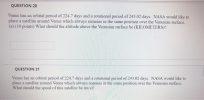 QUESTION 20 Venus has an orbital period of 224.7 days and a rotational period of 243.02 days. NASA would like to place a satellite around Venus which always remains in the same position over the Venusian surface. (a) (10 points) What should the altitude above the Venusian surface be (KILOMETERS)? QUESTION 21 Venus has an orbital period of 224.7 days and a rotational period of 243.02 days. NASA would like to place a satellite around Venus which always remains in...
QUESTION 20 Venus has an orbital period of 224.7 days and a rotational period of 243.02...
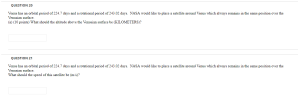 QUESTION 20 Venus has an orbital period of 224.7 days and a rotational period of 243.02 days. NASA would like to place a satellite around Venus which always remains in the same position over the Venusian surface. (a) (10 points) What should the altitude above the Venusian surface be (KILOMETERS)? QUESTION 21 Venus has an orbital period of 224.7 days and a rotational period of 243.02 days. NASA would like to place a satellite around Venus which always remains in...
Venus has an orbital period of 224.7 days and a rotational period of 243.02 days. NASA would...
Venus has an orbital period of 224.7 days and a rotational period of 243.02 days. NASA would like to place a satellite around Venus which always remains in the same position over the Venusian surface. (a) (10 points) What should the altitude above the Venusian surface be (KILOMETERS)? B. What should the speed of this satellite be (m/s)?
Venus has an orbital period of 224.7 days and a rotational period of 243.02 days. NASA...
Venus has an orbital period of 224.7 days and a rotational period of 243.02 days. NASA would like to place a satellite around Venus which always remains in the same position over the Venusian surface. (a) (10 points) What should the altitude above the Venusian surface be (KILOMETERS)?
The Moon has a mass of M = 7.3·1022 kg,a radius of R = 1.7·106 m...
The Moon has a mass of M = 7.3·1022 kg,a radius of R = 1.7·106 m and a rotation period of T = 27.3 days.Scientists are planning to place a satellite around the Moon that always remains above the same position (geostationary). (a)Calculate the distance from the Moon’s surface to this satellite. (b)Explain if such a Moon satellite is possible in reality.
The International Space Station, ISS hereafter, has an orbital period of approxi- mately 93 minutes. Determine the following: 12. How fast is the ISS moving? 13. How far above the surface of the Eart...
 The International Space Station, ISS hereafter, has an orbital period of approxi- mately 93 minutes. Determine the following: 12. How fast is the ISS moving? 13. How far above the surface of the Earth is the ISS? 14. Using only your answer to question 12 and the given orbital perdiod of the ISS, determine how high the Hubble Space Telescope orbits above the surface of the Earth, if its orbital period is 95.42 minutes 15. If NASA launched portable rocket-boosters...
The tidal forces between the Earth and the Moon slowed down the Moon’s rotation about its own axis until the rotation period became equal to the Moon’s orbital period around the Earth as we observe today.
 The tidal forces between the Earth and the Moon slowed down the Moon's rotation about its own axis until the rotation period became equal to the Moon's orbital period around the Earth as we observe today. The same effect is also slowing down the Earth's rotation about its own axis and increasing the separation \(D\) between the Moon and the Earth at a rate of \(\Delta D / \Delta t=3.8 \mathrm{~cm}\) per year. In this problem, you can ignore the...
QUESTION 10: A company has an average collection period of 21 days. The firm’s annual credit...
QUESTION 10: A company has an average collection period of 21 days. The firm’s annual credit sales total $23,389,300. Calculate the firm’s accounts receivable. $1,345,686 $2,012,012 $1,946,090 $1,648,567 none of these QUESTION 11: A firm has an ROE of 18% and a ROA of 12%. What would the equity multiplier (leverage) be? .883 1.02 1.5 20 none of these
Question 6: (a.) The asteroid Vesta orbits the Sun with a semi-major axis of 2.362 AU....
 Question 6: (a.) The asteroid Vesta orbits the Sun with a semi-major axis of 2.362 AU. It has a rotational period of about 5 hr 21 min and an albedo of 0.38 (unusually reflective for an asteroid). (a) Estimate Vesta's surface temperature (b) Estimate what Vesta's surface temperature would be if it were instead tidally locked with the Sun so that it always kept the same side facing the Sun. State at what point on the planet this temperature is...
Today, the Moon’s orbit around Earth has a semi-major axis of a=384,400 km and an orbital...
 Today, the Moon’s orbit around
Earth has a semi-major axis of a=384,400 km and an orbital period
of 27.32166 days.
a. The Moon slowly moves outward due to tidal braking of the
Earth’s rotation, and at some future date the Moon will have an
orbital period of 47 days. Compute the semi-major axis of the
Moon’s orbit at this future date (express your answer in
kilometers).
semi-major axis = 5.5*10^5 km
b. Today, the Moon has an angular diameter of...
Today, the Moon’s orbit around
Earth has a semi-major axis of a=384,400 km and an orbital period
of 27.32166 days.
a. The Moon slowly moves outward due to tidal braking of the
Earth’s rotation, and at some future date the Moon will have an
orbital period of 47 days. Compute the semi-major axis of the
Moon’s orbit at this future date (express your answer in
kilometers).
semi-major axis = 5.5*10^5 km
b. Today, the Moon has an angular diameter of...
 QUESTION 20 Venus has an orbital period of 224.7 days and a rotational period of 243.02 days. NASA would like to place a satellite around Venus which always remains in the same position over the Venusian surface. (a) (10 points) What should the altitude above the Venusian surface be (KILOMETERS)? QUESTION 21 Venus has an orbital period of 224.7 days and a rotational period of 243.02 days. NASA would like to place a satellite around Venus which always remains in...
 QUESTION 20 Venus has an orbital period of 224.7 days and a rotational period of 243.02 days. NASA would like to place a satellite around Venus which always remains in the same position over the Venusian surface. (a) (10 points) What should the altitude above the Venusian surface be (KILOMETERS)? QUESTION 21 Venus has an orbital period of 224.7 days and a rotational period of 243.02 days. NASA would like to place a satellite around Venus which always remains in...
 The International Space Station, ISS hereafter, has an orbital period of approxi- mately 93 minutes. Determine the following: 12. How fast is the ISS moving? 13. How far above the surface of the Earth is the ISS? 14. Using only your answer to question 12 and the given orbital perdiod of the ISS, determine how high the Hubble Space Telescope orbits above the surface of the Earth, if its orbital period is 95.42 minutes 15. If NASA launched portable rocket-boosters...
 Question 6: (a.) The asteroid Vesta orbits the Sun with a semi-major axis of 2.362 AU. It has a rotational period of about 5 hr 21 min and an albedo of 0.38 (unusually reflective for an asteroid). (a) Estimate Vesta's surface temperature (b) Estimate what Vesta's surface temperature would be if it were instead tidally locked with the Sun so that it always kept the same side facing the Sun. State at what point on the planet this temperature is...
 Today, the Moon’s orbit around
Earth has a semi-major axis of a=384,400 km and an orbital period
of 27.32166 days.
a. The Moon slowly moves outward due to tidal braking of the
Earth’s rotation, and at some future date the Moon will have an
orbital period of 47 days. Compute the semi-major axis of the
Moon’s orbit at this future date (express your answer in
kilometers).
semi-major axis = 5.5*10^5 km
b. Today, the Moon has an angular diameter of...
Today, the Moon’s orbit around
Earth has a semi-major axis of a=384,400 km and an orbital period
of 27.32166 days.
a. The Moon slowly moves outward due to tidal braking of the
Earth’s rotation, and at some future date the Moon will have an
orbital period of 47 days. Compute the semi-major axis of the
Moon’s orbit at this future date (express your answer in
kilometers).
semi-major axis = 5.5*10^5 km
b. Today, the Moon has an angular diameter of...
Most questions answered within 3 hours.
-
Where is the error in this code sequence?
String s1 = "Hello";
String s2 = "ello";...
asked 11 months ago -
Financial data for Joel de Paris, Inc., for last year
follow:
Joel de Paris, Inc.
Balance...
asked 11 months ago -
Consider this reaction:
Al2(SO4)3 (aq)+ BaCl3
(aq) Al2Cl6 (aq)- +
3BaSO4(s) . What is the...
asked 11 months ago -
Suppose that Savneet is considering increasing her
recent random sample from 20 car rentals to 40...
asked 11 months ago -
Trucks arrive at an unloading terminal at an average rate of 120
per hour.
Trucks arrive...
asked 11 months ago -
Why are methanol and ethanol completely soluble in water while
octanol is not very little soluble....
asked 11 months ago -
A facilities manager at a university reads in a research report
that the mean amount of...
asked 11 months ago -
When the CuSO4 is rehydrated by adding water to the anhydrous
compound, is this an endothermic...
asked 11 months ago -
A ray of sunlight is passing from diamond into crown glass; the
angle of incidence is...
asked 11 months ago -
A block of mass 0.249 kg is placed on top of a light, vertical
spring of...
asked 11 months ago -
how do the kidneys compensate in the presences of acidosis
a) trigger hyperventilate
b) reserve acid...
asked 11 months ago -
Question 501 pts
The rental rate of capital to the firm increases. Which of the
following...
asked 11 months ago