
Homework Answers

Add Answer to:
Given that mass of an electron is 9.11 x 10⁻³¹ kg and its charge is 1.602...
Consider an electron, of charge magnitude e 1.602 x10¹⁹ C and mass me 9.11 x 10⁻³¹...
 Consider an electron, of charge magnitude e 1.602 x10¹⁹ C and mass me 9.11 x 10⁻³¹ kg, moving in an electric field with an electric field magnitude E-7 x 10² N/C, similar to what Thana observed in the simulation. Let the length of the plates be L = 50 cm, and the distance between them be d = 20 cm. Find the maximum speed, v, the electron could be moving if it enters the space halfway between and parallel to...
An electron (mass 9.11×10^-31 kg, charge -1.602×10^ -19 C)is placed in a uniform electric field, E=5000N/C....
An electron (mass 9.11×10^-31 kg, charge -1.602×10^ -19 C)is placed in a uniform electric field, E=5000N/C. A) what is the change in electric potential if the election moves 1cm in the direction of the electric field? B)What is the change in electric potential energy if the electron moves 1 cm in the direction of the electric field?C) What is the change in electric potential if the election is 1 cm perpendicular to the electric field?D) What is the change in...
An electron (mass 9.11×10^-31 kg, charge -1.602×10^ -19 C)is placed in a uniform electric field, E=5000N/C....
An electron (mass 9.11×10^-31 kg, charge -1.602×10^ -19 C)is placed in a uniform electric field, E=5000N/C. A) what is the change in electric potential if the election moves 1cm in the direction of the electric field? B)What is the change in electric potential energy if the electron moves 1 cm in the direction of the electric field?C) What is the change in electric potential if the election is 1 cm perpendicular to the electric field?D) What is the change in...
An electron (mass m = 9.11 x 10⁻³¹ kg, charge e = 1.6 x 10⁻¹⁹ C)...
An electron (mass m = 9.11 x 10⁻³¹ kg, charge e = 1.6 x 10⁻¹⁹ C) are accelerated from rest through a potential difference V = 450 V and are then deflected by a magnetic field (B = 0.4 T) that is perpendicular to their velocity. The radius of the resulting electron trajectory is:
Use the following values for mass and charge: an electron has mass me = 9.11×10⁻³¹ kg...
Use the following values for mass and charge: an electron has mass me = 9.11×10⁻³¹ kg and charge -e, a proton has mass mp = 1.67×10⁻²⁷ kg and charge +e, an alpha particle has mass malpha = 6.65×10⁻²⁷ kg and charge +2e, where e = 1.60×10⁻¹⁹ C. An electron is released from rest in a vacuum between two flat, parallel metal plates that are 17.0 cm apart and are maintained at a constant electric potential difference of 730 Volts. If...
An electron has a mass of 9.11×10^−31 kg. The charge on an electron is −1.60×10^−19 C...
An electron has a mass of 9.11×10^−31 kg. The charge on an electron is −1.60×10^−19 C . An electron is released from rest in a field that has a magnitude of 100 V/m = 100 N/C. What is the magnitude of the electron's acceleration, in m/s/s? Please provide your answer both in scientific notation and as a decimal.
An electron of mass me 9.11 x 10⁻³¹ kg and a charge of ge1.60 x 10-19...
 An electron of mass me 9.11 x 10⁻³¹ kg and a charge of ge1.60 x 10-19 C is released, from rest, in a region of uniform electric field that points to the right with a magnitude of IE -6.06 N/C. How long does it take for the electron to reach a speed of 7.00 x 10⁴ m/s? Assume the experiment is performed in a vacuum and that you can ignore the effects of gravity and friction. Give you answer in...
An electron (q = -1.602 x 10"C and m = 9.11 x 10 kg) is placed...
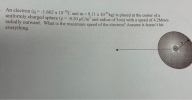 An electron (q = -1.602 x 10"C and m = 9.11 x 10 kg) is placed at the center of a uniformly charged sphere (p = -0.20 uC/m and radius of 5cm) with a speed of 4.2Mm/s radially outward. What is the maximum speed of the electron? Assume it doesn't hit everything
An electron (charge≈ 1.602 × 10⁻¹⁹ C; mass≈ 9.109 × 10⁻³¹ kg) moving at speed 200...
An electron (charge≈ 1.602 × 10⁻¹⁹ C; mass≈ 9.109 × 10⁻³¹ kg) moving at speed 200 m/s finds itself in a region of constant magnetic field. The magnetic field points perpendicular to the electron velocity and has strength 10−3 Tesla. (a) Find the magnitude of the magnetic force experienced by the electron. (b) The magnetic force causes cyclotron motion, so that the electron moves around a circular trajectory. Find the radius of the circular trajectory. (c) How long does it...
particle electron: proton: charge mass me = 9.11 × 10⁻³¹ kg me = 1.67 × 10⁻²⁷...
 particle electron: proton: charge mass me = 9.11 × 10⁻³¹ kg me = 1.67 × 10⁻²⁷ kg m, = 1.67 × 10⁻²⁷ kg 9e =-1.60 × 10⁻¹⁹ C = +1.60 × 10⁻¹⁹ C neutron: Coulomb's law: F = kelellel/r2 where ke = 8.9875 × 10" N m?/C". Electric field: E = F/go- Electric field of a point charge: E kell/r2. 1. Sketch the electric field of a pair of oppositely charged particles.
 Consider an electron, of charge magnitude e 1.602 x10¹⁹ C and mass me 9.11 x 10⁻³¹ kg, moving in an electric field with an electric field magnitude E-7 x 10² N/C, similar to what Thana observed in the simulation. Let the length of the plates be L = 50 cm, and the distance between them be d = 20 cm. Find the maximum speed, v, the electron could be moving if it enters the space halfway between and parallel to...
 An electron of mass me 9.11 x 10⁻³¹ kg and a charge of ge1.60 x 10-19 C is released, from rest, in a region of uniform electric field that points to the right with a magnitude of IE -6.06 N/C. How long does it take for the electron to reach a speed of 7.00 x 10⁴ m/s? Assume the experiment is performed in a vacuum and that you can ignore the effects of gravity and friction. Give you answer in...
 An electron (q = -1.602 x 10"C and m = 9.11 x 10 kg) is placed at the center of a uniformly charged sphere (p = -0.20 uC/m and radius of 5cm) with a speed of 4.2Mm/s radially outward. What is the maximum speed of the electron? Assume it doesn't hit everything
 particle electron: proton: charge mass me = 9.11 × 10⁻³¹ kg me = 1.67 × 10⁻²⁷ kg m, = 1.67 × 10⁻²⁷ kg 9e =-1.60 × 10⁻¹⁹ C = +1.60 × 10⁻¹⁹ C neutron: Coulomb's law: F = kelellel/r2 where ke = 8.9875 × 10" N m?/C". Electric field: E = F/go- Electric field of a point charge: E kell/r2. 1. Sketch the electric field of a pair of oppositely charged particles.
Most questions answered within 3 hours.
-
Where is the error in this code sequence?
String s1 = "Hello";
String s2 = "ello";...
asked 11 months ago -
Financial data for Joel de Paris, Inc., for last year
follow:
Joel de Paris, Inc.
Balance...
asked 11 months ago -
Consider this reaction:
Al2(SO4)3 (aq)+ BaCl3
(aq) Al2Cl6 (aq)- +
3BaSO4(s) . What is the...
asked 11 months ago -
Suppose that Savneet is considering increasing her
recent random sample from 20 car rentals to 40...
asked 11 months ago -
Trucks arrive at an unloading terminal at an average rate of 120
per hour.
Trucks arrive...
asked 11 months ago -
Why are methanol and ethanol completely soluble in water while
octanol is not very little soluble....
asked 11 months ago -
A facilities manager at a university reads in a research report
that the mean amount of...
asked 11 months ago -
When the CuSO4 is rehydrated by adding water to the anhydrous
compound, is this an endothermic...
asked 11 months ago -
A ray of sunlight is passing from diamond into crown glass; the
angle of incidence is...
asked 11 months ago -
A block of mass 0.249 kg is placed on top of a light, vertical
spring of...
asked 11 months ago -
how do the kidneys compensate in the presences of acidosis
a) trigger hyperventilate
b) reserve acid...
asked 11 months ago -
Question 501 pts
The rental rate of capital to the firm increases. Which of the
following...
asked 11 months ago