An electron (charge≈ 1.602 × 10⁻¹⁹ C; mass≈ 9.109 × 10⁻³¹ kg) moving at speed 200...
An electron (charge≈ 1.602 × 10⁻¹⁹ C; mass≈ 9.109 × 10⁻³¹ kg) moving at speed 200 m/s finds itself in a region of constant magnetic field. The magnetic field points perpendicular to the electron velocity and has strength 10−3 Tesla.
(a) Find the magnitude of the magnetic force experienced by the electron.
(b) The magnetic force causes cyclotron motion, so that the electron moves around a circular trajectory. Find the radius of the circular trajectory.
(c) How long does it take for the electron to complete one cycle? (i.e., what is the period of the cyclotron motion?)
Homework Answers

 thumbs up please
If you have any doubt regarding this partiular question then please comment
Add Answer to:
An electron (charge≈ 1.602 × 10⁻¹⁹ C; mass≈ 9.109 × 10⁻³¹ kg)
moving at speed 200...
A proton with charge 1.602 x 10^-19 C moves at a speed of 300 m/s in...
A proton with charge 1.602 x 10^-19 C moves at a speed of 300 m/s in a magnetic field at an angle of 65 degrees. If the strength of the magnetic field is 19 T, what would be the magnitude of the force the charge experiences? 8.28 x 10^-16 N 13.78 x 10^-15 N 5.09 x 10^-14 N 7.75 x 10^-17 N An alpha particle travelling at 2155 m/s enters a magnetic field of strength 12.2 T. The particle is...
(a) What is Magnetic flux? (b) An electron with a rest mass of 9.11 x 10...
 (a) What is Magnetic flux? (b) An electron with a rest mass of 9.11 x 10 kg moves in a circular orbit of radius 1.4 x 10-'m in a uniform magnetic field of 3.5 x 10 Weber/meter square, perpendicular to the speed with which electron moves. Find the cyclotron frequency of the moving electron. (c) Discuss your answer in 4b above.
An electron (mass 9.11×10^-31 kg, charge -1.602×10^ -19 C)is placed in a uniform electric field, E=5000N/C....
An electron (mass 9.11×10^-31 kg, charge -1.602×10^ -19 C)is placed in a uniform electric field, E=5000N/C. A) what is the change in electric potential if the election moves 1cm in the direction of the electric field? B)What is the change in electric potential energy if the electron moves 1 cm in the direction of the electric field?C) What is the change in electric potential if the election is 1 cm perpendicular to the electric field?D) What is the change in...
An electron (mass 9.11×10^-31 kg, charge -1.602×10^ -19 C)is placed in a uniform electric field, E=5000N/C....
An electron (mass 9.11×10^-31 kg, charge -1.602×10^ -19 C)is placed in a uniform electric field, E=5000N/C. A) what is the change in electric potential if the election moves 1cm in the direction of the electric field? B)What is the change in electric potential energy if the electron moves 1 cm in the direction of the electric field?C) What is the change in electric potential if the election is 1 cm perpendicular to the electric field?D) What is the change in...
Problem 3. a. An electron moving at 4.00x10³ m/s in a 1.25-T magnetic field experiences a...
 Problem 3. a. An electron moving at 4.00x10³ m/s in a 1.25-T magnetic field experiences a magnetic force of 1.40*10-16 N. What angle does the velocity of the electron make with the magnetic field? There are two answers. b. A proton moves at 7.50x10⁷ m/s perpendicular to a magnetic field. The field causes the proton to travel in a circular path of radius 0.800 m. What is the field strength?
5. An electron carrying charge -9 (where q=1.602e-19 C) is moving along the x axis in...
 5. An electron carrying charge -9 (where q=1.602e-19 C) is moving along the x axis in the +x direction with a velocity ū(x, y, z) = 5 x 107 cm/s. a. We want to make the electron to curve to the right and eventually go in a circle clockwise in the xy plane by applying a magnetic field. To achieve that, the magnetic field should exert a force on the electron that is perpendicular to its direction of motion. Which...
An electron (mass m = 9.11 x 10⁻³¹ kg, charge e = 1.6 x 10⁻¹⁹ C)...
An electron (mass m = 9.11 x 10⁻³¹ kg, charge e = 1.6 x 10⁻¹⁹ C) are accelerated from rest through a potential difference V = 450 V and are then deflected by a magnetic field (B = 0.4 T) that is perpendicular to their velocity. The radius of the resulting electron trajectory is:
6. An electron of mass 9.1 x 10⁻³¹ kg and charge -1.6 x 10⁻¹⁹ C rotates...
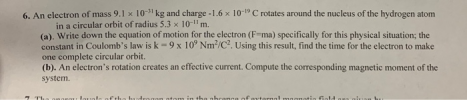 6. An electron of mass 9.1 x 10⁻³¹ kg and charge -1.6 x 10⁻¹⁹ C rotates around the nucleus of the hydrogen atom in a circular orbit of radius 5.3 x 10⁻¹lm. (a). Write down the equation of motion for the electron (F-ma) specifically for this physical situation; the constant in Coulomb's law is k 9x 10 Nm/C2. Using this result, find the time for the electron to make one complete circular orbit. (b). An electron's rotation creates an effective...
7) What is a "gauss" and how does it compare to the tesla? 8) If a...
 7) What is a "gauss" and how does it compare to the tesla? 8) If a charged particle moves in a straight line through some region of space, can you say that the magnetic field in that region is necessarily zero? Can you set a resting electron in motion with a magnetic field? Explain. 9) 10) What is the direction of the magnetic force on a positive charge that moves as shown in each of the six cases shown in...
An electron is moving at a speed of 1.50 ✕ 104 m/s in a circular path...
An electron is moving at a speed of 1.50 ✕ 104 m/s in a circular path of radius of 1.7 cm inside a solenoid. The magnetic field of the solenoid is perpendicular to the plane of the electron's path. The solenoid has 25 turns per centimeter. (a) Find the strength of the magnetic field inside the solenoid. . μT (b) Find the current in the solenoid mA
 (a) What is Magnetic flux? (b) An electron with a rest mass of 9.11 x 10 kg moves in a circular orbit of radius 1.4 x 10-'m in a uniform magnetic field of 3.5 x 10 Weber/meter square, perpendicular to the speed with which electron moves. Find the cyclotron frequency of the moving electron. (c) Discuss your answer in 4b above.
 Problem 3. a. An electron moving at 4.00x10³ m/s in a 1.25-T magnetic field experiences a magnetic force of 1.40*10-16 N. What angle does the velocity of the electron make with the magnetic field? There are two answers. b. A proton moves at 7.50x10⁷ m/s perpendicular to a magnetic field. The field causes the proton to travel in a circular path of radius 0.800 m. What is the field strength?
 5. An electron carrying charge -9 (where q=1.602e-19 C) is moving along the x axis in the +x direction with a velocity ū(x, y, z) = 5 x 107 cm/s. a. We want to make the electron to curve to the right and eventually go in a circle clockwise in the xy plane by applying a magnetic field. To achieve that, the magnetic field should exert a force on the electron that is perpendicular to its direction of motion. Which...
 6. An electron of mass 9.1 x 10⁻³¹ kg and charge -1.6 x 10⁻¹⁹ C rotates around the nucleus of the hydrogen atom in a circular orbit of radius 5.3 x 10⁻¹lm. (a). Write down the equation of motion for the electron (F-ma) specifically for this physical situation; the constant in Coulomb's law is k 9x 10 Nm/C2. Using this result, find the time for the electron to make one complete circular orbit. (b). An electron's rotation creates an effective...
 7) What is a "gauss" and how does it compare to the tesla? 8) If a charged particle moves in a straight line through some region of space, can you say that the magnetic field in that region is necessarily zero? Can you set a resting electron in motion with a magnetic field? Explain. 9) 10) What is the direction of the magnetic force on a positive charge that moves as shown in each of the six cases shown in...
Most questions answered within 3 hours.
-
Where is the error in this code sequence?
String s1 = "Hello";
String s2 = "ello";...
asked 10 months ago -
Financial data for Joel de Paris, Inc., for last year
follow:
Joel de Paris, Inc.
Balance...
asked 10 months ago -
Consider this reaction:
Al2(SO4)3 (aq)+ BaCl3
(aq) Al2Cl6 (aq)- +
3BaSO4(s) . What is the...
asked 10 months ago -
Suppose that Savneet is considering increasing her
recent random sample from 20 car rentals to 40...
asked 10 months ago -
Trucks arrive at an unloading terminal at an average rate of 120
per hour.
Trucks arrive...
asked 10 months ago -
Why are methanol and ethanol completely soluble in water while
octanol is not very little soluble....
asked 10 months ago -
A facilities manager at a university reads in a research report
that the mean amount of...
asked 10 months ago -
When the CuSO4 is rehydrated by adding water to the anhydrous
compound, is this an endothermic...
asked 10 months ago -
A ray of sunlight is passing from diamond into crown glass; the
angle of incidence is...
asked 10 months ago -
A block of mass 0.249 kg is placed on top of a light, vertical
spring of...
asked 10 months ago -
how do the kidneys compensate in the presences of acidosis
a) trigger hyperventilate
b) reserve acid...
asked 10 months ago -
Question 501 pts
The rental rate of capital to the firm increases. Which of the
following...
asked 10 months ago