Classify all linear functions by showing that f : M(2×2)(F) → F is a linear function if and only if

Homework Answers
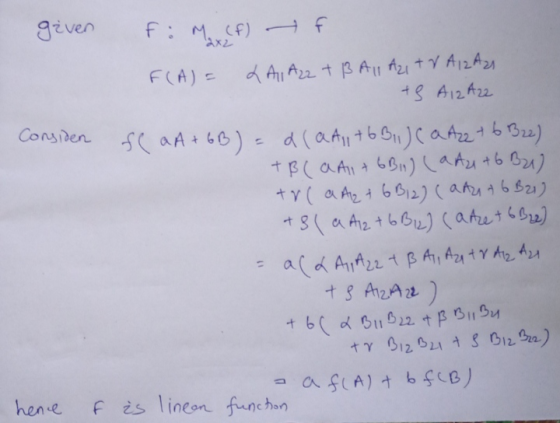
I use definition of linear function to solve this problem
Add Answer to:
Classify all linear functions by showing that f : M(2×2)(F) → F
is a linear function...
2. (a) Obtain and classify all stationary points and point of inflection of the function f(x)...
 2. (a) Obtain and classify all stationary points and point of inflection of the function f(x) = 4x3 – 22x2 + 40x – 25. [5 marks) (b) Sketch the function y = f(x) showing all x and y intercepts, stationary points and point of inflection. One of the factors of f(x) = 423 – 22cr2 + 40x – 25 is (r – ). [2 marks] (c) Evaluate the definite integral of f(c) on the domain 2 € (0,6]. [3 marks)
. M Compute all the first and second partial derivatives of the function f(x,t) = 2...
 . M Compute all the first and second partial derivatives of the function f(x,t) = 2 COS(4+3 – 27t) af ar af at 22 a22 TO M PO 02f δεδε 02f at2 M
OGRAPHS AND FUNCTIONS Finding a difference quotient for a linear or quadratic function f(x+h)-f(x) Find the...
 OGRAPHS AND FUNCTIONS Finding a difference quotient for a linear or quadratic function f(x+h)-f(x) Find the difference quotient h where h#0, for the function below. F f(x) = -372 -4x+9 Simplify your answer as much as possible. $(x + n) - f(x) h I
2. Which of the following recursive functions, written in a fictitious language, are tail recursive? Select all that are A. function f(n) ifn<2 else f(n-1) + f(n-2) end If m=0 else B. function g(m...
 2. Which of the following recursive functions, written in a fictitious language, are tail recursive? Select all that are A. function f(n) ifn<2 else f(n-1) + f(n-2) end If m=0 else B. function g(m,n) g(m-1,m'n) C. function h(n) if n 100 else 3 h(n+5) end D. function j(m.n) IT m=n 100 j(m-n,n) 10 j(n,n-m) elseif mn else
2. Which of the following recursive functions, written in a fictitious language, are tail recursive? Select all that are A. function f(n) ifn
2. Which of the following recursive functions, written in a fictitious language, are tail recursive? Select all that are A. function f(n) ifn<2 else f(n-1) + f(n-2) end If m=0 else B. function g(m,n) g(m-1,m'n) C. function h(n) if n 100 else 3 h(n+5) end D. function j(m.n) IT m=n 100 j(m-n,n) 10 j(n,n-m) elseif mn else
2. Which of the following recursive functions, written in a fictitious language, are tail recursive? Select all that are A. function f(n) ifn
sin z-tanz Find and classify all singularities of the function f(z) = 2
 sin z-tanz Find and classify all singularities of the function f(z) = 2
Functions f and g are defined for all real numbers. The function f has zeroes at...
Functions f and g are defined for all real numbers. The function f has zeroes at -2, 3, and 7; and the function g has zeroes at -3, -1, 4, and 7. How many distinct zeroes dose the product function f * g have? Explain and show your answer.
The text says: "If the functions f are linear, then CQ holds for all feasible x; for then we may use the linear arc +to." Why is that so? The text says: "If the functions f are linea...
 The text says: "If the functions f are linear, then CQ holds for all feasible x; for then we may use the linear arc +to." Why is that so?
The text says: "If the functions f are linear, then CQ holds for all feasible x; for then we may use the linear arc +to." Why is that so?
The text says: "If the functions f are linear, then CQ holds for all feasible x; for then we may use the linear arc +to." Why is that so?
(a) Find and classify all of the critical points of the function X f(x, y, z)...
 (a) Find and classify all of the critical points of the function X f(x, y, z) = (x2 +42 + x2)3/2 on the unit sphere. (b) Find and classify all of the critical points of the function f(x, y, z) = x sin(x2 + y2 +22) on the sphere of radius
9. (4pts) Consider the linear functions f(x) 6-x+3(x-4) and g (x)-3(x+)-5(+1). Solve f(x) g() algebraically, showing...
 9. (4pts) Consider the linear functions f(x) 6-x+3(x-4) and g (x)-3(x+)-5(+1). Solve f(x) g() algebraically, showing all steps. (You may also check graphically) 10. 4pts) Test algebraically whether the function f(x)-4x- is even, odd, or neither even nor odd. Show your work. (You may also check your results graphically.) 11. (4pts) Determine whether the graph of y =-x' + 4x is symmetric with respect to the x-axis, the y-axis, and/or the origin. Use your graphing calculator make a sketch below...
[8 marks] For a function space, the scalar (or inner) product of two functions f(r) and 8() is defined as (.8) = f()8(r...
 [8 marks] For a function space, the scalar (or inner) product of two functions f(r) and 8() is defined as (.8) = f()8(r)dr (a) Show that this definition of the scalar product satisfies all axioms of an inner prod- uct. Brief answers are sufficient. (b) Consider the functions Lo(r) =1 and L(r) =r and L2(r) =-. You may assume that Lo, L1 and L2 are an orthogonal function set, with respect to the scalar product defined above. Consider an arbitrary...
 2. (a) Obtain and classify all stationary points and point of inflection of the function f(x) = 4x3 – 22x2 + 40x – 25. [5 marks) (b) Sketch the function y = f(x) showing all x and y intercepts, stationary points and point of inflection. One of the factors of f(x) = 423 – 22cr2 + 40x – 25 is (r – ). [2 marks] (c) Evaluate the definite integral of f(c) on the domain 2 € (0,6]. [3 marks)
 . M Compute all the first and second partial derivatives of the function f(x,t) = 2 COS(4+3 – 27t) af ar af at 22 a22 TO M PO 02f δεδε 02f at2 M
 OGRAPHS AND FUNCTIONS Finding a difference quotient for a linear or quadratic function f(x+h)-f(x) Find the difference quotient h where h#0, for the function below. F f(x) = -372 -4x+9 Simplify your answer as much as possible. $(x + n) - f(x) h I
 2. Which of the following recursive functions, written in a fictitious language, are tail recursive? Select all that are A. function f(n) ifn<2 else f(n-1) + f(n-2) end If m=0 else B. function g(m,n) g(m-1,m'n) C. function h(n) if n 100 else 3 h(n+5) end D. function j(m.n) IT m=n 100 j(m-n,n) 10 j(n,n-m) elseif mn else
2. Which of the following recursive functions, written in a fictitious language, are tail recursive? Select all that are A. function f(n) ifn
2. Which of the following recursive functions, written in a fictitious language, are tail recursive? Select all that are A. function f(n) ifn<2 else f(n-1) + f(n-2) end If m=0 else B. function g(m,n) g(m-1,m'n) C. function h(n) if n 100 else 3 h(n+5) end D. function j(m.n) IT m=n 100 j(m-n,n) 10 j(n,n-m) elseif mn else
2. Which of the following recursive functions, written in a fictitious language, are tail recursive? Select all that are A. function f(n) ifn
 sin z-tanz Find and classify all singularities of the function f(z) = 2
 The text says: "If the functions f are linear, then CQ holds for all feasible x; for then we may use the linear arc +to." Why is that so?
The text says: "If the functions f are linear, then CQ holds for all feasible x; for then we may use the linear arc +to." Why is that so?
The text says: "If the functions f are linear, then CQ holds for all feasible x; for then we may use the linear arc +to." Why is that so?
 (a) Find and classify all of the critical points of the function X f(x, y, z) = (x2 +42 + x2)3/2 on the unit sphere. (b) Find and classify all of the critical points of the function f(x, y, z) = x sin(x2 + y2 +22) on the sphere of radius
 9. (4pts) Consider the linear functions f(x) 6-x+3(x-4) and g (x)-3(x+)-5(+1). Solve f(x) g() algebraically, showing all steps. (You may also check graphically) 10. 4pts) Test algebraically whether the function f(x)-4x- is even, odd, or neither even nor odd. Show your work. (You may also check your results graphically.) 11. (4pts) Determine whether the graph of y =-x' + 4x is symmetric with respect to the x-axis, the y-axis, and/or the origin. Use your graphing calculator make a sketch below...
 [8 marks] For a function space, the scalar (or inner) product of two functions f(r) and 8() is defined as (.8) = f()8(r)dr (a) Show that this definition of the scalar product satisfies all axioms of an inner prod- uct. Brief answers are sufficient. (b) Consider the functions Lo(r) =1 and L(r) =r and L2(r) =-. You may assume that Lo, L1 and L2 are an orthogonal function set, with respect to the scalar product defined above. Consider an arbitrary...
Most questions answered within 3 hours.
-
Where is the error in this code sequence?
String s1 = "Hello";
String s2 = "ello";...
asked 10 months ago -
Financial data for Joel de Paris, Inc., for last year
follow:
Joel de Paris, Inc.
Balance...
asked 10 months ago -
Consider this reaction:
Al2(SO4)3 (aq)+ BaCl3
(aq) Al2Cl6 (aq)- +
3BaSO4(s) . What is the...
asked 10 months ago -
Suppose that Savneet is considering increasing her
recent random sample from 20 car rentals to 40...
asked 10 months ago -
Trucks arrive at an unloading terminal at an average rate of 120
per hour.
Trucks arrive...
asked 10 months ago -
Why are methanol and ethanol completely soluble in water while
octanol is not very little soluble....
asked 10 months ago -
A facilities manager at a university reads in a research report
that the mean amount of...
asked 10 months ago -
When the CuSO4 is rehydrated by adding water to the anhydrous
compound, is this an endothermic...
asked 10 months ago -
A ray of sunlight is passing from diamond into crown glass; the
angle of incidence is...
asked 10 months ago -
A block of mass 0.249 kg is placed on top of a light, vertical
spring of...
asked 10 months ago -
how do the kidneys compensate in the presences of acidosis
a) trigger hyperventilate
b) reserve acid...
asked 10 months ago -
Question 501 pts
The rental rate of capital to the firm increases. Which of the
following...
asked 10 months ago