![[8 marks] For a function space, the scalar (or inner) product of two functions f(r) and 8() is defined as (.8) = f()8(r)dr (a](http://img.homeworklib.com/images/d4b83e96-6f6d-453c-9bde-5b7f18a5baa6.png?x-oss-process=image/resize,w_560)
Homework Answers


Add Answer to:
[8 marks] For a function space, the scalar (or inner) product of two functions f(r) and 8() is defined as (.8) = f()8(r...
Let clo, π] := {f : [0, π] → R I f is continuous). With addition and scalar multiplication defined in the usual way, th...
 Let clo, π] := {f : [0, π] → R I f is continuous). With addition and scalar multiplication defined in the usual way, this is a vector space. Let the inner product on CO,T] be defined analogous to (21), that is, (me) :-o u(z)r(z) dz. sinx and g(x) = 2.2. Which is "bigger": f or g? (a) Let f(x) (b) g? xplain. (c) Find a nontrivial function in CIO, π], which is orthogonal to f. d) Find a nontrivial...
Consider the three-dimensional subspace of function space defined by the span of 1, r, and a2 the...
 Consider the three-dimensional subspace of function space defined by the span of 1, r, and a2 the first three orthogonal polynomials on -1,1. Let f(x) 21, and consider the subset G-{g(z) | 〈f,g〉 0), the set of functions orthogonal to f using the L inner product on, (This can be thought of as the plane normal to f(x) in the three-dimensional function space.) Let h(z) 2-1. Find the function g(x) є G in the plane which is closest to h(x)....
Orthogonal projections. In class we showed that if V is a finite-dimensional inner product space ...
 Orthogonal projections. In class we showed that if V is a finite-dimensional inner product space and U-V s a subspace, then U㊥ U↓-V, (U 1-U, and Pb is well-defined Inspecting the proofs, convince yourself that all that was needed was for U to be finite- dimensional. (In fact, your book does it this way). Then answer the following questions (a) Let V be an inner product space. Prove that for any u V. if u 0, we have proj, Pspan(v)...
- Let V be the vector space of continuous functions defined f : [0,1] → R...
 - Let V be the vector space of continuous functions defined f : [0,1] → R and a : [0, 1] →R a positive continuous function. Let < f, g >a= Soa(x)f(x)g(x)dx. a) Prove that <, >a defines an inner product in V. b) For f,gE V let < f,g >= So f(x)g(x)dx. Prove that {xn} is a Cauchy sequence in the metric defined by <, >a if and only if it a Cauchy sequence in the metric defined by...
Question 10 (6 marks) Consider the inner product on P2 defined by rl 0 Find two...
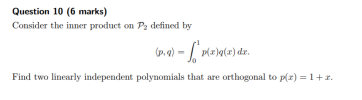 Question 10 (6 marks) Consider the inner product on P2 defined by rl 0 Find two linearly independent polynomials that are orthogonal to p(x)-1+r.
Consider the function f(1) = el defined on the interval (0,1). Compute the 2nd order Taylor...
 Consider the function f(1) = el defined on the interval (0,1). Compute the 2nd order Taylor series approximation to f. Next, compute the approximation to f using the orthogonal projection onto the span of (1,1,2²}, with the inner product of two functions on [0,1] being defined by (5.9) = ['s(a)g(z) ds.
Consider the function f(1) = el defined on the interval (0,1). Compute the 2nd order Taylor...
 Consider the function f(1) = el defined on the interval (0,1). Compute the 2nd order Taylor series approximation to f. Next, compute the approximation to f using the orthogonal projection onto the span of (1,1,2²}, with the inner product of two functions on [0,1] being defined by (5.9) = ['s(a)g(z) ds.
4. Let L2(-π, π)) be the Lebesgue space of square integrable functions f: [-π, π] → C with inner-product, (f,g) =|...
 4. Let L2(-π, π)) be the Lebesgue space of square integrable functions f: [-π, π] → C with inner-product, (f,g) =| f(t)g(t)dt (a) Show thatkt k e is an orthonormal system 2rZ s an orthonormal system (b) Let M be the linear span of (1, et, e). Find the point in M closest to the function [4 marks] 2π f(t) = t. [6 marks]
4. Let L2(-π, π)) be the Lebesgue space of square integrable functions f: [-π, π] →...
4. Let L2(-π, π)) be the Lebesgue space of square integrable functions f: [-π, π] → C with inner-product, (f,g) =| f(t)g(t)dt (a) Show thatkt k e is an orthonormal system 2rZ s an orthonormal system (b) Let M be the linear span of (1, et, e). Find the point in M closest to the function [4 marks] 2π f(t) = t. [6 marks]
4. Let L2(-π, π)) be the Lebesgue space of square integrable functions f: [-π, π] →...
2. Consider the vector space C([0, 1]) consisting of all continuous functions f: [0,1]-R with the...
 2. Consider the vector space C([0, 1]) consisting of all continuous functions f: [0,1]-R with the weighted inner product, (f.g)-f(x) g(x) x dr. (a) Let Po(z) = 1, Pi(z) = x-2, and P2(x) = x2-6r + 흡 Show that {Po, pi,r) are orthogonal with respect to this inner product b) Use Gram-Schmidt on f(x)3 to find a polynomial pa(r) which is orthogonal to each of po P1 P2 You may use your favorite web site or software to calculate the...
3. Consider the function defined by f(x) = 1, 0 < r< a, | 0, a<...
 3. Consider the function defined by f(x) = 1, 0 < r< a, | 0, a< x < T, where 0a < T (a) Sketch the odd and even periodic extension of f (x) on the interval -3n < x < 3« for aT/2 (b) Find the half-range Fourier sine series expansion of f(x) for arbitrary a. (e) To what value does the half-range Fourier sine series expansion converge at r a? [8 marks
3. Consider the function defined by...
3. Consider the function defined by f(x) = 1, 0 < r< a, | 0, a< x < T, where 0a < T (a) Sketch the odd and even periodic extension of f (x) on the interval -3n < x < 3« for aT/2 (b) Find the half-range Fourier sine series expansion of f(x) for arbitrary a. (e) To what value does the half-range Fourier sine series expansion converge at r a? [8 marks
3. Consider the function defined by...
 Let clo, π] := {f : [0, π] → R I f is continuous). With addition and scalar multiplication defined in the usual way, this is a vector space. Let the inner product on CO,T] be defined analogous to (21), that is, (me) :-o u(z)r(z) dz. sinx and g(x) = 2.2. Which is "bigger": f or g? (a) Let f(x) (b) g? xplain. (c) Find a nontrivial function in CIO, π], which is orthogonal to f. d) Find a nontrivial...
 Consider the three-dimensional subspace of function space defined by the span of 1, r, and a2 the first three orthogonal polynomials on -1,1. Let f(x) 21, and consider the subset G-{g(z) | 〈f,g〉 0), the set of functions orthogonal to f using the L inner product on, (This can be thought of as the plane normal to f(x) in the three-dimensional function space.) Let h(z) 2-1. Find the function g(x) є G in the plane which is closest to h(x)....
 Orthogonal projections. In class we showed that if V is a finite-dimensional inner product space and U-V s a subspace, then U㊥ U↓-V, (U 1-U, and Pb is well-defined Inspecting the proofs, convince yourself that all that was needed was for U to be finite- dimensional. (In fact, your book does it this way). Then answer the following questions (a) Let V be an inner product space. Prove that for any u V. if u 0, we have proj, Pspan(v)...
 - Let V be the vector space of continuous functions defined f : [0,1] → R and a : [0, 1] →R a positive continuous function. Let < f, g >a= Soa(x)f(x)g(x)dx. a) Prove that <, >a defines an inner product in V. b) For f,gE V let < f,g >= So f(x)g(x)dx. Prove that {xn} is a Cauchy sequence in the metric defined by <, >a if and only if it a Cauchy sequence in the metric defined by...
 Question 10 (6 marks) Consider the inner product on P2 defined by rl 0 Find two linearly independent polynomials that are orthogonal to p(x)-1+r.
 Consider the function f(1) = el defined on the interval (0,1). Compute the 2nd order Taylor series approximation to f. Next, compute the approximation to f using the orthogonal projection onto the span of (1,1,2²}, with the inner product of two functions on [0,1] being defined by (5.9) = ['s(a)g(z) ds.
 Consider the function f(1) = el defined on the interval (0,1). Compute the 2nd order Taylor series approximation to f. Next, compute the approximation to f using the orthogonal projection onto the span of (1,1,2²}, with the inner product of two functions on [0,1] being defined by (5.9) = ['s(a)g(z) ds.
 4. Let L2(-π, π)) be the Lebesgue space of square integrable functions f: [-π, π] → C with inner-product, (f,g) =| f(t)g(t)dt (a) Show thatkt k e is an orthonormal system 2rZ s an orthonormal system (b) Let M be the linear span of (1, et, e). Find the point in M closest to the function [4 marks] 2π f(t) = t. [6 marks]
4. Let L2(-π, π)) be the Lebesgue space of square integrable functions f: [-π, π] →...
4. Let L2(-π, π)) be the Lebesgue space of square integrable functions f: [-π, π] → C with inner-product, (f,g) =| f(t)g(t)dt (a) Show thatkt k e is an orthonormal system 2rZ s an orthonormal system (b) Let M be the linear span of (1, et, e). Find the point in M closest to the function [4 marks] 2π f(t) = t. [6 marks]
4. Let L2(-π, π)) be the Lebesgue space of square integrable functions f: [-π, π] →...
 2. Consider the vector space C([0, 1]) consisting of all continuous functions f: [0,1]-R with the weighted inner product, (f.g)-f(x) g(x) x dr. (a) Let Po(z) = 1, Pi(z) = x-2, and P2(x) = x2-6r + 흡 Show that {Po, pi,r) are orthogonal with respect to this inner product b) Use Gram-Schmidt on f(x)3 to find a polynomial pa(r) which is orthogonal to each of po P1 P2 You may use your favorite web site or software to calculate the...
 3. Consider the function defined by f(x) = 1, 0 < r< a, | 0, a< x < T, where 0a < T (a) Sketch the odd and even periodic extension of f (x) on the interval -3n < x < 3« for aT/2 (b) Find the half-range Fourier sine series expansion of f(x) for arbitrary a. (e) To what value does the half-range Fourier sine series expansion converge at r a? [8 marks
3. Consider the function defined by...
3. Consider the function defined by f(x) = 1, 0 < r< a, | 0, a< x < T, where 0a < T (a) Sketch the odd and even periodic extension of f (x) on the interval -3n < x < 3« for aT/2 (b) Find the half-range Fourier sine series expansion of f(x) for arbitrary a. (e) To what value does the half-range Fourier sine series expansion converge at r a? [8 marks
3. Consider the function defined by...
Most questions answered within 3 hours.
-
Where is the error in this code sequence?
String s1 = "Hello";
String s2 = "ello";...
asked 11 months ago -
Financial data for Joel de Paris, Inc., for last year
follow:
Joel de Paris, Inc.
Balance...
asked 11 months ago -
Consider this reaction:
Al2(SO4)3 (aq)+ BaCl3
(aq) Al2Cl6 (aq)- +
3BaSO4(s) . What is the...
asked 11 months ago -
Suppose that Savneet is considering increasing her
recent random sample from 20 car rentals to 40...
asked 11 months ago -
Trucks arrive at an unloading terminal at an average rate of 120
per hour.
Trucks arrive...
asked 11 months ago -
Why are methanol and ethanol completely soluble in water while
octanol is not very little soluble....
asked 11 months ago -
A facilities manager at a university reads in a research report
that the mean amount of...
asked 11 months ago -
When the CuSO4 is rehydrated by adding water to the anhydrous
compound, is this an endothermic...
asked 11 months ago -
A ray of sunlight is passing from diamond into crown glass; the
angle of incidence is...
asked 11 months ago -
A block of mass 0.249 kg is placed on top of a light, vertical
spring of...
asked 11 months ago -
how do the kidneys compensate in the presences of acidosis
a) trigger hyperventilate
b) reserve acid...
asked 11 months ago -
Question 501 pts
The rental rate of capital to the firm increases. Which of the
following...
asked 11 months ago