
Homework Answers
Q.7.) Gradient of the given function at given point.
What is Gradient?
☆ If we want to know the direction of any object, we draw the normal vector from that we come to know that what is the direction of the object,
☆ And if we want to know the direction of the function we use Gradient concept,
☆ Calulating gradient of any function at any point means we calculating its normal at that point from which we come to know the direction of the function at that particular point.
Find -:
Gradient of f(x,y,z)

☆ Gradient


At point (-1,-1, 2)

Q.9.)

Changing the order of integration.
☆ Changing the order of integration means,
As we can see in the question, it is in the form,

we have to integrate first w.r.t dx and then integrate it with dy,
☆ but in this method we reverse it order by, first we integrate it with respect to dy then w.r.t dx.
☆ this method makes most of the integration easy to solve.
☆ For this we have to simply interchange the limit value, in the form

☆ Now, let's start solving the question

☆ It's limit are,

☆ For changing the order, we first have to draw the limit on the graph and then change its order,
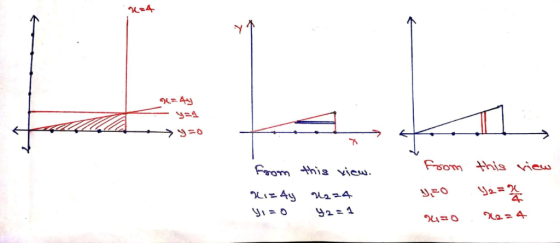
I.) In the below figure, left most figure shows the correct diagram of the limit,
II.) In second figure, the limit is taken first with x as dependent variable and y as independent variable, which is mention in the question.
☆ For reversing the order of the limit, we just have to choose y as dependent variable and x as independent variable.
III.) In rightmost figure, the limit is taken as y as dependent figure and x as independent variable.
☆ The integral will look like

☆ The answer which is in option is completely wrong, I had solve all 4 integral which is in the option and all are wrong the form and I had obtain the answer with the right concept.
☆☆ Please comment below if you have any doubt regarding this question before rating this answer.
Add Answer to:
e 09, 201 (6) 2 points An equation for the level curve of f(z, y) = In(z+y) that passes through the point (0, e2) i...
(8) 2 points Let f be a function defined and continuous, with continuous first partial derivative at the origin (0,...
 (8) 2 points Let f be a function defined and continuous, with continuous first partial derivative at the origin (0,0). A unit vector u for which D.f (0,0) is the maximum is: maximum a 1 (0,0)), A. /(0,0)x,0),y (0 af B. (0,0) 8x0,0),(0,0)), af 1 ((0,0),-y C. (0,0), /(0,0) D. None of the above.
(8) 2 points Let f be a function defined and continuous, with continuous first partial derivative at the origin (0,0). A unit vector u for which...
(8) 2 points Let f be a function defined and continuous, with continuous first partial derivative at the origin (0,0). A unit vector u for which D.f (0,0) is the maximum is: maximum a 1 (0,0)), A. /(0,0)x,0),y (0 af B. (0,0) 8x0,0),(0,0)), af 1 ((0,0),-y C. (0,0), /(0,0) D. None of the above.
(8) 2 points Let f be a function defined and continuous, with continuous first partial derivative at the origin (0,0). A unit vector u for which...
b) i. Using e-8 definition show that f is continuous at (0,0), where f(x,y) = {aš...
 b) i. Using e-8 definition show that f is continuous at (0,0), where f(x,y) = {aš sin () + yś sin () if xy + 0 242ADES if xy = 0 ii. Prove that every linear transformation T:R" - R" is continuous on R". iii. Let f:R" → R and a ER" Define Dis (a), the i-th partial derivative of f at a, 1 sisn. Determine whether the partial derivatives of f exist at (0,0) for the following function. In...
(2) Let f(z, y)-xy +x-y be defined on the closed disk {(z, y) E R2 :...
 (2) Let f(z, y)-xy +x-y be defined on the closed disk {(z, y) E R2 : z? + y2 < 4} of radius 2. (a) Find the maximu and minimu of Duf at (0,0) over all unit vectors u. (b) Find the maximum and minimum of Duf over all points in the disk(,y) E R2 r2 + y2 < 4} and all unit vectors u. (llint. Think of IvJF as a function ofェand y in the disk.)
Question 6 6 pts Suppose that f(x, y, z) is a scalar-valued function and F(x, y,...
 Question 6 6 pts Suppose that f(x, y, z) is a scalar-valued function and F(x, y, z) = (P(x, y, z), Q(2,y,z), R(x, y, z)) is a vector field. If P, Q, R, and f all have continuous partial derivatives, then which of the following equations is invalid? O curl (aF) N21 = a curl F for any positive integer Q. REC o div (fF) = fdiv F+FVF Odiv curl F = 0 O grad div f = div grad...
Define f: R2R by 224V2 y) (0,0) 0 if (x, y)-(0,0) if (z, f(z, y) (a)...
 Define f: R2R by 224V2 y) (0,0) 0 if (x, y)-(0,0) if (z, f(z, y) (a) Prove that Dif(z, y) and D2f (x, y) exist for each (x, y) E R2. (b) Prove that f is not continuous at (0,0).
1. (2 points) Find F dF if curl(F) 3 in the region defined by the 4 curves and C4 Ci F . d7 where F(x,y,z)-Wi +pz? + Vi> and C consists of the arc of the 2. (2 points) Evaluate curve y = sin(...
 1. (2 points) Find F dF if curl(F) 3 in the region defined by the 4 curves and C4 Ci F . d7 where F(x,y,z)-Wi +pz? + Vi> and C consists of the arc of the 2. (2 points) Evaluate curve y = sin(x) from (0,0) to (π, 0) and the line segment from (π,0) to (0,0). 4 3 3. (2 points) Evaluate F di where F.y,(ry, 2:,3) and C is the curve of intersection of 5 and y29. going...
1. (You may use the fact that 2xy ++ y2 for all real 2 and y.)...
 1. (You may use the fact that 2xy ++ y2 for all real 2 and y.) a. Show that the function f : E→ El defined by f(x, y) = y) if (r, y) + (0,0) 10 if (2,y) = (0,0) is a continuous function on all of E. b. Prove that the same function is uniformly continuous on the closed ball of radius 100 around the origin in E2. c. Show that the same function is not uniformly continuous...
true or false is zero. F 9. The plane tangent to the surface za the point (0,0, 3) is given by the equation 2x - 12y -z+3-0. 10. If f is a differentiable function and zf(x -y), then z +. T 11. If...
 true or false
is zero. F 9. The plane tangent to the surface za the point (0,0, 3) is given by the equation 2x - 12y -z+3-0. 10. If f is a differentiable function and zf(x -y), then z +. T 11. If a unit vector u makes the angle of π/4 with the gradient ▽f(P), the directional derivative Duf(P) is equal to |Vf(P)I/2. F 12. There is a point on the hyperboloid 2 -y is parallel to the plane...
true or false
is zero. F 9. The plane tangent to the surface za the point (0,0, 3) is given by the equation 2x - 12y -z+3-0. 10. If f is a differentiable function and zf(x -y), then z +. T 11. If a unit vector u makes the angle of π/4 with the gradient ▽f(P), the directional derivative Duf(P) is equal to |Vf(P)I/2. F 12. There is a point on the hyperboloid 2 -y is parallel to the plane...
(2) The area of the surface with equation z = f(x,y). (x,y) E D. where fra...
 (2) The area of the surface with equation z = f(x,y). (x,y) E D. where fra f, are continuous, is A(S) = SVGC3. y)]? + [f;(x, y)]? +T dA If you attempt to use Formula 2 to find the area of the top half of the sphere x + y2 + 2? = a, you have a slight problem because the double integral is improper. In fact, the integrand has an infinite discontinuity at every point of the boundary circle...
Use (part A) line integral directly then use (part B) Stokes' Theorem 10. Let C be the triangle from (0, 0,0) to (2, 0, 0) to (0, 2, 1) to (0, 0, 0) which lies in the plane z 2 -Зугі + 4zj + 6x k...
 Use (part A) line integral directly then use (part B) Stokes'
Theorem
10. Let C be the triangle from (0, 0,0) to (2, 0, 0) to (0, 2, 1) to (0, 0, 0) which lies in the plane z 2 -Зугі + 4zj + 6x k, calculate | F . dr using Stokes's Theorem. If F(x, y, z) (b) 14 3 (c) 2 (d) 0 (e) None of these
10. Let C be the triangle from (0, 0,0) to (2,...
Use (part A) line integral directly then use (part B) Stokes'
Theorem
10. Let C be the triangle from (0, 0,0) to (2, 0, 0) to (0, 2, 1) to (0, 0, 0) which lies in the plane z 2 -Зугі + 4zj + 6x k, calculate | F . dr using Stokes's Theorem. If F(x, y, z) (b) 14 3 (c) 2 (d) 0 (e) None of these
10. Let C be the triangle from (0, 0,0) to (2,...
 (8) 2 points Let f be a function defined and continuous, with continuous first partial derivative at the origin (0,0). A unit vector u for which D.f (0,0) is the maximum is: maximum a 1 (0,0)), A. /(0,0)x,0),y (0 af B. (0,0) 8x0,0),(0,0)), af 1 ((0,0),-y C. (0,0), /(0,0) D. None of the above.
(8) 2 points Let f be a function defined and continuous, with continuous first partial derivative at the origin (0,0). A unit vector u for which...
(8) 2 points Let f be a function defined and continuous, with continuous first partial derivative at the origin (0,0). A unit vector u for which D.f (0,0) is the maximum is: maximum a 1 (0,0)), A. /(0,0)x,0),y (0 af B. (0,0) 8x0,0),(0,0)), af 1 ((0,0),-y C. (0,0), /(0,0) D. None of the above.
(8) 2 points Let f be a function defined and continuous, with continuous first partial derivative at the origin (0,0). A unit vector u for which...
 b) i. Using e-8 definition show that f is continuous at (0,0), where f(x,y) = {aš sin () + yś sin () if xy + 0 242ADES if xy = 0 ii. Prove that every linear transformation T:R" - R" is continuous on R". iii. Let f:R" → R and a ER" Define Dis (a), the i-th partial derivative of f at a, 1 sisn. Determine whether the partial derivatives of f exist at (0,0) for the following function. In...
 (2) Let f(z, y)-xy +x-y be defined on the closed disk {(z, y) E R2 : z? + y2 < 4} of radius 2. (a) Find the maximu and minimu of Duf at (0,0) over all unit vectors u. (b) Find the maximum and minimum of Duf over all points in the disk(,y) E R2 r2 + y2 < 4} and all unit vectors u. (llint. Think of IvJF as a function ofェand y in the disk.)
 Question 6 6 pts Suppose that f(x, y, z) is a scalar-valued function and F(x, y, z) = (P(x, y, z), Q(2,y,z), R(x, y, z)) is a vector field. If P, Q, R, and f all have continuous partial derivatives, then which of the following equations is invalid? O curl (aF) N21 = a curl F for any positive integer Q. REC o div (fF) = fdiv F+FVF Odiv curl F = 0 O grad div f = div grad...
 Define f: R2R by 224V2 y) (0,0) 0 if (x, y)-(0,0) if (z, f(z, y) (a) Prove that Dif(z, y) and D2f (x, y) exist for each (x, y) E R2. (b) Prove that f is not continuous at (0,0).
 1. (2 points) Find F dF if curl(F) 3 in the region defined by the 4 curves and C4 Ci F . d7 where F(x,y,z)-Wi +pz? + Vi> and C consists of the arc of the 2. (2 points) Evaluate curve y = sin(x) from (0,0) to (π, 0) and the line segment from (π,0) to (0,0). 4 3 3. (2 points) Evaluate F di where F.y,(ry, 2:,3) and C is the curve of intersection of 5 and y29. going...
 1. (You may use the fact that 2xy ++ y2 for all real 2 and y.) a. Show that the function f : E→ El defined by f(x, y) = y) if (r, y) + (0,0) 10 if (2,y) = (0,0) is a continuous function on all of E. b. Prove that the same function is uniformly continuous on the closed ball of radius 100 around the origin in E2. c. Show that the same function is not uniformly continuous...
 true or false
is zero. F 9. The plane tangent to the surface za the point (0,0, 3) is given by the equation 2x - 12y -z+3-0. 10. If f is a differentiable function and zf(x -y), then z +. T 11. If a unit vector u makes the angle of π/4 with the gradient ▽f(P), the directional derivative Duf(P) is equal to |Vf(P)I/2. F 12. There is a point on the hyperboloid 2 -y is parallel to the plane...
true or false
is zero. F 9. The plane tangent to the surface za the point (0,0, 3) is given by the equation 2x - 12y -z+3-0. 10. If f is a differentiable function and zf(x -y), then z +. T 11. If a unit vector u makes the angle of π/4 with the gradient ▽f(P), the directional derivative Duf(P) is equal to |Vf(P)I/2. F 12. There is a point on the hyperboloid 2 -y is parallel to the plane...
 (2) The area of the surface with equation z = f(x,y). (x,y) E D. where fra f, are continuous, is A(S) = SVGC3. y)]? + [f;(x, y)]? +T dA If you attempt to use Formula 2 to find the area of the top half of the sphere x + y2 + 2? = a, you have a slight problem because the double integral is improper. In fact, the integrand has an infinite discontinuity at every point of the boundary circle...
 Use (part A) line integral directly then use (part B) Stokes'
Theorem
10. Let C be the triangle from (0, 0,0) to (2, 0, 0) to (0, 2, 1) to (0, 0, 0) which lies in the plane z 2 -Зугі + 4zj + 6x k, calculate | F . dr using Stokes's Theorem. If F(x, y, z) (b) 14 3 (c) 2 (d) 0 (e) None of these
10. Let C be the triangle from (0, 0,0) to (2,...
Use (part A) line integral directly then use (part B) Stokes'
Theorem
10. Let C be the triangle from (0, 0,0) to (2, 0, 0) to (0, 2, 1) to (0, 0, 0) which lies in the plane z 2 -Зугі + 4zj + 6x k, calculate | F . dr using Stokes's Theorem. If F(x, y, z) (b) 14 3 (c) 2 (d) 0 (e) None of these
10. Let C be the triangle from (0, 0,0) to (2,...
Most questions answered within 3 hours.
-
Where is the error in this code sequence?
String s1 = "Hello";
String s2 = "ello";...
asked 10 months ago -
Financial data for Joel de Paris, Inc., for last year
follow:
Joel de Paris, Inc.
Balance...
asked 10 months ago -
Consider this reaction:
Al2(SO4)3 (aq)+ BaCl3
(aq) Al2Cl6 (aq)- +
3BaSO4(s) . What is the...
asked 10 months ago -
Suppose that Savneet is considering increasing her
recent random sample from 20 car rentals to 40...
asked 10 months ago -
Trucks arrive at an unloading terminal at an average rate of 120
per hour.
Trucks arrive...
asked 10 months ago -
Why are methanol and ethanol completely soluble in water while
octanol is not very little soluble....
asked 10 months ago -
A facilities manager at a university reads in a research report
that the mean amount of...
asked 10 months ago -
When the CuSO4 is rehydrated by adding water to the anhydrous
compound, is this an endothermic...
asked 10 months ago -
A ray of sunlight is passing from diamond into crown glass; the
angle of incidence is...
asked 10 months ago -
A block of mass 0.249 kg is placed on top of a light, vertical
spring of...
asked 10 months ago -
how do the kidneys compensate in the presences of acidosis
a) trigger hyperventilate
b) reserve acid...
asked 10 months ago -
Question 501 pts
The rental rate of capital to the firm increases. Which of the
following...
asked 10 months ago