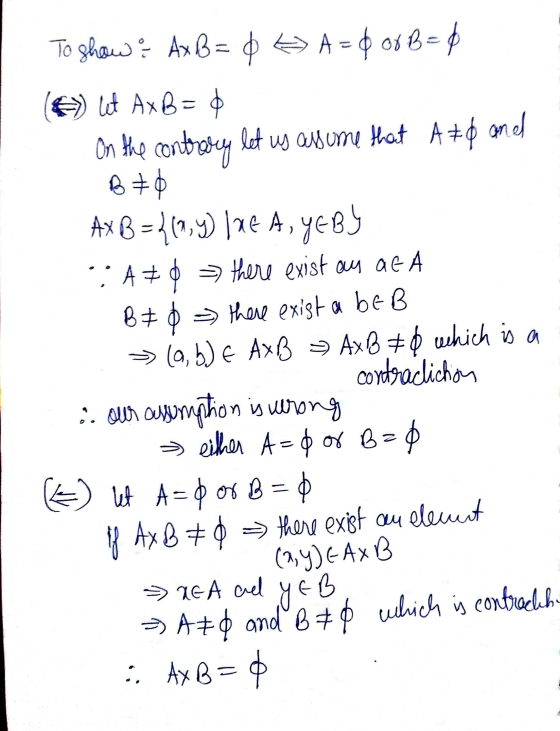
Prove: A x B = ∅ iff. A = ∅ or B = ∅
Prove: A x B = ∅ iff. A = ∅ or B = ∅
Homework Answers
Use the definitions: x ∈ S ∩ T iff (x ∈ S) ∧ (x ∈ T)...
 Use the definitions:
x ∈ S ∩ T iff (x ∈ S) ∧ (x ∈ T)
x ∈ S' iff ¬(x ∈ S)
S ⊆ T iff (∀x)(x ∈ S → X ∈ T)
1. Prove line-by-line:
r → ¬(p → q)
assuming that ¬r ∨ ¬q and ¬(q ∧ r) ∧ p
2. A, B, C & A ⊆ B are sets.
Prove:
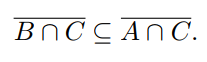
BnCgAnC
Use the definitions:
x ∈ S ∩ T iff (x ∈ S) ∧ (x ∈ T)
x ∈ S' iff ¬(x ∈ S)
S ⊆ T iff (∀x)(x ∈ S → X ∈ T)
1. Prove line-by-line:
r → ¬(p → q)
assuming that ¬r ∨ ¬q and ¬(q ∧ r) ∧ p
2. A, B, C & A ⊆ B are sets.
Prove:
BnCgAnC
10. Prove that a connected surface M is orientable iff there exists a nonvanishing differential 2-form on M 10. Prove t...
 10. Prove that a connected surface M is orientable iff there
exists a nonvanishing differential 2-form on M
10. Prove that a connected surface M is orientable iff there exists a nonvanishing differential 2-form on M.
10. Prove that a connected surface M is orientable iff there exists a nonvanishing differential 2-form on M.
10. Prove that a connected surface M is orientable iff there
exists a nonvanishing differential 2-form on M
10. Prove that a connected surface M is orientable iff there exists a nonvanishing differential 2-form on M.
10. Prove that a connected surface M is orientable iff there exists a nonvanishing differential 2-form on M.
Prove, in R, that (in the generalized sense) {an] converges to u iff u is the...
 Prove, in R, that (in the generalized sense) {an] converges to u iff u is the only subsequence limit of {an)
Assume n is an integer. Prove that n is odd iff 3n2 + 4 is odd....
Assume n is an integer. Prove that n is odd iff 3n2 + 4 is odd. Remember that to prove p iff q, you need to prove (i) p → q, and (ii) q → p. Use the fact that any odd n can be expressed as 2k + 1 and any even n can be expressed as 2k, where k is an integer. No other assumptions should be made.
Let an and br be sequences. Prove that sequences an and by both converge iff both...
 Let an and br be sequences. Prove that sequences an and by both converge iff both an + br and an - bre converge.
Define a relation < on Z by m <n iff |m| < |n| or (\m| =...
 Define a relation < on Z by m <n iff |m| < |n| or (\m| = |n| 1 m <n) (a) Prove that < is a partial order on Z. (b) A partial order R on a set S is called a total order (or linear order) iff (Vx, Y ES)(x + y + ((x, y) E R V (y,x) E R)) Prove that is a total order on Z. (c) List the following elements in <-increasing order. –5, 2,...
4. (5 points) Let A and B ben x n matrices. Prove that if A and...
 4. (5 points) Let A and B ben x n matrices. Prove that if A and B are skew symmetric, then A - B is skew symmetric. Recall C = [cj] is skew symmetric iff Cij =-Cji.
1. Let V be a vector space with bases B and C. Suppose that T:V V is a linear map with matrix representations Ms(T)A and Me(T) B. Prove the following (a) T is one-to-one iff A is one-to-one. (b...
 1. Let V be a vector space with bases B and C. Suppose that T:V V is a linear map with matrix representations Ms(T)A and Me(T) B. Prove the following (a) T is one-to-one iff A is one-to-one. (b) λ is an eigenvalue of T iff λ is an eigenvalue of B. Consequently, A and B have the same eigenvalues (c) There exists an invertible matrix V such that A-V-BV
1. Let V be a vector space with bases B...
1. Let V be a vector space with bases B and C. Suppose that T:V V is a linear map with matrix representations Ms(T)A and Me(T) B. Prove the following (a) T is one-to-one iff A is one-to-one. (b) λ is an eigenvalue of T iff λ is an eigenvalue of B. Consequently, A and B have the same eigenvalues (c) There exists an invertible matrix V such that A-V-BV
1. Let V be a vector space with bases B...
1. f : riemann integrabel in [0,inf). prove that f is lebesgue integrable iff the improper...
1. f : riemann integrabel in [0,inf). prove that f is lebesgue integrable iff the improper integral converges absolutly.
Let R be the relation on N defined by xRy iff 2 divides x+y. R is...
Let R be the relation on N defined by xRy iff 2 divides x+y. R is an equivalence relation. You do not have to prove that R is an equivalence relation. True or False: 3 ∈ 4/R.
 Use the definitions:
x ∈ S ∩ T iff (x ∈ S) ∧ (x ∈ T)
x ∈ S' iff ¬(x ∈ S)
S ⊆ T iff (∀x)(x ∈ S → X ∈ T)
1. Prove line-by-line:
r → ¬(p → q)
assuming that ¬r ∨ ¬q and ¬(q ∧ r) ∧ p
2. A, B, C & A ⊆ B are sets.
Prove:
BnCgAnC
Use the definitions:
x ∈ S ∩ T iff (x ∈ S) ∧ (x ∈ T)
x ∈ S' iff ¬(x ∈ S)
S ⊆ T iff (∀x)(x ∈ S → X ∈ T)
1. Prove line-by-line:
r → ¬(p → q)
assuming that ¬r ∨ ¬q and ¬(q ∧ r) ∧ p
2. A, B, C & A ⊆ B are sets.
Prove:
BnCgAnC
 10. Prove that a connected surface M is orientable iff there
exists a nonvanishing differential 2-form on M
10. Prove that a connected surface M is orientable iff there exists a nonvanishing differential 2-form on M.
10. Prove that a connected surface M is orientable iff there exists a nonvanishing differential 2-form on M.
10. Prove that a connected surface M is orientable iff there
exists a nonvanishing differential 2-form on M
10. Prove that a connected surface M is orientable iff there exists a nonvanishing differential 2-form on M.
10. Prove that a connected surface M is orientable iff there exists a nonvanishing differential 2-form on M.
 Prove, in R, that (in the generalized sense) {an] converges to u iff u is the only subsequence limit of {an)
 Let an and br be sequences. Prove that sequences an and by both converge iff both an + br and an - bre converge.
 Define a relation < on Z by m <n iff |m| < |n| or (\m| = |n| 1 m <n) (a) Prove that < is a partial order on Z. (b) A partial order R on a set S is called a total order (or linear order) iff (Vx, Y ES)(x + y + ((x, y) E R V (y,x) E R)) Prove that is a total order on Z. (c) List the following elements in <-increasing order. –5, 2,...
 4. (5 points) Let A and B ben x n matrices. Prove that if A and B are skew symmetric, then A - B is skew symmetric. Recall C = [cj] is skew symmetric iff Cij =-Cji.
 1. Let V be a vector space with bases B and C. Suppose that T:V V is a linear map with matrix representations Ms(T)A and Me(T) B. Prove the following (a) T is one-to-one iff A is one-to-one. (b) λ is an eigenvalue of T iff λ is an eigenvalue of B. Consequently, A and B have the same eigenvalues (c) There exists an invertible matrix V such that A-V-BV
1. Let V be a vector space with bases B...
1. Let V be a vector space with bases B and C. Suppose that T:V V is a linear map with matrix representations Ms(T)A and Me(T) B. Prove the following (a) T is one-to-one iff A is one-to-one. (b) λ is an eigenvalue of T iff λ is an eigenvalue of B. Consequently, A and B have the same eigenvalues (c) There exists an invertible matrix V such that A-V-BV
1. Let V be a vector space with bases B...
Most questions answered within 3 hours.
-
Where is the error in this code sequence?
String s1 = "Hello";
String s2 = "ello";...
asked 10 months ago -
Financial data for Joel de Paris, Inc., for last year
follow:
Joel de Paris, Inc.
Balance...
asked 10 months ago -
Consider this reaction:
Al2(SO4)3 (aq)+ BaCl3
(aq) Al2Cl6 (aq)- +
3BaSO4(s) . What is the...
asked 10 months ago -
Suppose that Savneet is considering increasing her
recent random sample from 20 car rentals to 40...
asked 10 months ago -
Trucks arrive at an unloading terminal at an average rate of 120
per hour.
Trucks arrive...
asked 10 months ago -
Why are methanol and ethanol completely soluble in water while
octanol is not very little soluble....
asked 10 months ago -
A facilities manager at a university reads in a research report
that the mean amount of...
asked 10 months ago -
When the CuSO4 is rehydrated by adding water to the anhydrous
compound, is this an endothermic...
asked 10 months ago -
A ray of sunlight is passing from diamond into crown glass; the
angle of incidence is...
asked 10 months ago -
A block of mass 0.249 kg is placed on top of a light, vertical
spring of...
asked 10 months ago -
how do the kidneys compensate in the presences of acidosis
a) trigger hyperventilate
b) reserve acid...
asked 10 months ago -
Question 501 pts
The rental rate of capital to the firm increases. Which of the
following...
asked 10 months ago