For the reaction N2 (g) + 3H2(g) --> 2 NH3 (g), (a) what is the reaction...
For the reaction N2 (g) + 3H2(g) --> 2 NH3 (g),
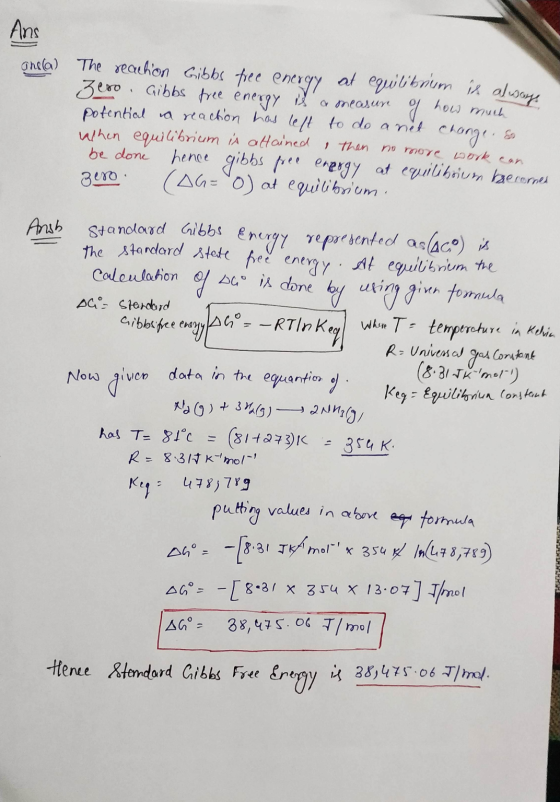
(a) what is the reaction Gibbs free energy at equilibrium in J/mol?
The equilibrium constant of the reaction N2 (g) + 3H2(g) --> 2 NH3 (g) at 81 oC is Keq = 478,789.
(b) What is the standard reaction Gibbs energy of this reaction in J/mol?
Homework Answers
Add Answer to:
For the reaction N2 (g) + 3H2(g) --> 2
NH3 (g),
(a) what is the reaction...
1. The simplest ammonia formation is from nitrogen and hydrogen. Consider the reversible reaction N2(g) + 3H2(g) → 2NH3(g) The standard enthaply and Gibbs free energy of formation one mole NH3 is ∆H◦...
1. The simplest ammonia formation is from nitrogen and hydrogen. Consider the reversible reaction N2(g) + 3H2(g) → 2NH3(g) The standard enthaply and Gibbs free energy of formation one mole NH3 is ∆H◦ m = −46.11 kJ mol−1 and ∆G◦ m = −16.78 kJ mol−1 . (a) What is equilibrium constant at standard condition (25°C and 1 atm)? (b) What is equilibrium constant at 60°C and 1 atm? (c) What is the Gibbs free-energy change relative to that under standard...
1. The simplest ammonia formation is from nitrogen and hydrogen. Consider the reversible reaction N2(g) +...
1. The simplest ammonia formation is from nitrogen and hydrogen. Consider the reversible reaction N2(g) + 3H2(g) → 2NH3(g) The standard enthaply and Gibbs free energy of formation one mole NH3 is ∆H◦ m = −46.11 kJ mol−1 and ∆G◦ m = −16.78 kJ mol−1 . (a) What is equilibrium constant at standard condition (25°C and 1 atm)? (b) What is equilibrium constant at 60°C and 1 atm? (c) What is the Gibbs free-energy change relative to that under standard...
Consider the reaction: N2(g) + 3H2(g) <---> 2NH3(g) The Gibbs free energy of formation ((delta)Gfo) for...
Consider the reaction: N2(g) + 3H2(g) <---> 2NH3(g) The Gibbs free energy of formation ((delta)Gfo) for ammonia is -16.5 kJ/mol and the reaction is exothermic. Calculate the (delta)Gorxn and the equilibrium constant for the reaction and clearly state whether K increases or decreases with temperature.
2. (Type III) The reaction N2(g) + 3H2(g) → 2 NH3(g) starts with 6.00 moles of...
 2. (Type III) The reaction N2(g) + 3H2(g) → 2 NH3(g) starts with 6.00 moles of N2 and 6.00 moles of H2 in a 4.00L flask. a. What are the concentrations of N2 and H2 initially? b. If, at equilibrium, the concentration of N2 is 1.14 M. what are the concentrations of H2 and NH3 at equilibrium? c. What is the value of equilibrium constant K?
For the reaction 3H2(g) + N2(g) =2NH3(8), Keq = 0.297 at 700K. If [H2] = [N2]...
 For the reaction 3H2(g) + N2(g) =2NH3(8), Keq = 0.297 at 700K. If [H2] = [N2] - [NH3) = 1.62 Mat 700K, which one of the following is correct? (NH3) increases as the system approaches equilibrium. [H2] and [N2] increase as the system approaches equilibrium. [N]) and (NH3) increase as the system approaches equilibrium. [H2) and (NH3) decrease as the system moves toward equilibrium.
The equilibrium constant, K, for the following reaction is 6.30 at 723K. 2NH3(g) N2(g) + 3H2(g)...
 The equilibrium constant, K, for the following reaction is 6.30 at 723K. 2NH3(g) N2(g) + 3H2(g) If an equilibrium mixture of the three gases in a 10.1 L container at 723K contains 0.410 mol of NH3(g) and 0.250 mol of N2, the equilibrium concentration of Hy is M.
The equilibrium constant, Kc, for the following reaction is 6.30 at 723K. 2NH3(g) N2(g) + 3H2(g)...
The equilibrium constant, Kc, for the following reaction is 6.30 at 723K. 2NH3(g) N2(g) + 3H2(g) If an equilibrium mixture of the three gases in a 15.7 L container at 723K contains 0.284 mol of NH3(g) and 0.437 mol of N2, the equilibrium concentration of H2 is__________ M.
Question 5 0/1 point The equilibrium constant for the gas phase reaction N2 (g) + 3H2(g)...
 Question 5 0/1 point The equilibrium constant for the gas phase reaction N2 (g) + 3H2(g) + 2NH3 (B) is Keq - 4,34 x 10⁻³ at 300 °C. At equilibrium, Question 5 The equilibrium constant for the gas phase reaction N2 (8) + 3H2 (g) – 2N63 (g) is keq = 4.34 x 10⁻³ at 300 °C. At equilibrium, products predominate only reactants are present roughly equal amounts of products and reactants are present only products are present reactants predominate
Ammonia (NH3) is formed via the following reaction between hydrogen (H2) and nitrogen (N2): 3H2(g) +...
 Ammonia (NH3) is formed via the following reaction between hydrogen (H2) and nitrogen (N2): 3H2(g) + N2(g) 22 NH3(g) For a particular experiment at equilibrium, it was found that the molar concentrations of the three species were as follows: [H2(g)] = 0.162 M, [N2(g)] = 0.100 M. and [NH3(g)] = 0.0100 M. What is the equilibrium constant (K) for this experiment? 4.25 0.617 1.622 0.412 0.235
3. Consider the ammonia production reaction, N2(g)+3H2(g) = 2NH3 (g) The equi librium constant for this reaction at 298...
 3. Consider the ammonia production reaction, N2(g)+3H2(g) = 2NH3 (g) The equi librium constant for this reaction at 298K is 6.10x 10⁵. When the system starts with 2 mol of NH3 (no H2 or N2), it reaches the equilibrium at the total pressure of 2.0 bar (a) What is the mole fraction of each species at equilibrium? (b) If we increase the total pressure to 3.0 bar, will it be stimulating the decompo- sition of ammonia? Explain
 2. (Type III) The reaction N2(g) + 3H2(g) → 2 NH3(g) starts with 6.00 moles of N2 and 6.00 moles of H2 in a 4.00L flask. a. What are the concentrations of N2 and H2 initially? b. If, at equilibrium, the concentration of N2 is 1.14 M. what are the concentrations of H2 and NH3 at equilibrium? c. What is the value of equilibrium constant K?
 For the reaction 3H2(g) + N2(g) =2NH3(8), Keq = 0.297 at 700K. If [H2] = [N2] - [NH3) = 1.62 Mat 700K, which one of the following is correct? (NH3) increases as the system approaches equilibrium. [H2] and [N2] increase as the system approaches equilibrium. [N]) and (NH3) increase as the system approaches equilibrium. [H2) and (NH3) decrease as the system moves toward equilibrium.
 The equilibrium constant, K, for the following reaction is 6.30 at 723K. 2NH3(g) N2(g) + 3H2(g) If an equilibrium mixture of the three gases in a 10.1 L container at 723K contains 0.410 mol of NH3(g) and 0.250 mol of N2, the equilibrium concentration of Hy is M.
 Question 5 0/1 point The equilibrium constant for the gas phase reaction N2 (g) + 3H2(g) + 2NH3 (B) is Keq - 4,34 x 10⁻³ at 300 °C. At equilibrium, Question 5 The equilibrium constant for the gas phase reaction N2 (8) + 3H2 (g) – 2N63 (g) is keq = 4.34 x 10⁻³ at 300 °C. At equilibrium, products predominate only reactants are present roughly equal amounts of products and reactants are present only products are present reactants predominate
 Ammonia (NH3) is formed via the following reaction between hydrogen (H2) and nitrogen (N2): 3H2(g) + N2(g) 22 NH3(g) For a particular experiment at equilibrium, it was found that the molar concentrations of the three species were as follows: [H2(g)] = 0.162 M, [N2(g)] = 0.100 M. and [NH3(g)] = 0.0100 M. What is the equilibrium constant (K) for this experiment? 4.25 0.617 1.622 0.412 0.235
 3. Consider the ammonia production reaction, N2(g)+3H2(g) = 2NH3 (g) The equi librium constant for this reaction at 298K is 6.10x 10⁵. When the system starts with 2 mol of NH3 (no H2 or N2), it reaches the equilibrium at the total pressure of 2.0 bar (a) What is the mole fraction of each species at equilibrium? (b) If we increase the total pressure to 3.0 bar, will it be stimulating the decompo- sition of ammonia? Explain
Most questions answered within 3 hours.
-
Where is the error in this code sequence?
String s1 = "Hello";
String s2 = "ello";...
asked 11 months ago -
Financial data for Joel de Paris, Inc., for last year
follow:
Joel de Paris, Inc.
Balance...
asked 11 months ago -
Consider this reaction:
Al2(SO4)3 (aq)+ BaCl3
(aq) Al2Cl6 (aq)- +
3BaSO4(s) . What is the...
asked 11 months ago -
Suppose that Savneet is considering increasing her
recent random sample from 20 car rentals to 40...
asked 11 months ago -
Trucks arrive at an unloading terminal at an average rate of 120
per hour.
Trucks arrive...
asked 11 months ago -
Why are methanol and ethanol completely soluble in water while
octanol is not very little soluble....
asked 11 months ago -
A facilities manager at a university reads in a research report
that the mean amount of...
asked 11 months ago -
When the CuSO4 is rehydrated by adding water to the anhydrous
compound, is this an endothermic...
asked 11 months ago -
A ray of sunlight is passing from diamond into crown glass; the
angle of incidence is...
asked 11 months ago -
A block of mass 0.249 kg is placed on top of a light, vertical
spring of...
asked 11 months ago -
how do the kidneys compensate in the presences of acidosis
a) trigger hyperventilate
b) reserve acid...
asked 11 months ago -
Question 501 pts
The rental rate of capital to the firm increases. Which of the
following...
asked 11 months ago