


Homework Answers
Question 14:- the structure where spores are produced is sporangia which is present multiple in sori.
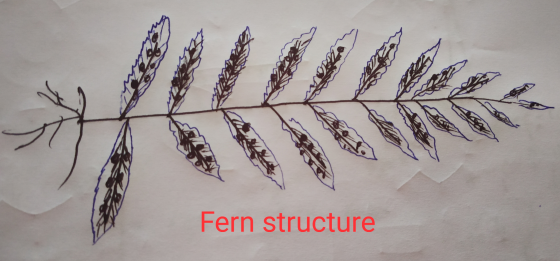
The image shows the sori of the fern each of the round dots contain multiple sporangia.
In the ferns, the sporangia are clustered into dense
aggregations called ‘sori’, which appear as round dots on the under
side of the fronds. Conversely, the sporangia of the lycophytes are
on the upper side of the leaves or along the stems.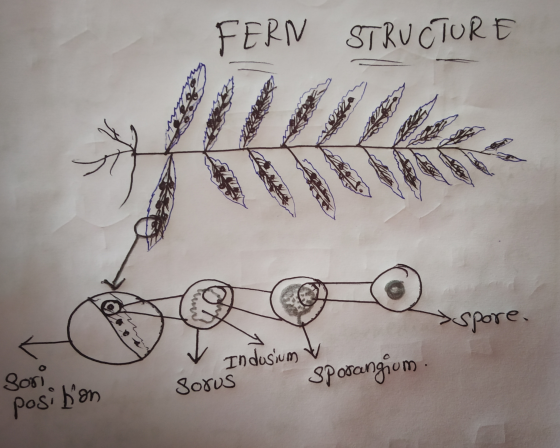
The microsporangia of the angiosperms (flowering plants) develop within the anther of the stamen. The microspores produced within the microsporangia—of which there is typically four per anther—eventually develop into pollen grains.
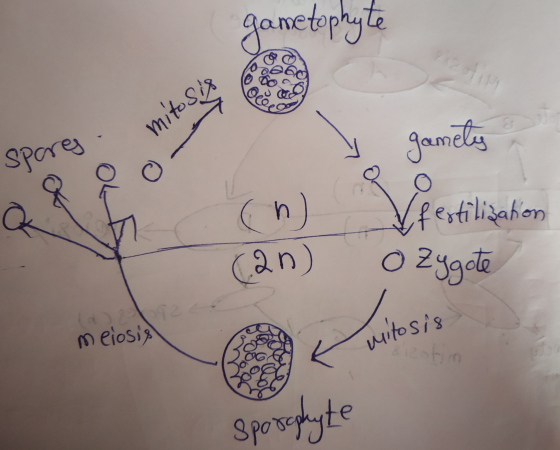
Pteridophytes are vascular plants. Leaves called sporophylls produce clusters of capsular structures called sporangia that bears spores which germinate and yield gametophytes. Hence they show alternation of generations, in which a sporophyte produces spores through meiosis and a gametophyte forms gametes by mitosis.
Question 23:- the name of the generation in the letter A is sporophyte.
Question 24:- the organisim belong to the phylum Zygomycota.
Rhizopus stolonifer is more commonly known as black bread mold. Rhizopus specifically means any rot causing fungi. This type of mold also has a synonym name of Rhizopus nigricans.
Rhizopus stolonifer is classified as a member of the Eukarya because it has cells that are organized into complex structures that are enclosed within membranes, along with membrane bound nuclei and other organelles in those cells.
Kingdom: Fungi
The kingdom Fungi consists of organisms that are heterotrophic. Rhizopus stolonifer is a mold that lacks chlorophyll, is non-motile, filamentous, and a decomposer of organic material.
Phylum: Zygomycota
Rhizopus stolonifer belongs to the phylum Zygomycota because it sexually produces zygospores and is considered saprophytic and parasitic.
Class: Zygomycetes
The Zygomycetes all have chitenous cell walls in a coenocytic mycelium and they lack motile spores.
Order: Mucorales
Rhizopus stolonifer is a member of the Mucorales because it is fast growing, with wide hyphae, that lack septa or is coenocytic, and grow within a substrate. Rhizopus stolonifer is also considered a member of the Mucorales because it is a major saprophyte, or grows and acquires nutrients from dead and decaying matter
Family: Mucoraceae
Rhizopus stolonifer is a part of the family Mucoraceae due to the key feature of a swollen extension of the sporangiophore, called the columella. It looks like a balloon within the sporangium and it often persists after the spores have been released.
Genus: Rhizopus
Rhizopus stolonifer is a member of the Rhizopus species because it is a rot causing fungus that has columnar hemispherical aerial sporangia anchored to the substrate by rhizoids.
Species: Rhizopus stolonifer
There are multiple species of Rhizopus, but Rhizopus stolonifer earned this species name because it is a black mold that grows on bread and its spores float around in the air. Rhizopus stolonifer also uses rhizoids as a way to anchor itself to the vast array of substrates it can come in contact with.
Identification Tips:
To identify Rhizopus stolonifer look for either a grayish fluffy mass or a blue or yellow colored coating on the substrate. Black spores are also visible to the eye on the surface of the substrate, which may look like black specs. The interesting looking fungi can appear on stale bread, damp leathers, and decaying fruits of which are kept at favorable temperatures.
Add Answer to:
Question 14 2 pts What is the name of the structures where the spores are produced...
ving questions about ferns: 1. Are the spores produced by the fern sporophyte formed by mitosis...
 ving questions about ferns: 1. Are the spores produced by the fern sporophyte formed by mitosis or meiosis? 2. Do the spores belong to the gametophyte or the sporophyte generation? 3. Are the gametes produced by mitosis or meiosis? 4. Are the archegonia and antheridia haploid or diploid? (HINT: Think about which generation produces them) 5. Is the dominant generation for the fern the gametophyte or the sporophyte? 6. Can you suggest an ecological role for ferns?
arrange the following structures or prosses into a diagram showing the life cycle of a moss...
 arrange the following structures or prosses into a
diagram showing the life cycle of a moss plant
1 What is meant by alternation of generations? alternation of generations between haploid and diploid the grocess their life that life Cycle cycle in alternate 2 What type of nuclear division is involved in the development of a sporophyte plant? Of the spores? meiosis ; Mitosis REVIEW QUESTIONS 3 Arrange the following structures or processes into a diagram showing the life cycle of...
arrange the following structures or prosses into a
diagram showing the life cycle of a moss plant
1 What is meant by alternation of generations? alternation of generations between haploid and diploid the grocess their life that life Cycle cycle in alternate 2 What type of nuclear division is involved in the development of a sporophyte plant? Of the spores? meiosis ; Mitosis REVIEW QUESTIONS 3 Arrange the following structures or processes into a diagram showing the life cycle of...
Question 2 2 pts Among sac fungi, which of these correctly distinguishes ascospores from conidia? Ascospores...
 Question 2 2 pts Among sac fungi, which of these correctly distinguishes ascospores from conidia? Ascospores are diploid, whereas conidia are haploid. Ascospores are genetically different, whereas conidia are genetically identical. Ascospores are larger, whereas conidia are smaller. Ascospores will germinate into haploid hyphae, whereas conidia will germinate into diploid hyphae. When trying to differentiate between septate hyphae and nonseptate hyphae, one should be observing o whether the mycelia has undergone plasmogamy or karyogamy. whether the spores are born in...
Using the information you have gathered, address the Focus Question: What is the life cycle of...
Using the information you have gathered, address the Focus Question: What is the life cycle of a flowering plant? Draw a circular diagram of the life cycle of a flowering plant. Be sure to include the five structures, listed in Table 1, in the proper order (gametophyte, sporophyte, zygote, spore, gamete). Indicate whether each structure is haploid or diploid and the process by which each structure is produced by the previous structure. You should draw male and female gametophytes and...
Question 9 2 pts You are given an organism to identify. It has a fruiting body...
 Question 9 2 pts You are given an organism to identify. It has a fruiting body that contains many structures with eight haploid spores lined up in a row. What kind of a fungus is this? O zygomycete chytrid O ascomycete basidiomycete O deuteromycete Which of the following terms refers to symbiotic relationships that involve fungi living between the cells in plant leaves? O endosymbioses O mycorrhizae O pathogens O lichens O endophytes
The ancestors of plants were probably algae. True/False 2) What do plants and the green algae...
The ancestors of plants were probably algae. True/False 2) What do plants and the green algae charophytes have in common? 3) What advantages did life in land provide for plants? 4) What were the disadvantages for life on land for plants? 5) What are some differences between plants and algae? 6) How do land plants maintain moisture in their cells? 7) What structures do land plants use to obtain resources such as water, minerals, and CO2? 8) List the two...
1. The superclass are jawed vertebrates. most with paired appendages 2. The head region of a...
 1. The superclass are jawed vertebrates. most with paired appendages 2. The head region of a tapeworm is the 3. Sea anemones belong to the phylum 4. The of the tapeworm contains both male and female sex organs and become filled with developing embryo. 5. Pollen would land on the 6. structures in plants that produce the gametes are called- 7. Spores are produced in the 8. Structures in plants that produce the gametes are called 9. Ascaris Lumbricoides is...
Question 131 pts A polygenic trait is due to a single gene. True False Flag this...
Question 131 pts A polygenic trait is due to a single gene. True False Flag this Question Question 142 pts IAIA and IAi are genotypes that produce the same phenotype. True False Flag this Question Question 152 pts Colorblindness and hemophilia are sex-linked traits in humans. True False Flag this Question Question 161 pts Transcription involves converting mRNA into proteins. True False Flag this Question Question 171 pts Another name for a reproductive cell is somatic cell. True False Flag...
6583 - 1 - Page 1 Name: 1) Which is a true statement about the process...
 6583 - 1 - Page 1 Name: 1) Which is a true statement about the process illustrated below? A) It is the beginning of embryonic development and occurs only in a freshwater environment B) It is the beginning of regeneration and occurs only within the female. C) It is the beginning of ovule formation and occurs on the stigma of flowers. D) It is the beginning of embryonic development and occurs within the female or in water. Normally, each cell...
i know this is very much to do but i need help plsssss Questions 32 and...
 i know this is very much to do but i need help plsssss
Questions 32 and 33 refer to the following: The illustration below represents the flower of an amaryllis plant. __32) Using a complete sentence, state a process carried out within the circled structure. _ 33) Name the circled part of the stamen. - 34) in which stage is an egg is released from a follicle? A) follicle stage B) corpus luteum stage Questions 35 through 37 refer to...
i know this is very much to do but i need help plsssss
Questions 32 and 33 refer to the following: The illustration below represents the flower of an amaryllis plant. __32) Using a complete sentence, state a process carried out within the circled structure. _ 33) Name the circled part of the stamen. - 34) in which stage is an egg is released from a follicle? A) follicle stage B) corpus luteum stage Questions 35 through 37 refer to...
 ving questions about ferns: 1. Are the spores produced by the fern sporophyte formed by mitosis or meiosis? 2. Do the spores belong to the gametophyte or the sporophyte generation? 3. Are the gametes produced by mitosis or meiosis? 4. Are the archegonia and antheridia haploid or diploid? (HINT: Think about which generation produces them) 5. Is the dominant generation for the fern the gametophyte or the sporophyte? 6. Can you suggest an ecological role for ferns?
 arrange the following structures or prosses into a
diagram showing the life cycle of a moss plant
1 What is meant by alternation of generations? alternation of generations between haploid and diploid the grocess their life that life Cycle cycle in alternate 2 What type of nuclear division is involved in the development of a sporophyte plant? Of the spores? meiosis ; Mitosis REVIEW QUESTIONS 3 Arrange the following structures or processes into a diagram showing the life cycle of...
arrange the following structures or prosses into a
diagram showing the life cycle of a moss plant
1 What is meant by alternation of generations? alternation of generations between haploid and diploid the grocess their life that life Cycle cycle in alternate 2 What type of nuclear division is involved in the development of a sporophyte plant? Of the spores? meiosis ; Mitosis REVIEW QUESTIONS 3 Arrange the following structures or processes into a diagram showing the life cycle of...
 Question 2 2 pts Among sac fungi, which of these correctly distinguishes ascospores from conidia? Ascospores are diploid, whereas conidia are haploid. Ascospores are genetically different, whereas conidia are genetically identical. Ascospores are larger, whereas conidia are smaller. Ascospores will germinate into haploid hyphae, whereas conidia will germinate into diploid hyphae. When trying to differentiate between septate hyphae and nonseptate hyphae, one should be observing o whether the mycelia has undergone plasmogamy or karyogamy. whether the spores are born in...
 Question 9 2 pts You are given an organism to identify. It has a fruiting body that contains many structures with eight haploid spores lined up in a row. What kind of a fungus is this? O zygomycete chytrid O ascomycete basidiomycete O deuteromycete Which of the following terms refers to symbiotic relationships that involve fungi living between the cells in plant leaves? O endosymbioses O mycorrhizae O pathogens O lichens O endophytes
 1. The superclass are jawed vertebrates. most with paired appendages 2. The head region of a tapeworm is the 3. Sea anemones belong to the phylum 4. The of the tapeworm contains both male and female sex organs and become filled with developing embryo. 5. Pollen would land on the 6. structures in plants that produce the gametes are called- 7. Spores are produced in the 8. Structures in plants that produce the gametes are called 9. Ascaris Lumbricoides is...
 6583 - 1 - Page 1 Name: 1) Which is a true statement about the process illustrated below? A) It is the beginning of embryonic development and occurs only in a freshwater environment B) It is the beginning of regeneration and occurs only within the female. C) It is the beginning of ovule formation and occurs on the stigma of flowers. D) It is the beginning of embryonic development and occurs within the female or in water. Normally, each cell...
 i know this is very much to do but i need help plsssss
Questions 32 and 33 refer to the following: The illustration below represents the flower of an amaryllis plant. __32) Using a complete sentence, state a process carried out within the circled structure. _ 33) Name the circled part of the stamen. - 34) in which stage is an egg is released from a follicle? A) follicle stage B) corpus luteum stage Questions 35 through 37 refer to...
i know this is very much to do but i need help plsssss
Questions 32 and 33 refer to the following: The illustration below represents the flower of an amaryllis plant. __32) Using a complete sentence, state a process carried out within the circled structure. _ 33) Name the circled part of the stamen. - 34) in which stage is an egg is released from a follicle? A) follicle stage B) corpus luteum stage Questions 35 through 37 refer to...
Most questions answered within 3 hours.
-
Where is the error in this code sequence?
String s1 = "Hello";
String s2 = "ello";...
asked 11 months ago -
Financial data for Joel de Paris, Inc., for last year
follow:
Joel de Paris, Inc.
Balance...
asked 11 months ago -
Consider this reaction:
Al2(SO4)3 (aq)+ BaCl3
(aq) Al2Cl6 (aq)- +
3BaSO4(s) . What is the...
asked 11 months ago -
Suppose that Savneet is considering increasing her
recent random sample from 20 car rentals to 40...
asked 11 months ago -
Trucks arrive at an unloading terminal at an average rate of 120
per hour.
Trucks arrive...
asked 11 months ago -
Why are methanol and ethanol completely soluble in water while
octanol is not very little soluble....
asked 11 months ago -
A facilities manager at a university reads in a research report
that the mean amount of...
asked 11 months ago -
When the CuSO4 is rehydrated by adding water to the anhydrous
compound, is this an endothermic...
asked 11 months ago -
A ray of sunlight is passing from diamond into crown glass; the
angle of incidence is...
asked 11 months ago -
A block of mass 0.249 kg is placed on top of a light, vertical
spring of...
asked 11 months ago -
how do the kidneys compensate in the presences of acidosis
a) trigger hyperventilate
b) reserve acid...
asked 11 months ago -
Question 501 pts
The rental rate of capital to the firm increases. Which of the
following...
asked 11 months ago