chemical reaction between vinegar and baking soda experment
Homework Answers
Request Answer!
We need at least 10 more requests to produce the answer.
0 / 10 have requested this problem solution
The more requests, the faster the answer.
1. Baking Soda: 0.15g of Baking Soda 20Ml of Vinager Temperature=23C Mass of Reaction Vessel=56.91g 2....
 1. Baking Soda:
0.15g of Baking Soda
20Ml of Vinager
Temperature=23C
Mass of Reaction Vessel=56.91g
2. Baking Powder:
0.14g of Baking Powder
20Ml of Vinager
Temperature=22C
Mass of Reaction Vessel=56.02g
Name: 1. Calculate the percent of sodium bicarbonate in baking soda and baking powder using the ideal gas law and the results of the reactions between the solids and vinegar.
1. Baking Soda:
0.15g of Baking Soda
20Ml of Vinager
Temperature=23C
Mass of Reaction Vessel=56.91g
2. Baking Powder:
0.14g of Baking Powder
20Ml of Vinager
Temperature=22C
Mass of Reaction Vessel=56.02g
Name: 1. Calculate the percent of sodium bicarbonate in baking soda and baking powder using the ideal gas law and the results of the reactions between the solids and vinegar.
Chemical Engineering Question When baking cookies, cookie batter undergoes a reaction with heat. The baking soda...
Chemical Engineering Question When baking cookies, cookie batter undergoes a reaction with heat. The baking soda (NaHCO3) breaks down to form sodium carbonate, water, and carbon dioxide. Each of these products contributes to the delicious cookies. a. Write a balanced chemical reaction for the breakdown of baking soda to products? Please include the phase of each component. b. Calculate the standard heat of reaction for this process? c. Is this process exothermic or endothermic?
Baking soda with vinegar to produce CO, as follows: NaHCO, (aq) + HC,H,O, (ag) CO (9)...
 Baking soda with vinegar to produce CO, as follows: NaHCO, (aq) + HC,H,O, (ag) CO (9) + H20 (1) + NaC,H,O2 (aq) AH - 7.3 kJ/mol Write the equation representing the rate of the reaction with respect to baking soda (NaHCO,) and then calculate the rate if a 0.5M solution of baking soda reacts completely in 45 seconds. Rates M/sec Select which of the following you expect the reaction coordinate (energy diagram to look like). - A
Question 13 of 36 > Attempt 3 Baking soda is sodium bicarbonate, NaHCO3, and vinegar is...
 Question 13 of 36 > Attempt 3 Baking soda is sodium bicarbonate, NaHCO3, and vinegar is primarily acetic acid, HC,H,O2- At room temperature, the addition of baking soda to vinegar results in a reaction that produces a tremendous amount of gas, as shown in the video. 201 - Fall 19 (Session ll) - DAYAO Activities and Due Dates > HW 4 signment Score: 32.9% Resources [ Give Up? Feedback Try Again Question 13 of 36 > Attempt 3 < Feedback...
1. Identify the chemicals present in the following substances: a) baking soda b) vinegar 2. the...
1. Identify the chemicals present in the following substances: a) baking soda b) vinegar 2. the reaction of ammonium bicarbonate, NH4HCO3, with acetic acid, HC2H2O, in vinegar can be described by the following chemical equation NH4HCO3(s) + HC2H3O2(aq) = NH4^+ (aq) + C2H3O2^- (aq) + H2O(l) + CO2(g) an experiment was performed to determine the volume of vinegar required to completely react to a known mass of NH4HCO3. the experimental data were NH4HCO3,............................... g vinegar, mL 0.62 ...................................... 10 0.85...
Question 3 When vinegar (CH3COOH) and baking soda (NaHCO3) are combined, the mixture spontaneously undergoes an...
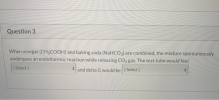 Question 3 When vinegar (CH3COOH) and baking soda (NaHCO3) are combined, the mixture spontaneously undergoes an endothermic reaction while releasing CO2 gas. The test tube would feel [Select] and delta G would be Select)
2) Calculations to determine the amount of CO2(g) produced in the Baking Soda-Vinegar reaction Starting Material:...
2) Calculations to determine the amount of CO2(g) produced in the Baking Soda-Vinegar reaction Starting Material: 40 ml Vinegar - SpecificGrav (CH3COOH) = 1.05 & vol%(CH3COOH) = 5 vol% a) Calculate the stoichiometric amount (moles and grams) of sodium bicarbonate needed. [CH3COOH(aq.) + H2O(l)]+ NaHCO3(s) --> H2O(l) +CO2(g) + NaCH3COO(aq.) c) Given that 1 mol of an ideal gas at standard temperature and pressure occupies 22.4 L, calculate the Ideal Gas Constant (R) in units of liter-atm/mol-K. NOTE: Remember R is...
Write an equation for the neutralization of vinegar (acetic acid) with baking soda. Your equation should...
Write an equation for the neutralization of vinegar (acetic acid) with baking soda. Your equation should show a proton transfer to form carbonic acid and a salt
Vinegar and baking soda are mixed and bubbles form. Which of these statements is true? 1.)...
Vinegar and baking soda are mixed and bubbles form. Which of these statements is true? 1.) All products are in solution. 2.) All reactants are solids. 3.) At least one reactant is a gas. 4.) At least one product is a gas.
When H2CO3 forms as a product in the reaction with acetic acid (CH3COOH) in vinegar and HCO3 in baking soda, bubbles ar...
 When H2CO3 forms as a product in the reaction with acetic acid (CH3COOH) in vinegar and HCO3 in baking soda, bubbles are formed. Those bubbles are from H2CO3 reacting (being removed from the solution) to generate water and CO2. Why does this removal of H2CO3 (product) shift the reaction Rate fwd < Raterev, so the reaction will shift to make more reactants To B Rate fwd > Raterev, so the reaction will shift to make more reactants o C Rate...
 1. Baking Soda:
0.15g of Baking Soda
20Ml of Vinager
Temperature=23C
Mass of Reaction Vessel=56.91g
2. Baking Powder:
0.14g of Baking Powder
20Ml of Vinager
Temperature=22C
Mass of Reaction Vessel=56.02g
Name: 1. Calculate the percent of sodium bicarbonate in baking soda and baking powder using the ideal gas law and the results of the reactions between the solids and vinegar.
1. Baking Soda:
0.15g of Baking Soda
20Ml of Vinager
Temperature=23C
Mass of Reaction Vessel=56.91g
2. Baking Powder:
0.14g of Baking Powder
20Ml of Vinager
Temperature=22C
Mass of Reaction Vessel=56.02g
Name: 1. Calculate the percent of sodium bicarbonate in baking soda and baking powder using the ideal gas law and the results of the reactions between the solids and vinegar.
 Baking soda with vinegar to produce CO, as follows: NaHCO, (aq) + HC,H,O, (ag) CO (9) + H20 (1) + NaC,H,O2 (aq) AH - 7.3 kJ/mol Write the equation representing the rate of the reaction with respect to baking soda (NaHCO,) and then calculate the rate if a 0.5M solution of baking soda reacts completely in 45 seconds. Rates M/sec Select which of the following you expect the reaction coordinate (energy diagram to look like). - A
 Question 13 of 36 > Attempt 3 Baking soda is sodium bicarbonate, NaHCO3, and vinegar is primarily acetic acid, HC,H,O2- At room temperature, the addition of baking soda to vinegar results in a reaction that produces a tremendous amount of gas, as shown in the video. 201 - Fall 19 (Session ll) - DAYAO Activities and Due Dates > HW 4 signment Score: 32.9% Resources [ Give Up? Feedback Try Again Question 13 of 36 > Attempt 3 < Feedback...
 Question 3 When vinegar (CH3COOH) and baking soda (NaHCO3) are combined, the mixture spontaneously undergoes an endothermic reaction while releasing CO2 gas. The test tube would feel [Select] and delta G would be Select)
 When H2CO3 forms as a product in the reaction with acetic acid (CH3COOH) in vinegar and HCO3 in baking soda, bubbles are formed. Those bubbles are from H2CO3 reacting (being removed from the solution) to generate water and CO2. Why does this removal of H2CO3 (product) shift the reaction Rate fwd < Raterev, so the reaction will shift to make more reactants To B Rate fwd > Raterev, so the reaction will shift to make more reactants o C Rate...
Most questions answered within 3 hours.
-
Where is the error in this code sequence?
String s1 = "Hello";
String s2 = "ello";...
asked 10 months ago -
Financial data for Joel de Paris, Inc., for last year
follow:
Joel de Paris, Inc.
Balance...
asked 10 months ago -
Consider this reaction:
Al2(SO4)3 (aq)+ BaCl3
(aq) Al2Cl6 (aq)- +
3BaSO4(s) . What is the...
asked 10 months ago -
Suppose that Savneet is considering increasing her
recent random sample from 20 car rentals to 40...
asked 10 months ago -
Trucks arrive at an unloading terminal at an average rate of 120
per hour.
Trucks arrive...
asked 10 months ago -
Why are methanol and ethanol completely soluble in water while
octanol is not very little soluble....
asked 10 months ago -
A facilities manager at a university reads in a research report
that the mean amount of...
asked 10 months ago -
When the CuSO4 is rehydrated by adding water to the anhydrous
compound, is this an endothermic...
asked 10 months ago -
A ray of sunlight is passing from diamond into crown glass; the
angle of incidence is...
asked 10 months ago -
A block of mass 0.249 kg is placed on top of a light, vertical
spring of...
asked 10 months ago -
how do the kidneys compensate in the presences of acidosis
a) trigger hyperventilate
b) reserve acid...
asked 10 months ago -
Question 501 pts
The rental rate of capital to the firm increases. Which of the
following...
asked 10 months ago