Chemical Engineering Question When baking cookies, cookie batter undergoes a reaction with heat. The baking soda...
Chemical Engineering Question
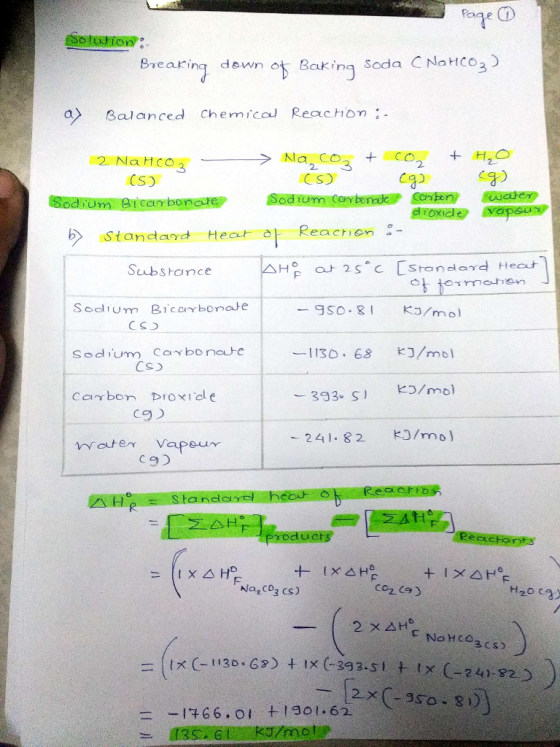
When baking cookies, cookie batter undergoes a reaction with heat. The baking soda (NaHCO3) breaks down to form sodium carbonate, water, and carbon dioxide. Each of these products contributes to the delicious cookies.
a. Write a balanced chemical reaction for the breakdown of baking soda to products? Please include the phase of each component.
b. Calculate the standard heat of reaction for this process?
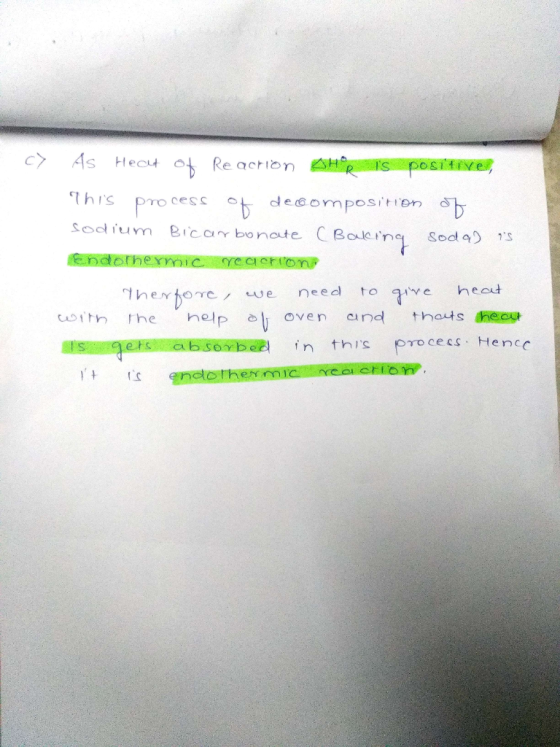
c. Is this process exothermic or endothermic?
Homework Answers
Add Answer to:
Chemical Engineering Question
When baking cookies, cookie batter undergoes a reaction with
heat. The baking soda...
Question 3 When vinegar (CH3COOH) and baking soda (NaHCO3) are combined, the mixture spontaneously undergoes an...
 Question 3 When vinegar (CH3COOH) and baking soda (NaHCO3) are combined, the mixture spontaneously undergoes an endothermic reaction while releasing CO2 gas. The test tube would feel [Select] and delta G would be Select)
23b 23. Sodium bicarbonate (baking soda) is used to make cookies and cakes rise when buking...
 23b
23. Sodium bicarbonate (baking soda) is used to make cookies and cakes rise when buking because it decomposes with heat to produce gaseous carbon dioxide as shown below. 2 NaHCO, Na Costa HO + CO, AH° = 129.2 kmol + a) i) Determine the transition temperature of this reaction. ii) Should the temperature be above or below this value to favor the products? Briefly justify your choice. b) Sodium bicarbonate does not decompose significantly at room temperature, 25 °C...
23b
23. Sodium bicarbonate (baking soda) is used to make cookies and cakes rise when buking because it decomposes with heat to produce gaseous carbon dioxide as shown below. 2 NaHCO, Na Costa HO + CO, AH° = 129.2 kmol + a) i) Determine the transition temperature of this reaction. ii) Should the temperature be above or below this value to favor the products? Briefly justify your choice. b) Sodium bicarbonate does not decompose significantly at room temperature, 25 °C...
Experiment 9- Decomposition of Baking Soda A. mass of H2CO3 gas released, (H2CO3 decomposed into H2O...
 Experiment 9- Decomposition of Baking Soda
A. mass of H2CO3 gas released, (H2CO3 decomposed into H2O +
CO2)?
B. mass of NaHCO3 in unknown mixture?
C. mass of NaHCO3 in unknown mixture?
D. mass of KCL in unknown mixture?
CURCU ILI U ULICOS MOLLE (Part 2) Percent of NaHCO3 in an Unknown Mixture 1) Weigh out approximately 1 g of the unknown sample into your cruci 2) Repeat the steps of the previous procedure. ne steps of the previous procedure....
Experiment 9- Decomposition of Baking Soda
A. mass of H2CO3 gas released, (H2CO3 decomposed into H2O +
CO2)?
B. mass of NaHCO3 in unknown mixture?
C. mass of NaHCO3 in unknown mixture?
D. mass of KCL in unknown mixture?
CURCU ILI U ULICOS MOLLE (Part 2) Percent of NaHCO3 in an Unknown Mixture 1) Weigh out approximately 1 g of the unknown sample into your cruci 2) Repeat the steps of the previous procedure. ne steps of the previous procedure....
Please complete for Tuesday, we will go through the questions and mark them in class. pg 156 - 4.23,...
 Please complete for Tuesday, we will go through the questions and mark them in class. pg 156 - 4.23, 4.24, 4.26 pg 170 - 4.29, 4.31, pg 171-4.36 pg 175 - 4.59 pg 176- 4.74, 4.75, 4.80 pg 177-4.81, 4.82 pg 188- 5.1, 5.4, 5.5, 5.6, 5.11 - Using Table 5.1 pg 198-5.22, 5.25 pg 203 - 5.29 pg 206 - 5.37 pg 209 - 5.39 pg 2.14 5.61 pg 235-6.11, 6.14, 6.16 156 CHAPTER 4 Introduction to Organic Compounds...
 Question 3 When vinegar (CH3COOH) and baking soda (NaHCO3) are combined, the mixture spontaneously undergoes an endothermic reaction while releasing CO2 gas. The test tube would feel [Select] and delta G would be Select)
 23b
23. Sodium bicarbonate (baking soda) is used to make cookies and cakes rise when buking because it decomposes with heat to produce gaseous carbon dioxide as shown below. 2 NaHCO, Na Costa HO + CO, AH° = 129.2 kmol + a) i) Determine the transition temperature of this reaction. ii) Should the temperature be above or below this value to favor the products? Briefly justify your choice. b) Sodium bicarbonate does not decompose significantly at room temperature, 25 °C...
23b
23. Sodium bicarbonate (baking soda) is used to make cookies and cakes rise when buking because it decomposes with heat to produce gaseous carbon dioxide as shown below. 2 NaHCO, Na Costa HO + CO, AH° = 129.2 kmol + a) i) Determine the transition temperature of this reaction. ii) Should the temperature be above or below this value to favor the products? Briefly justify your choice. b) Sodium bicarbonate does not decompose significantly at room temperature, 25 °C...
 Experiment 9- Decomposition of Baking Soda
A. mass of H2CO3 gas released, (H2CO3 decomposed into H2O +
CO2)?
B. mass of NaHCO3 in unknown mixture?
C. mass of NaHCO3 in unknown mixture?
D. mass of KCL in unknown mixture?
CURCU ILI U ULICOS MOLLE (Part 2) Percent of NaHCO3 in an Unknown Mixture 1) Weigh out approximately 1 g of the unknown sample into your cruci 2) Repeat the steps of the previous procedure. ne steps of the previous procedure....
Experiment 9- Decomposition of Baking Soda
A. mass of H2CO3 gas released, (H2CO3 decomposed into H2O +
CO2)?
B. mass of NaHCO3 in unknown mixture?
C. mass of NaHCO3 in unknown mixture?
D. mass of KCL in unknown mixture?
CURCU ILI U ULICOS MOLLE (Part 2) Percent of NaHCO3 in an Unknown Mixture 1) Weigh out approximately 1 g of the unknown sample into your cruci 2) Repeat the steps of the previous procedure. ne steps of the previous procedure....
 Please complete for Tuesday, we will go through the questions and mark them in class. pg 156 - 4.23, 4.24, 4.26 pg 170 - 4.29, 4.31, pg 171-4.36 pg 175 - 4.59 pg 176- 4.74, 4.75, 4.80 pg 177-4.81, 4.82 pg 188- 5.1, 5.4, 5.5, 5.6, 5.11 - Using Table 5.1 pg 198-5.22, 5.25 pg 203 - 5.29 pg 206 - 5.37 pg 209 - 5.39 pg 2.14 5.61 pg 235-6.11, 6.14, 6.16 156 CHAPTER 4 Introduction to Organic Compounds...
Most questions answered within 3 hours.
-
Where is the error in this code sequence?
String s1 = "Hello";
String s2 = "ello";...
asked 10 months ago -
Financial data for Joel de Paris, Inc., for last year
follow:
Joel de Paris, Inc.
Balance...
asked 10 months ago -
Consider this reaction:
Al2(SO4)3 (aq)+ BaCl3
(aq) Al2Cl6 (aq)- +
3BaSO4(s) . What is the...
asked 10 months ago -
Suppose that Savneet is considering increasing her
recent random sample from 20 car rentals to 40...
asked 10 months ago -
Trucks arrive at an unloading terminal at an average rate of 120
per hour.
Trucks arrive...
asked 10 months ago -
Why are methanol and ethanol completely soluble in water while
octanol is not very little soluble....
asked 10 months ago -
A facilities manager at a university reads in a research report
that the mean amount of...
asked 10 months ago -
When the CuSO4 is rehydrated by adding water to the anhydrous
compound, is this an endothermic...
asked 10 months ago -
A ray of sunlight is passing from diamond into crown glass; the
angle of incidence is...
asked 10 months ago -
A block of mass 0.249 kg is placed on top of a light, vertical
spring of...
asked 10 months ago -
how do the kidneys compensate in the presences of acidosis
a) trigger hyperventilate
b) reserve acid...
asked 10 months ago -
Question 501 pts
The rental rate of capital to the firm increases. Which of the
following...
asked 10 months ago