
Homework Answers


I have written the detailed answer for the question provided with the appropriate method and explanation as well as formulation for it..in case of any doubts do write back.
Add Answer to:
A charged particle produces a field E at distance 4.1 m from the particle. At what...
At a distance of 12 mm from a charged particle, the electric field has a magnitude...
 At a distance of 12 mm from a charged particle, the electric
field has a magnitude of 100 N/CN/C.
Part A
At what distance is the electric field 400 N/CN/C?
Express your answer with the appropriate units.
r1r1 =
SubmitPrevious AnswersRequest Answer
Incorrect; Try Again; 5 attempts remaining
Part B
At what distance is it 16 N/CN/C?
Express your answer with the appropriate units.
r2r2 =
nothingnothing
SubmitRequest Answer
Provide Feedback
Next
At a distance of 12 mm from a charged particle, the electric
field has a magnitude of 100 N/CN/C.
Part A
At what distance is the electric field 400 N/CN/C?
Express your answer with the appropriate units.
r1r1 =
SubmitPrevious AnswersRequest Answer
Incorrect; Try Again; 5 attempts remaining
Part B
At what distance is it 16 N/CN/C?
Express your answer with the appropriate units.
r2r2 =
nothingnothing
SubmitRequest Answer
Provide Feedback
Next
A -60 nC charged particle is in a uniform electric field E⃗ = (20 V/m , east)....
A -60 nC charged particle is in a uniform electric field E⃗ = (20 V/m , east). An external force moves the particle 2.0 m north, then 5.0 m east, then 7.0 m south, and finally 4.0 m west. The particle begins and ends its motion with zero velocity. Part A How much work is done on it by the external force? Express your answer to two significant figures and include the appropriate units. Part B What is the potential difference...
In Example 24.6, we found that the electric field of a charged disk approaches that of...
In Example 24.6, we found that the electric field of a charged disk approaches that of a charged particle for distances y that are large compared to R, the radius of the disk. To see a numerical instance of this, calculate the magnitude of the electric field a distance y = 3.1 m from a disk of radius R = 3.1 cm that has a total charge of 6.8 µC using the exact formula as follows. (Enter your answer to...
need help in solving this. thank you At a certain distance from a charged particle, the...
 need help in solving this.
thank you
At a certain distance from a charged particle, the magnitude of the electric field is 516 V/m and the electric potential is -2.40 kV. (a) What is the distance to the particle? (b) What is the magnitude of the charge? HC
need help in solving this.
thank you
At a certain distance from a charged particle, the magnitude of the electric field is 516 V/m and the electric potential is -2.40 kV. (a) What is the distance to the particle? (b) What is the magnitude of the charge? HC
In the figure point P is at a distance di = 4.65 m from particle 1...
 In the figure point P is at a distance di = 4.65 m from particle 1 (91 = -9e) and distance d2 = 2.24 m from particle 2 (92 = +9e), with both particles fixed in place. (a) With V =0 at infinity, what is V at P? If we bring a particle of charge 93 = +9e from infinity to P, (b) how much work do we do and (c) what is the potential energy of the three-particle system?...
A particle of mass M there is a constant electric field of E 1.6x10³ & field...
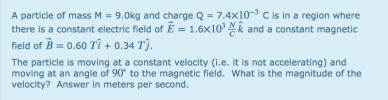 A particle of mass M there is a constant electric field of E 1.6x10³ & field of B = 0.60 Ti + 0.34 TA. 9.0kg and charge Q -7.4x10⁻³ C is in a region where and a constant magnetic The particle is moving at a constant velocity (i.e. it is not accelerating) and moving at an angle of 90° to the magnetic field. What is the magnitude of the velocity? Answer in meters per second.
A 2.00-g charged particle is released from rest in a region that has a uniform electric...
A 2.00-g charged particle is released from rest in a region that has a uniform electric field E= 160 N/C. After traveling a distance of 20.0 m in this region, the particle has a kinetic energy of 233 J. Determine the charge of the particle in units of coulomb.
A charged cloud system produces an electric field in the air near Earth's surface. A particle...
 A charged cloud system produces an electric field in the air near Earth's surface. A particle of charge -2.1 x 10⁻⁹ C is acted on by a downward electrostatic force of 4.0 x 10⁻⁶ N when placed in this field. (a) What is the magnitude of the electric field? (b) What is the magnitude of the electrostatic force on a proton placed in this field? (c) What is the gravitational force on the proton? (d) What is the ratio of...
A charged cloud system produces an electric field in the air near Earth's surface. A particle...
 A charged cloud system produces an electric field in the air near Earth's surface. A particle of charge -2.1 x 10°C is acted on by a downward electrostatic force of 3.6 x 10⁻⁶ N when placed in this field. (a) What is the magnitude of the electric field? (b) What is the magnitude of the electrostatic force on a proton placed in this field? (c) What is the gravitational force on the proton? (d) What is the ratio of the...
 At a distance of 12 mm from a charged particle, the electric
field has a magnitude of 100 N/CN/C.
Part A
At what distance is the electric field 400 N/CN/C?
Express your answer with the appropriate units.
r1r1 =
SubmitPrevious AnswersRequest Answer
Incorrect; Try Again; 5 attempts remaining
Part B
At what distance is it 16 N/CN/C?
Express your answer with the appropriate units.
r2r2 =
nothingnothing
SubmitRequest Answer
Provide Feedback
Next
At a distance of 12 mm from a charged particle, the electric
field has a magnitude of 100 N/CN/C.
Part A
At what distance is the electric field 400 N/CN/C?
Express your answer with the appropriate units.
r1r1 =
SubmitPrevious AnswersRequest Answer
Incorrect; Try Again; 5 attempts remaining
Part B
At what distance is it 16 N/CN/C?
Express your answer with the appropriate units.
r2r2 =
nothingnothing
SubmitRequest Answer
Provide Feedback
Next
 need help in solving this.
thank you
At a certain distance from a charged particle, the magnitude of the electric field is 516 V/m and the electric potential is -2.40 kV. (a) What is the distance to the particle? (b) What is the magnitude of the charge? HC
need help in solving this.
thank you
At a certain distance from a charged particle, the magnitude of the electric field is 516 V/m and the electric potential is -2.40 kV. (a) What is the distance to the particle? (b) What is the magnitude of the charge? HC
 In the figure point P is at a distance di = 4.65 m from particle 1 (91 = -9e) and distance d2 = 2.24 m from particle 2 (92 = +9e), with both particles fixed in place. (a) With V =0 at infinity, what is V at P? If we bring a particle of charge 93 = +9e from infinity to P, (b) how much work do we do and (c) what is the potential energy of the three-particle system?...
 A particle of mass M there is a constant electric field of E 1.6x10³ & field of B = 0.60 Ti + 0.34 TA. 9.0kg and charge Q -7.4x10⁻³ C is in a region where and a constant magnetic The particle is moving at a constant velocity (i.e. it is not accelerating) and moving at an angle of 90° to the magnetic field. What is the magnitude of the velocity? Answer in meters per second.
 A charged cloud system produces an electric field in the air near Earth's surface. A particle of charge -2.1 x 10⁻⁹ C is acted on by a downward electrostatic force of 4.0 x 10⁻⁶ N when placed in this field. (a) What is the magnitude of the electric field? (b) What is the magnitude of the electrostatic force on a proton placed in this field? (c) What is the gravitational force on the proton? (d) What is the ratio of...
 A charged cloud system produces an electric field in the air near Earth's surface. A particle of charge -2.1 x 10°C is acted on by a downward electrostatic force of 3.6 x 10⁻⁶ N when placed in this field. (a) What is the magnitude of the electric field? (b) What is the magnitude of the electrostatic force on a proton placed in this field? (c) What is the gravitational force on the proton? (d) What is the ratio of the...
Most questions answered within 3 hours.
-
Where is the error in this code sequence?
String s1 = "Hello";
String s2 = "ello";...
asked 10 months ago -
Financial data for Joel de Paris, Inc., for last year
follow:
Joel de Paris, Inc.
Balance...
asked 10 months ago -
Consider this reaction:
Al2(SO4)3 (aq)+ BaCl3
(aq) Al2Cl6 (aq)- +
3BaSO4(s) . What is the...
asked 10 months ago -
Suppose that Savneet is considering increasing her
recent random sample from 20 car rentals to 40...
asked 10 months ago -
Trucks arrive at an unloading terminal at an average rate of 120
per hour.
Trucks arrive...
asked 10 months ago -
Why are methanol and ethanol completely soluble in water while
octanol is not very little soluble....
asked 10 months ago -
A facilities manager at a university reads in a research report
that the mean amount of...
asked 10 months ago -
When the CuSO4 is rehydrated by adding water to the anhydrous
compound, is this an endothermic...
asked 10 months ago -
A ray of sunlight is passing from diamond into crown glass; the
angle of incidence is...
asked 10 months ago -
A block of mass 0.249 kg is placed on top of a light, vertical
spring of...
asked 10 months ago -
how do the kidneys compensate in the presences of acidosis
a) trigger hyperventilate
b) reserve acid...
asked 10 months ago -
Question 501 pts
The rental rate of capital to the firm increases. Which of the
following...
asked 10 months ago