A 4.7 kg block is being pushed across a frictionless horizontal surface by a horizontal force....
A 4.7 kg block is being pushed across a frictionless horizontal surface by a horizontal force. The block accelerates at 3.8 m/s2. What is the magnitude of the normal force the surface exerts on the block? Express your answer in newtons and round to one decimal place.
Homework Answers
Given:

Since it is a horizontal table, the normal force is equal to the weight of the block. That is,
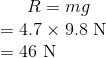
Add Answer to:
A 4.7 kg block is being pushed across a frictionless horizontal
surface by a horizontal force....
A 3.9 kg block is being pushed across a frictionless horizontal surface by a horizontal force....
A 3.9 kg block is being pushed across a frictionless horizontal surface by a horizontal force. The block accelerates at 5.6 m/s2. What is the magnitude of the normal force the surface exerts on the block? Express your answer in newtons and round to one decimal place.
A 5.3 kg block is pushed across a horizontal surface with a horizontal force of 34.2...
A 5.3 kg block is pushed across a horizontal surface with a horizontal force of 34.2 N against a friction force of 17.0 N. What is the acceleration of the block? Please report your answer with 1 number behind the decimal and select the correct unit
A 2.0 kg block starts from rest. It is pushed across a rough horizontal surface by...
 A 2.0 kg block starts from rest. It is pushed across a rough
horizontal surface by a force F (magnitude of F = 8.0 N) directed
at a 40° angle as shown. The block is found to accelerate along the
surface at 2.0 m/s2.
Prove that there is a frictional force acting on the block
F-8.0 N 40° 40 2.0 kg
A 2.0 kg block starts from rest. It is pushed across a rough
horizontal surface by a force F (magnitude of F = 8.0 N) directed
at a 40° angle as shown. The block is found to accelerate along the
surface at 2.0 m/s2.
Prove that there is a frictional force acting on the block
F-8.0 N 40° 40 2.0 kg
A 6.00-kg block is in contact with a 4.00-kg block on a horizontal frictionless surface as...
 A 6.00-kg block is in contact with a 4.00-kg block on a horizontal frictionless surface as shown in the figure. The 6.00-kg block is being pushed by a horizontal 20.0-N force as shown. 1. 20.0 6.00 4.00 kg kg A) Draw free-body diagram and write the equation of motion for the 6.0kg block Free-Body Diagram X: Y: B) Draw free-body diagram and write the equation of motion for the 4.0kg block X: Free-Body Diagram Y: C) What is the common...
A 6.00-kg block is in contact with a 4.00-kg block on a horizontal frictionless surface as...
 A 6.00-kg block is in contact with a 4.00-kg block on a
horizontal frictionless surface as shown
in the figure. The 6.00-kg block is being pushed by a horizontal
20.0-N force as shown.
a. What is the acceleration of the blocks?
b. What is the magnitude of the force of the 6.00-kg block on the
4.00-kg block?
c. What is the magnitude of the force of the 4.00-kg block on the
6.00-kg block?
d. What is the net force on...
A 6.00-kg block is in contact with a 4.00-kg block on a
horizontal frictionless surface as shown
in the figure. The 6.00-kg block is being pushed by a horizontal
20.0-N force as shown.
a. What is the acceleration of the blocks?
b. What is the magnitude of the force of the 6.00-kg block on the
4.00-kg block?
c. What is the magnitude of the force of the 4.00-kg block on the
6.00-kg block?
d. What is the net force on...
A 46 kg crate is on a rough horizontal surface. I push the block horizontally with...
A 46 kg crate is on a rough horizontal surface. I push the block horizontally with a 115 N force but the crate remains stationary. What is the magnitude of the friction force between the crate and the surface? Express your answer in newtons and round to one decimal place.
A 40 kg crate is on a rough horizontal surface. I push the block horizontally with...
A 40 kg crate is on a rough horizontal surface. I push the block horizontally with a 127 N force but the crate remains stationary. What is the magnitude of the friction force between the crate and the surface? Express your answer in newtons and round to one decimal place.
Block A is pushed across a horizontal surface at a constant speed by a hand that...
 Block A is pushed across a horizontal surface at a constant
speed by a hand that exerts force towards the right. Assume that
there is friction between the block and the surface.
a. Draw an interaction diagram for the situation.
b. Use your interaction diagram to draw two free-body diagrams,
one for the hand and the other for the block.
c. Rank in order from largest to smallest, the magnitudes of all
of the horizontal forces you showed in part...
Block A is pushed across a horizontal surface at a constant
speed by a hand that exerts force towards the right. Assume that
there is friction between the block and the surface.
a. Draw an interaction diagram for the situation.
b. Use your interaction diagram to draw two free-body diagrams,
one for the hand and the other for the block.
c. Rank in order from largest to smallest, the magnitudes of all
of the horizontal forces you showed in part...
A 0.73 kg block on a horizontal frictionless surface is attached to a spring whose force...
A 0.73 kg block on a horizontal frictionless surface is attached to a spring whose force constant is 210 N/m. The block is pulled from its equilibrium position at x = 0 m to a displacement x = +0.080 m and is released from rest. The block then executes simple harmonic motion along the x-axis (horizontal). When the displacement is x = -2.8×10⁻² m, the magnitude of the acceleration of the block is closest to: A 0.73 block on a horizontal...
A 900 g block is being pulled across a smooth (frictionless) horizontal table by a string...
A 900 g block is being pulled across a smooth (frictionless) horizontal table by a string that makes a 38o angle up from horizontal. The tension in the string is 2.5 N. What is the acceleration of the block? Express your answer in meters per second squared and round to one decimal place.
 A 2.0 kg block starts from rest. It is pushed across a rough
horizontal surface by a force F (magnitude of F = 8.0 N) directed
at a 40° angle as shown. The block is found to accelerate along the
surface at 2.0 m/s2.
Prove that there is a frictional force acting on the block
F-8.0 N 40° 40 2.0 kg
A 2.0 kg block starts from rest. It is pushed across a rough
horizontal surface by a force F (magnitude of F = 8.0 N) directed
at a 40° angle as shown. The block is found to accelerate along the
surface at 2.0 m/s2.
Prove that there is a frictional force acting on the block
F-8.0 N 40° 40 2.0 kg
 A 6.00-kg block is in contact with a 4.00-kg block on a horizontal frictionless surface as shown in the figure. The 6.00-kg block is being pushed by a horizontal 20.0-N force as shown. 1. 20.0 6.00 4.00 kg kg A) Draw free-body diagram and write the equation of motion for the 6.0kg block Free-Body Diagram X: Y: B) Draw free-body diagram and write the equation of motion for the 4.0kg block X: Free-Body Diagram Y: C) What is the common...
 A 6.00-kg block is in contact with a 4.00-kg block on a
horizontal frictionless surface as shown
in the figure. The 6.00-kg block is being pushed by a horizontal
20.0-N force as shown.
a. What is the acceleration of the blocks?
b. What is the magnitude of the force of the 6.00-kg block on the
4.00-kg block?
c. What is the magnitude of the force of the 4.00-kg block on the
6.00-kg block?
d. What is the net force on...
A 6.00-kg block is in contact with a 4.00-kg block on a
horizontal frictionless surface as shown
in the figure. The 6.00-kg block is being pushed by a horizontal
20.0-N force as shown.
a. What is the acceleration of the blocks?
b. What is the magnitude of the force of the 6.00-kg block on the
4.00-kg block?
c. What is the magnitude of the force of the 4.00-kg block on the
6.00-kg block?
d. What is the net force on...
 Block A is pushed across a horizontal surface at a constant
speed by a hand that exerts force towards the right. Assume that
there is friction between the block and the surface.
a. Draw an interaction diagram for the situation.
b. Use your interaction diagram to draw two free-body diagrams,
one for the hand and the other for the block.
c. Rank in order from largest to smallest, the magnitudes of all
of the horizontal forces you showed in part...
Block A is pushed across a horizontal surface at a constant
speed by a hand that exerts force towards the right. Assume that
there is friction between the block and the surface.
a. Draw an interaction diagram for the situation.
b. Use your interaction diagram to draw two free-body diagrams,
one for the hand and the other for the block.
c. Rank in order from largest to smallest, the magnitudes of all
of the horizontal forces you showed in part...
Most questions answered within 3 hours.
-
Where is the error in this code sequence?
String s1 = "Hello";
String s2 = "ello";...
asked 10 months ago -
Financial data for Joel de Paris, Inc., for last year
follow:
Joel de Paris, Inc.
Balance...
asked 10 months ago -
Consider this reaction:
Al2(SO4)3 (aq)+ BaCl3
(aq) Al2Cl6 (aq)- +
3BaSO4(s) . What is the...
asked 10 months ago -
Suppose that Savneet is considering increasing her
recent random sample from 20 car rentals to 40...
asked 10 months ago -
Trucks arrive at an unloading terminal at an average rate of 120
per hour.
Trucks arrive...
asked 10 months ago -
Why are methanol and ethanol completely soluble in water while
octanol is not very little soluble....
asked 10 months ago -
A facilities manager at a university reads in a research report
that the mean amount of...
asked 10 months ago -
When the CuSO4 is rehydrated by adding water to the anhydrous
compound, is this an endothermic...
asked 10 months ago -
A ray of sunlight is passing from diamond into crown glass; the
angle of incidence is...
asked 10 months ago -
A block of mass 0.249 kg is placed on top of a light, vertical
spring of...
asked 10 months ago -
how do the kidneys compensate in the presences of acidosis
a) trigger hyperventilate
b) reserve acid...
asked 10 months ago -
Question 501 pts
The rental rate of capital to the firm increases. Which of the
following...
asked 10 months ago