
Homework Answers
Request Answer!
We need at least 10 more requests to produce the answer.
0 / 10 have requested this problem solution
The more requests, the faster the answer.
Add Answer to:
Part B Decide which molecules in the simulation will represent the substances from the actual reaction....
Part A: Draw the Lewis structures of all the molecules involved in the reaction: N2(g)+3H2(g)→2NH3(g) Part B: If the bond energy for the N≡N bond is 946 kJ/mol, how much energy is needed to break all...
Part A: Draw the Lewis structures of all the molecules involved in the reaction: N2(g)+3H2(g)→2NH3(g) Part B: If the bond energy for the N≡N bond is 946 kJ/mol, how much energy is needed to break all the bonds in 3.0 mol of nitrogen molecules? Part C: If the bond energy for the H−H bond is 432 kJ/mol, how much energy is needed to break all the bonds in 9 hydrogen gas? Part D: If the bond energy for the N=H...
3H2(g)+N2(g)→2NH3(g) Part A: How many moles of NH3 can be produced from 12.0 mol of H2...
3H2(g)+N2(g)→2NH3(g) Part A: How many moles of NH3 can be produced from 12.0 mol of H2 and excess N2? = 8.00 mol I need answers for Part B-D Part B: How many grams of NH3 can be produced from 3.75 mol of N2 and excess H2? Part C: How many grams of H2 are needed to produce 11.79 g of NH3? Part D: How many molecules (not moles) of NH3 are produced from 5.00×10⁻⁴ g of H2?
Part B? Review | Constants Periodic Table H2NH3 Consider the following reaction: 2NH3(g) = N2(g) +...
 Part B?
Review | Constants Periodic Table H2NH3 Consider the following reaction: 2NH3(g) = N2(g) + 3H2(g) Submit Previous Answers Correct The equilibrium constant is equal to the concentrations of the products divided by the concentrations of the reactants. The concentrations of both the reactants and the products are raised to a power of the respective coefficient from the balanced chemical reaction. K.= [N] [H] [NH3] Part B What is the numerical value of Kc for the reaction if the...
Part B?
Review | Constants Periodic Table H2NH3 Consider the following reaction: 2NH3(g) = N2(g) + 3H2(g) Submit Previous Answers Correct The equilibrium constant is equal to the concentrations of the products divided by the concentrations of the reactants. The concentrations of both the reactants and the products are raised to a power of the respective coefficient from the balanced chemical reaction. K.= [N] [H] [NH3] Part B What is the numerical value of Kc for the reaction if the...
37. Which of the following molecules or substances contain or (is) are derived from fatty acids?...
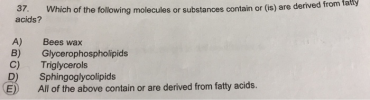 37. Which of the following molecules or substances contain or (is) are derived from fatty acids? A) Bees wax B) Glycerophospholipids C) Triglycerols D) Sphingoglycolipids All of the above contain or are derived from fatty acids.
14. A catalyst a. Participates in the reaction and b. Dec c. Increases the activation e...
 14. A catalyst a. Participates in the reaction and b. Dec c. Increases the activation e d. Binds to the reactants and releases them sequentially the reaction and changes the product release reases the activation energy required for the reaction 15. In an exothermic reaction, if heat is removed from the reaction a. Equilibrium shifts to the right b. Product formation increases c. Increase the value of K d. All the above 16. Initially, a mixture of 0.100 M No,...
PhET Simulation - Build a Molecule ③ 17 01 25 G Part B For many compounds,...
 PhET Simulation - Build a Molecule ③ 17 01 25 G Part B For many compounds, it is possible to draw multiple Lewis dot structures that are simplifications of the structure of the true molecule. The actual structure of the molecule, caled a resonance hybrid, is a combination of all of the different structures, which are called resonance forms. The cyanation (OCN ) is capable of forming three different resonance forms Draw Lewis dot structures for the three possible resonance...
PART B MELTING POINTS OF SOME ORGANIC SUBSTANCES Circle the pair of substances of which you measured the melting point...
 PART B MELTING POINTS OF SOME ORGANIC SUBSTANCES Circle the pair of substances of which you measured the melting point range 7 2-naphthol (A) and naphthalene (B) benzophenone (A) and benzil (B Complete the following table: [6 marks] Hint Molecules containing only Cand H can be assumed to be non-polar Present in Present in А Stronger in which substance? Why? Intermolecular Force В (yes or no) (yes or no) London Dispersion Dipole-Dipole Hydrogen Bonding Which of the two substances that...
answer please number 1) a and b and 2 and 3 Experiment 4: Limiting reagent Often reactants are added in amounts diff...
 answer please number 1) a and b and 2 and 3
Experiment 4: Limiting reagent Often reactants are added in amounts different from the proportions given by the chemical equation in such cases, only one of the reactants may be completely consumed at the end of the reaction, whereas some amounts of other reactants will remain unreacted. The limiting reactant (or limiting reagent) is the reactant that is entirely consumed or converted to product when a reaction goes to completion....
answer please number 1) a and b and 2 and 3
Experiment 4: Limiting reagent Often reactants are added in amounts different from the proportions given by the chemical equation in such cases, only one of the reactants may be completely consumed at the end of the reaction, whereas some amounts of other reactants will remain unreacted. The limiting reactant (or limiting reagent) is the reactant that is entirely consumed or converted to product when a reaction goes to completion....
Experiment 11 beeaalgnon Part C: For these molecules and polyatomic ions, some of which are from...
 Experiment 11 beeaalgnon Part C: For these molecules and polyatomic ions, some of which are from the table in Part A, draw all of their resonance structures following the Lewis structure drawing rules. If you do not have sufficient additional. space, provide other work on a separate page and note where to find your answer(s). NO, SO H2CNO2 OCN (Which resonance structure is "better," and why?)
Yellow-green spheres represent fluorine atoms and red spheres represent oxygen atoms, and all the molecules are...
 Yellow-green spheres represent fluorine atoms and red spheres represent oxygen atoms, and all the molecules are gases. Reactants Actual products Part A Write a balanced equation for the reaction. Express your answer as a chemical equation. Identify all of the phases in your answer. = AE O 2 ? Submit Previous Answers Request Answer X Incorrect; Try Again; 4 attempts remaining Part B Identify the limiting reactant. Express your answer as a chemical formula. AD A 2 ? Part C...
 Part B?
Review | Constants Periodic Table H2NH3 Consider the following reaction: 2NH3(g) = N2(g) + 3H2(g) Submit Previous Answers Correct The equilibrium constant is equal to the concentrations of the products divided by the concentrations of the reactants. The concentrations of both the reactants and the products are raised to a power of the respective coefficient from the balanced chemical reaction. K.= [N] [H] [NH3] Part B What is the numerical value of Kc for the reaction if the...
Part B?
Review | Constants Periodic Table H2NH3 Consider the following reaction: 2NH3(g) = N2(g) + 3H2(g) Submit Previous Answers Correct The equilibrium constant is equal to the concentrations of the products divided by the concentrations of the reactants. The concentrations of both the reactants and the products are raised to a power of the respective coefficient from the balanced chemical reaction. K.= [N] [H] [NH3] Part B What is the numerical value of Kc for the reaction if the...
 37. Which of the following molecules or substances contain or (is) are derived from fatty acids? A) Bees wax B) Glycerophospholipids C) Triglycerols D) Sphingoglycolipids All of the above contain or are derived from fatty acids.
 14. A catalyst a. Participates in the reaction and b. Dec c. Increases the activation e d. Binds to the reactants and releases them sequentially the reaction and changes the product release reases the activation energy required for the reaction 15. In an exothermic reaction, if heat is removed from the reaction a. Equilibrium shifts to the right b. Product formation increases c. Increase the value of K d. All the above 16. Initially, a mixture of 0.100 M No,...
 PhET Simulation - Build a Molecule ③ 17 01 25 G Part B For many compounds, it is possible to draw multiple Lewis dot structures that are simplifications of the structure of the true molecule. The actual structure of the molecule, caled a resonance hybrid, is a combination of all of the different structures, which are called resonance forms. The cyanation (OCN ) is capable of forming three different resonance forms Draw Lewis dot structures for the three possible resonance...
 PART B MELTING POINTS OF SOME ORGANIC SUBSTANCES Circle the pair of substances of which you measured the melting point range 7 2-naphthol (A) and naphthalene (B) benzophenone (A) and benzil (B Complete the following table: [6 marks] Hint Molecules containing only Cand H can be assumed to be non-polar Present in Present in А Stronger in which substance? Why? Intermolecular Force В (yes or no) (yes or no) London Dispersion Dipole-Dipole Hydrogen Bonding Which of the two substances that...
 answer please number 1) a and b and 2 and 3
Experiment 4: Limiting reagent Often reactants are added in amounts different from the proportions given by the chemical equation in such cases, only one of the reactants may be completely consumed at the end of the reaction, whereas some amounts of other reactants will remain unreacted. The limiting reactant (or limiting reagent) is the reactant that is entirely consumed or converted to product when a reaction goes to completion....
answer please number 1) a and b and 2 and 3
Experiment 4: Limiting reagent Often reactants are added in amounts different from the proportions given by the chemical equation in such cases, only one of the reactants may be completely consumed at the end of the reaction, whereas some amounts of other reactants will remain unreacted. The limiting reactant (or limiting reagent) is the reactant that is entirely consumed or converted to product when a reaction goes to completion....
 Experiment 11 beeaalgnon Part C: For these molecules and polyatomic ions, some of which are from the table in Part A, draw all of their resonance structures following the Lewis structure drawing rules. If you do not have sufficient additional. space, provide other work on a separate page and note where to find your answer(s). NO, SO H2CNO2 OCN (Which resonance structure is "better," and why?)
 Yellow-green spheres represent fluorine atoms and red spheres represent oxygen atoms, and all the molecules are gases. Reactants Actual products Part A Write a balanced equation for the reaction. Express your answer as a chemical equation. Identify all of the phases in your answer. = AE O 2 ? Submit Previous Answers Request Answer X Incorrect; Try Again; 4 attempts remaining Part B Identify the limiting reactant. Express your answer as a chemical formula. AD A 2 ? Part C...
Most questions answered within 3 hours.
-
Where is the error in this code sequence?
String s1 = "Hello";
String s2 = "ello";...
asked 10 months ago -
Financial data for Joel de Paris, Inc., for last year
follow:
Joel de Paris, Inc.
Balance...
asked 10 months ago -
Consider this reaction:
Al2(SO4)3 (aq)+ BaCl3
(aq) Al2Cl6 (aq)- +
3BaSO4(s) . What is the...
asked 10 months ago -
Suppose that Savneet is considering increasing her
recent random sample from 20 car rentals to 40...
asked 10 months ago -
Trucks arrive at an unloading terminal at an average rate of 120
per hour.
Trucks arrive...
asked 10 months ago -
Why are methanol and ethanol completely soluble in water while
octanol is not very little soluble....
asked 10 months ago -
A facilities manager at a university reads in a research report
that the mean amount of...
asked 10 months ago -
When the CuSO4 is rehydrated by adding water to the anhydrous
compound, is this an endothermic...
asked 10 months ago -
A ray of sunlight is passing from diamond into crown glass; the
angle of incidence is...
asked 10 months ago -
A block of mass 0.249 kg is placed on top of a light, vertical
spring of...
asked 10 months ago -
how do the kidneys compensate in the presences of acidosis
a) trigger hyperventilate
b) reserve acid...
asked 10 months ago -
Question 501 pts
The rental rate of capital to the firm increases. Which of the
following...
asked 10 months ago