
Homework Answers
Add Answer to:
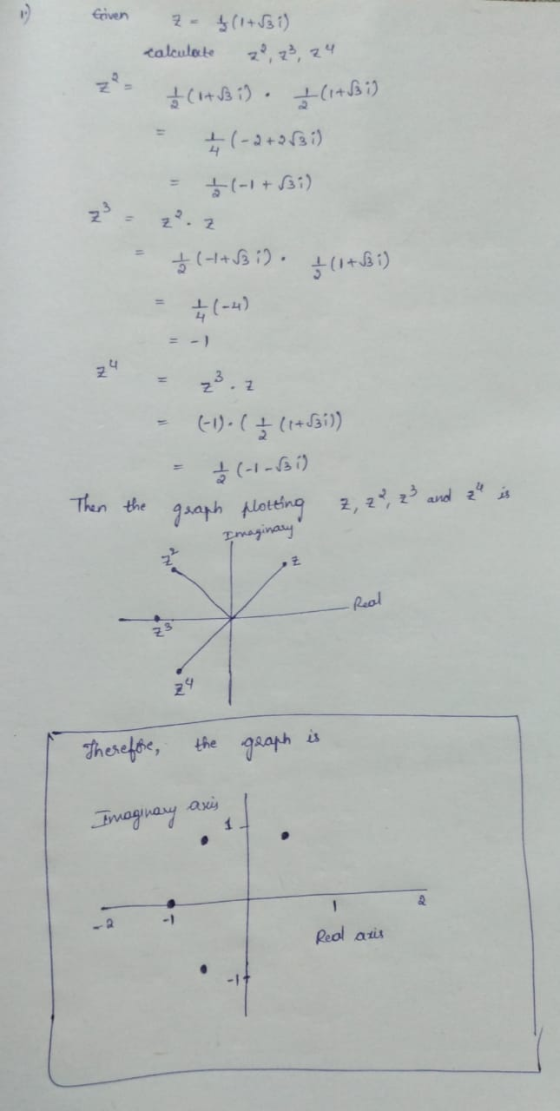
Represent the powers z, z2, z3, and 24 graphically. 2- 211 + V31) 2 Imaginary axis...
Note: if z = (z1, z2, z3), then the vectors x = (−z2, z1, 0) and...
 Note: if z = (z1, z2, z3), then the vectors x = (−z2, z1, 0) and
y = (−z3, 0, z1) are both orthogonal to z.
Consider the plane P = H4 (1,−1,3) in R 3 . Find vectors w, x, y
so that P = w + Span(x, y).
Note: if z = (2,22,23), then the vectors x = (-22,21,0) and y = (-23,0,2) are both orthogonal to z. Consider the plane P = H(1,-1,3) in R3. Find vectors...
Note: if z = (z1, z2, z3), then the vectors x = (−z2, z1, 0) and
y = (−z3, 0, z1) are both orthogonal to z.
Consider the plane P = H4 (1,−1,3) in R 3 . Find vectors w, x, y
so that P = w + Span(x, y).
Note: if z = (2,22,23), then the vectors x = (-22,21,0) and y = (-23,0,2) are both orthogonal to z. Consider the plane P = H(1,-1,3) in R3. Find vectors...
Represent the complex number graphically, and find the standard form of the number. 51 10 cos...
 Represent the complex number graphically, and find the standard form of the number. 51 10 cos Imaginary axis 10+ Imaginary axis 10F 5 5 Real axis 10 -10 Real axis 10 -5 -10 -5 5 -101 -10 Imaginary axis 10 Imaginary axis 104 51 Real axis 10 -10 -5 5 Real axis 10 -10 -5 -101 -101 CO x
Exercise 9.2. Let Z~ N(0, 1). Find the variance of Z2 and Z3 N0 1) Find...
 Exercise 9.2. Let Z~ N(0, 1). Find the variance of Z2 and Z3 N0 1) Find the density of . Is the density bounded?
show all working please 10 Given z = 2 – j2 is a root of 2z'...
 show all working please
10 Given z = 2 – j2 is a root of 2z' - 9z2 + 202 - 8 = 0 find the remaining roots of the equation. Find the real and imaginary parts of z when 1 2 1 2 2 + j3 3 - 2 .. Find z = Z4 + z2z3/(z2+z3) when 2, = 2 +j3, z2 = 3 + j4 and 23 = -5+j12. Find the values of the real numbers x and...
show all working please
10 Given z = 2 – j2 is a root of 2z' - 9z2 + 202 - 8 = 0 find the remaining roots of the equation. Find the real and imaginary parts of z when 1 2 1 2 2 + j3 3 - 2 .. Find z = Z4 + z2z3/(z2+z3) when 2, = 2 +j3, z2 = 3 + j4 and 23 = -5+j12. Find the values of the real numbers x and...
Find R and angle. Z1 =8+3i, Z2 =2+3i, Z3 =9-((2)^1/2 )i. (vi) z = TEM (vii)...
 Find R and angle. Z1 =8+3i, Z2 =2+3i,
Z3 =9-((2)^1/2 )i.
(vi) z = TEM (vii) 2 = 22 + 231
Find R and angle. Z1 =8+3i, Z2 =2+3i,
Z3 =9-((2)^1/2 )i.
(vi) z = TEM (vii) 2 = 22 + 231
Given: Z1 = 4-j1.5 ohms; Z2 = 2+j4 ohms; Z3 = 2 ohms; 24 = 3...
 Given: Z1 = 4-j1.5 ohms; Z2 = 2+j4 ohms; Z3 = 2 ohms; 24 = 3 + j5 ohms. If the four impedances are connected in parallel, find the magnitude of equivalent impedance in ohms. (No need to include the phase angle, ONLY THE MAGNITUDE)
Let Z! = 3H4, Z2-5-2, Z,--3-12, Z4--10-j6, and Z5--6-3. 1. Calculate Z1 + Z2 in rectangular...
 Let Z! = 3H4, Z2-5-2, Z,--3-12, Z4--10-j6, and Z5--6-3. 1. Calculate Z1 + Z2 in rectangular form. 2. Calculate Z1 - Z2 in rectangular form. 3. Calculate Z3 + Z4 in polar form. 4. Calculate Za - Z5 in polar form. 5. Calculate Z1Z2-Z3 in rectangular form. 6. Find ZsZ7 in polar form. 7. Find Z7Zs in rectangular form. 8. Find ZsZs+Z7 in rectangular form Reduce the following to rectangular form. 10. Z1/Z2
Consider the following Fifth roots of 32 Cos 1 32(cos 2* * is 2) (a) Use...
 Consider the following Fifth roots of 32 Cos 1 32(cos 2* * is 2) (a) Use the formula 2 - Viſcos @ + 24k + 2 + / sin to find the indicated roots of the complex number (Enter your answers in trigonometric form. Letos 0 < 20.) n 20- (6) Write each of the roots in standard form. (Round all numerical values to four decimal places.) Po 24- (c) Represent each of the roots graphically. Imaginary axis 5r Imaginary...
detailed solution for this one ????? 11. (a) Gi) If w=z+z-' prove that (i) z2 +...
 detailed solution for this one ?????
11. (a) Gi) If w=z+z-' prove that (i) z2 + z 2 = w2 -2 ; 24 +2° + z²+z+1 = z2 (W2 + w+1) = (z? +[1+V5]+1)(22 +[1–V5]+1). (b) Show that the roots of 24 +2+z2+z+1=0 are the four non-real roots of z' =1. (c) Deduce that cos 72° = +(15 – 1) and cos 36° = (15+1).
detailed solution for this one ?????
11. (a) Gi) If w=z+z-' prove that (i) z2 + z 2 = w2 -2 ; 24 +2° + z²+z+1 = z2 (W2 + w+1) = (z? +[1+V5]+1)(22 +[1–V5]+1). (b) Show that the roots of 24 +2+z2+z+1=0 are the four non-real roots of z' =1. (c) Deduce that cos 72° = +(15 – 1) and cos 36° = (15+1).
1. Let Z = (Z1, Z2, Z3) be a vector with i.i.d. N(0, 1) components. Let...
1. Let Z = (Z1, Z2, Z3) be a vector with i.i.d. N(0, 1) components. Let r be a constant with 0 < r < 1. Define X1 = √ rZ1 + √ 1 − rZ2 and X2 = √ rZ1 + √ 1 − rZ3. (a) Give the distribution of X1 and the distribution of X2. Find Cov(X1, X2). (b) Give the matrix A so that the vector X = (X1, X2) is a transform X = AZ. Give...
 Note: if z = (z1, z2, z3), then the vectors x = (−z2, z1, 0) and
y = (−z3, 0, z1) are both orthogonal to z.
Consider the plane P = H4 (1,−1,3) in R 3 . Find vectors w, x, y
so that P = w + Span(x, y).
Note: if z = (2,22,23), then the vectors x = (-22,21,0) and y = (-23,0,2) are both orthogonal to z. Consider the plane P = H(1,-1,3) in R3. Find vectors...
Note: if z = (z1, z2, z3), then the vectors x = (−z2, z1, 0) and
y = (−z3, 0, z1) are both orthogonal to z.
Consider the plane P = H4 (1,−1,3) in R 3 . Find vectors w, x, y
so that P = w + Span(x, y).
Note: if z = (2,22,23), then the vectors x = (-22,21,0) and y = (-23,0,2) are both orthogonal to z. Consider the plane P = H(1,-1,3) in R3. Find vectors...
 Represent the complex number graphically, and find the standard form of the number. 51 10 cos Imaginary axis 10+ Imaginary axis 10F 5 5 Real axis 10 -10 Real axis 10 -5 -10 -5 5 -101 -10 Imaginary axis 10 Imaginary axis 104 51 Real axis 10 -10 -5 5 Real axis 10 -10 -5 -101 -101 CO x
 Exercise 9.2. Let Z~ N(0, 1). Find the variance of Z2 and Z3 N0 1) Find the density of . Is the density bounded?
 show all working please
10 Given z = 2 – j2 is a root of 2z' - 9z2 + 202 - 8 = 0 find the remaining roots of the equation. Find the real and imaginary parts of z when 1 2 1 2 2 + j3 3 - 2 .. Find z = Z4 + z2z3/(z2+z3) when 2, = 2 +j3, z2 = 3 + j4 and 23 = -5+j12. Find the values of the real numbers x and...
show all working please
10 Given z = 2 – j2 is a root of 2z' - 9z2 + 202 - 8 = 0 find the remaining roots of the equation. Find the real and imaginary parts of z when 1 2 1 2 2 + j3 3 - 2 .. Find z = Z4 + z2z3/(z2+z3) when 2, = 2 +j3, z2 = 3 + j4 and 23 = -5+j12. Find the values of the real numbers x and...
 Find R and angle. Z1 =8+3i, Z2 =2+3i,
Z3 =9-((2)^1/2 )i.
(vi) z = TEM (vii) 2 = 22 + 231
Find R and angle. Z1 =8+3i, Z2 =2+3i,
Z3 =9-((2)^1/2 )i.
(vi) z = TEM (vii) 2 = 22 + 231
 Given: Z1 = 4-j1.5 ohms; Z2 = 2+j4 ohms; Z3 = 2 ohms; 24 = 3 + j5 ohms. If the four impedances are connected in parallel, find the magnitude of equivalent impedance in ohms. (No need to include the phase angle, ONLY THE MAGNITUDE)
 Let Z! = 3H4, Z2-5-2, Z,--3-12, Z4--10-j6, and Z5--6-3. 1. Calculate Z1 + Z2 in rectangular form. 2. Calculate Z1 - Z2 in rectangular form. 3. Calculate Z3 + Z4 in polar form. 4. Calculate Za - Z5 in polar form. 5. Calculate Z1Z2-Z3 in rectangular form. 6. Find ZsZ7 in polar form. 7. Find Z7Zs in rectangular form. 8. Find ZsZs+Z7 in rectangular form Reduce the following to rectangular form. 10. Z1/Z2
 Consider the following Fifth roots of 32 Cos 1 32(cos 2* * is 2) (a) Use the formula 2 - Viſcos @ + 24k + 2 + / sin to find the indicated roots of the complex number (Enter your answers in trigonometric form. Letos 0 < 20.) n 20- (6) Write each of the roots in standard form. (Round all numerical values to four decimal places.) Po 24- (c) Represent each of the roots graphically. Imaginary axis 5r Imaginary...
 detailed solution for this one ?????
11. (a) Gi) If w=z+z-' prove that (i) z2 + z 2 = w2 -2 ; 24 +2° + z²+z+1 = z2 (W2 + w+1) = (z? +[1+V5]+1)(22 +[1–V5]+1). (b) Show that the roots of 24 +2+z2+z+1=0 are the four non-real roots of z' =1. (c) Deduce that cos 72° = +(15 – 1) and cos 36° = (15+1).
detailed solution for this one ?????
11. (a) Gi) If w=z+z-' prove that (i) z2 + z 2 = w2 -2 ; 24 +2° + z²+z+1 = z2 (W2 + w+1) = (z? +[1+V5]+1)(22 +[1–V5]+1). (b) Show that the roots of 24 +2+z2+z+1=0 are the four non-real roots of z' =1. (c) Deduce that cos 72° = +(15 – 1) and cos 36° = (15+1).
Most questions answered within 3 hours.
-
Where is the error in this code sequence?
String s1 = "Hello";
String s2 = "ello";...
asked 10 months ago -
Financial data for Joel de Paris, Inc., for last year
follow:
Joel de Paris, Inc.
Balance...
asked 10 months ago -
Consider this reaction:
Al2(SO4)3 (aq)+ BaCl3
(aq) Al2Cl6 (aq)- +
3BaSO4(s) . What is the...
asked 10 months ago -
Suppose that Savneet is considering increasing her
recent random sample from 20 car rentals to 40...
asked 10 months ago -
Trucks arrive at an unloading terminal at an average rate of 120
per hour.
Trucks arrive...
asked 10 months ago -
Why are methanol and ethanol completely soluble in water while
octanol is not very little soluble....
asked 10 months ago -
A facilities manager at a university reads in a research report
that the mean amount of...
asked 10 months ago -
When the CuSO4 is rehydrated by adding water to the anhydrous
compound, is this an endothermic...
asked 10 months ago -
A ray of sunlight is passing from diamond into crown glass; the
angle of incidence is...
asked 10 months ago -
A block of mass 0.249 kg is placed on top of a light, vertical
spring of...
asked 10 months ago -
how do the kidneys compensate in the presences of acidosis
a) trigger hyperventilate
b) reserve acid...
asked 10 months ago -
Question 501 pts
The rental rate of capital to the firm increases. Which of the
following...
asked 10 months ago