


Homework Answers
Request Answer!
We need at least 10 more requests to produce the answer.
0 / 10 have requested this problem solution
The more requests, the faster the answer.
Add Answer to:
Review | Constants Periodic Table In the parts that follow, use the following abbreviations for time...
Review Constants Periodic a substance active times that the countable and will therefore decay by my...
 Review Constants Periodic a substance active times that the countable and will therefore decay by my name of processes the decay Del decay of the day of radioactive comm o der Therefore theme of daycan t orbed by the megrated w omen e n we used to describe the food chemical con In where the mo s t coloraty t he com by man of these quo ng 0. the world when contre long for fraction remaining - - (0.5)"...
In the parts that follow, use the following abbreviations for time: Measure of time Units of...
In the parts that follow, use the following abbreviations for time: Measure of time Units of time minutes min hours h days d years yr a) You are using a Geiger counter to measure the activity of a radioactive substance over the course of several minutes. If the reading of 400. counts has diminished to 100. counts after 93.0 minutes , what is the half-life of this substance? Express your answer with the appropriate units. t(1/2) = ______ b) An...
A 1.6 mg sample of radioactive Ho-166 has a half-life of 26.8 years. What mass remains...
A 1.6 mg sample of radioactive Ho-166 has a half-life of 26.8 years. What mass remains after 12 years? All radioactive decay processes are 1st order reactions. t1/2 = 0.693/k ln [A]t = -kt + ln [A
**SOLVE THIS USING MATHLAB** NOTE: Set the radioactive decay constant 'k' equal to 0.000100128 DIFFERENTIAL EQUATIONS...
 **SOLVE THIS USING MATHLAB**
NOTE: Set the radioactive decay constant 'k' equal to
0.000100128
DIFFERENTIAL EQUATIONS 2. One of the applications of Differential Equations is Growth and Decay. Radioactive decay is an exponential process. If xo is the initial quantity of a radioactive substance at time t= 0, then the amount of that substance that will be present at any time t in the future is given by x(t) = Where 'k' is the radioactive decay constant. Create a script...
**SOLVE THIS USING MATHLAB**
NOTE: Set the radioactive decay constant 'k' equal to
0.000100128
DIFFERENTIAL EQUATIONS 2. One of the applications of Differential Equations is Growth and Decay. Radioactive decay is an exponential process. If xo is the initial quantity of a radioactive substance at time t= 0, then the amount of that substance that will be present at any time t in the future is given by x(t) = Where 'k' is the radioactive decay constant. Create a script...
Review Constants Periodic Table Part A The rearrangement of methyl isonitrile (CH3NC) to acetonitrile (CH CN) is a firs...
 Review Constants Periodic Table Part A The rearrangement of methyl isonitrile (CH3NC) to acetonitrile (CH CN) is a first-order reaction and has a rate constant of 5.11x10⁵ s at 472 K Assume the initial concentration of CHs NC to be 3.80x10⁻² M What is the half-life (in hours) of this reaction? hours to three significant figures. Express the time t1/23,77 hr You may want to reference (Pages 510 513) Section 13.6 while completing this problem. Submit Previous Answers Correct Since...
References Use the References to access important values if needed for this question. can be described...
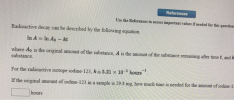 References Use the References to access important values if needed for this question. can be described by the following equation Radioactive decay In A = In Ao - kt where Ao is the original amount of the substance, A is the amount of the substance remaining after time t, and le substance. For the radioactive isotope iodine-123, k is 5.21 x 10² hours If the original amount of iodine-123 in a sample is 29.8 mg, how much time is needed...
A scientist begins with 250 grams of a radioactive substance. After 250 minutes, the sample has...
 A scientist begins with 250 grams of a radioactive substance. After 250 minutes, the sample has decayed to 36 grams. Write an exponential equation f(t) representing this situation. (Let f be the amount of radioactive substance in grams and t be the time in minutes.) f(t) 250e 0.0087t x To the nearest minute, what is the half-life of this substance? 89 min Use the model for continuous exponential decay, y = Ao e-kt, where y is the amount of radioactive...
The integrated rate law allows chemists to predict the reactant concentration after a certain amount of...
The integrated rate law allows chemists to predict the reactant concentration after a certain amount of time, or the time it would take for a certain concentration to be reached. The integrated rate law for a first-order reaction is: [A]=[A]0e−kt[A]=[A]0e−kt Now say we are particularly interested in the time it would take for the concentration to become one-half of its initial value. Then we could substitute [A]02[A]02 for [A][A] and rearrange the equation to: t1/2=0.693k t1/2=0.693k This equation calculates the...
If a sample of C-14 initially contains 1.7 mmol of C-14, how many millimoles will be...
If a sample of C-14 initially contains 1.7 mmol of C-14, how many millimoles will be left after 2260 years? The half-life for the radioactive decay of C-14C-14 is 5730 years. Part A Part complete How long will it take for 25% of the C-14C-14 atoms in a sample of C-14C-14 to decay? Express your answer using two significant figures. View Available Hint(s) tt = 2400 yearsyears SubmitPrevious Answers Correct First, the rate (or decay) constant, kk, for the first-order...
Perform a linear regression to determine the slope of the plot of Ln(A/A0) vs time that...
Perform a linear regression to determine the slope of the plot of Ln(A/A0) vs time that is discussed on page 16. Recall from page 12 that the slope for this plot is -k (where k is the radioactive decay constant). Input below the value for k obtained from this data set. Answer=0.0715 Note that your k value should be positive, since it is the negative of the slope. All reaction rate constants are positive values. The units for this k...
 Review Constants Periodic a substance active times that the countable and will therefore decay by my name of processes the decay Del decay of the day of radioactive comm o der Therefore theme of daycan t orbed by the megrated w omen e n we used to describe the food chemical con In where the mo s t coloraty t he com by man of these quo ng 0. the world when contre long for fraction remaining - - (0.5)"...
 **SOLVE THIS USING MATHLAB**
NOTE: Set the radioactive decay constant 'k' equal to
0.000100128
DIFFERENTIAL EQUATIONS 2. One of the applications of Differential Equations is Growth and Decay. Radioactive decay is an exponential process. If xo is the initial quantity of a radioactive substance at time t= 0, then the amount of that substance that will be present at any time t in the future is given by x(t) = Where 'k' is the radioactive decay constant. Create a script...
**SOLVE THIS USING MATHLAB**
NOTE: Set the radioactive decay constant 'k' equal to
0.000100128
DIFFERENTIAL EQUATIONS 2. One of the applications of Differential Equations is Growth and Decay. Radioactive decay is an exponential process. If xo is the initial quantity of a radioactive substance at time t= 0, then the amount of that substance that will be present at any time t in the future is given by x(t) = Where 'k' is the radioactive decay constant. Create a script...
 Review Constants Periodic Table Part A The rearrangement of methyl isonitrile (CH3NC) to acetonitrile (CH CN) is a first-order reaction and has a rate constant of 5.11x10⁵ s at 472 K Assume the initial concentration of CHs NC to be 3.80x10⁻² M What is the half-life (in hours) of this reaction? hours to three significant figures. Express the time t1/23,77 hr You may want to reference (Pages 510 513) Section 13.6 while completing this problem. Submit Previous Answers Correct Since...
 References Use the References to access important values if needed for this question. can be described by the following equation Radioactive decay In A = In Ao - kt where Ao is the original amount of the substance, A is the amount of the substance remaining after time t, and le substance. For the radioactive isotope iodine-123, k is 5.21 x 10² hours If the original amount of iodine-123 in a sample is 29.8 mg, how much time is needed...
 A scientist begins with 250 grams of a radioactive substance. After 250 minutes, the sample has decayed to 36 grams. Write an exponential equation f(t) representing this situation. (Let f be the amount of radioactive substance in grams and t be the time in minutes.) f(t) 250e 0.0087t x To the nearest minute, what is the half-life of this substance? 89 min Use the model for continuous exponential decay, y = Ao e-kt, where y is the amount of radioactive...
Most questions answered within 3 hours.
-
Where is the error in this code sequence?
String s1 = "Hello";
String s2 = "ello";...
asked 11 months ago -
Financial data for Joel de Paris, Inc., for last year
follow:
Joel de Paris, Inc.
Balance...
asked 11 months ago -
Consider this reaction:
Al2(SO4)3 (aq)+ BaCl3
(aq) Al2Cl6 (aq)- +
3BaSO4(s) . What is the...
asked 11 months ago -
Suppose that Savneet is considering increasing her
recent random sample from 20 car rentals to 40...
asked 11 months ago -
Trucks arrive at an unloading terminal at an average rate of 120
per hour.
Trucks arrive...
asked 11 months ago -
Why are methanol and ethanol completely soluble in water while
octanol is not very little soluble....
asked 11 months ago -
A facilities manager at a university reads in a research report
that the mean amount of...
asked 11 months ago -
When the CuSO4 is rehydrated by adding water to the anhydrous
compound, is this an endothermic...
asked 11 months ago -
A ray of sunlight is passing from diamond into crown glass; the
angle of incidence is...
asked 11 months ago -
A block of mass 0.249 kg is placed on top of a light, vertical
spring of...
asked 11 months ago -
how do the kidneys compensate in the presences of acidosis
a) trigger hyperventilate
b) reserve acid...
asked 11 months ago -
Question 501 pts
The rental rate of capital to the firm increases. Which of the
following...
asked 11 months ago