
Homework Answers
 time
required is 10.1 hr
time
required is 10.1 hr
Add Answer to:
Review Constants Periodic Table Part A The rearrangement of methyl isonitrile (CH3NC) to acetonitrile (CH CN) is a firs...
The conversion of methyl isonitrile to acetonitrile in the gas phase at 250 °C. CH3NC(g)---> CH3CN(g)...
The conversion of methyl isonitrile to acetonitrile in the gas phase at 250 °C. CH3NC(g)---> CH3CN(g) is first order in CH3NC with a rate constant of 3.00×10⁻³ s-1. If the initial concentration of CH3NC is 3.08×10⁻² M, the concentration of CH3NC will be how many M after 630 s have passed?
The conversion of methyl isonitrile to acetonitrile in the gas phase at 250 °C CH3NC(g)------------>CH3CN(g) is...
The conversion of methyl isonitrile to acetonitrile in the gas phase at 250 °C CH3NC(g)------------>CH3CN(g) is first order in CH3NC with a rate constant of 3.00×10⁻³ s-1. If an experiment is performed in which the initial concentration of CH3NC is 1.59×10⁻² M, what is the concentration of CH3NC after 427 seconds have passed? ___________M
The following data are for the conversion of methyl isonitrile to acetonitrile in the gas phase...
The following data are for the conversion of methyl isonitrile to acetonitrile in the gas phase at 250 °C. CH3NC(g) ------>CH3CN(g) [ CH3NC ], M 4.50×10⁻² 2.25×10⁻² 1.13×10⁻² 5.65×10⁻³ time, s 0 155 310 465 Hint: It is not necessary to graph these data. (1) The half life observed for this reaction is ______s . (2) Based on these data, the rate constant for this a.) zero b.) first c.) second order reaction is ______s -1.
The data below were collected for the following reaction at 500 °C: CH, CN(9) + CH3NC(9)...
 The data below were collected for the following reaction at 500 °C: CH, CN(9) + CH3NC(9) Time (h) [CH3CN] (M) 1.000 0.794 10.0 0.631 0.501 0.398 25.0 0.316 15.0 20.0 first order second order third order Submit Previous Answers ✓ Correct Part B Determine the value of the rate constant at this temperature. 190 A ¢ * * O O ? Submit Request Answer Review l Constants Periodic Table Part What is the half-life for this reaction (at the initial...
Review | Constants Periodic Table In the parts that follow, use the following abbreviations for time...
 Review | Constants Periodic Table In the parts that follow, use the following abbreviations for time If a substance is radioactive, this means that the nucleus is unstable and will therefore decay by any number of processes (alpha decay, beta decay, etc.). The decay of radioactive elements follows first-order kinetics. Therefore, the rate of decay can be described by the same integrated rate equations and half-life equations that are used to describe the rate of first-order chemical reactions: Measure of...
trans-Cycloheptene (C7H12), a strained cyclic hydrocarbon, converts to cis-cycloheptene at low temperatures. This molecular rearrangement is...
trans-Cycloheptene (C7H12), a strained cyclic hydrocarbon, converts to cis-cycloheptene at low temperatures. This molecular rearrangement is a second-order process with a rate constant of 0.030 M−1s−1 at 60 ∘C. If the initial concentration of trans-cycloheptene is 3.9×10⁻² M . Part A Part complete What is the concentration of trans-cycloheptene after a reaction time of 1400 s ? Express your answer to two significant figures and include the appropriate units. 1.5×10⁻² M Previous Answers Answer Requested Part B At what time...
Review Constants Periodic Table Part A Learning Goal: To understand how to use integrated rate laws...
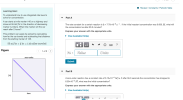 Review Constants Periodic Table Part A Learning Goal: To understand how to use integrated rate laws to solve for concentration. A car starts at mile marker 145 on a highway and drives at 55 mi/hr in the direction of decreasing marker numbers. What mile marker will the car reach after 2 hours? . If the initial reactant concentration was 0.600 M, what will The rate constant for a certain reaction is k = 7.70x10s the concentration be after 20.0 minutes?...
Review Constants Periodic Tab Part A Butadiene (C4H6) reacts with itself to form a dimer with...
 Review Constants Periodic Tab Part A Butadiene (C4H6) reacts with itself to form a dimer with the formula C8H12. The reaction is second order in C4H6. Assume the rate constant at a particular temperature is 4.0 x 10⁻² M-18-1 and the initial concentration of C4H6 is 0.0180 M. What is its molarity after a reaction time of 1.30 h? Express your answer in moles per liter to two significant figures. Molarity = Submit Request Answer Part B What is the...
I need help on C Review Constants 1 Periodic Table The acid-dissociation constant for benzoic acid...
 I need help on C
Review Constants 1 Periodic Table The acid-dissociation constant for benzoic acid (C6H3COOH) is 6.3 x 10⁻⁵. Part A You may want to reference (Pages 681 - 690) Section 16.6 while completing this problem. Calculate the equilibrium concentration of H3O+ in the solution if the initial concentration of C6H5COOH is 0.054 M. Express your answer using two significant figures. [H3O+] = 1.8x10⁻³ M Submit Previous Answers ✓ Correct Part B in the solution if the initial...
I need help on C
Review Constants 1 Periodic Table The acid-dissociation constant for benzoic acid (C6H3COOH) is 6.3 x 10⁻⁵. Part A You may want to reference (Pages 681 - 690) Section 16.6 while completing this problem. Calculate the equilibrium concentration of H3O+ in the solution if the initial concentration of C6H5COOH is 0.054 M. Express your answer using two significant figures. [H3O+] = 1.8x10⁻³ M Submit Previous Answers ✓ Correct Part B in the solution if the initial...
Part A . What is the half-life for this reaction? Chymotrypsin is a digestive enzyme component...
 Part A . What is the half-life for this reaction? Chymotrypsin is a digestive enzyme component of pancreatic juice that acts to break down proteins. The rate constant for the reaction that occurs when chymotrypsin reacts with its substrate N-acetylvaline ethyl ester is 1.7 x 10's Express your answer to two significant figures and include the appropriate units. Half-life = 4.1 S Sub Previous Answers Correct Use the equation to calculate the half-life for a first-order reaction (t1/2), where k...
 The data below were collected for the following reaction at 500 °C: CH, CN(9) + CH3NC(9) Time (h) [CH3CN] (M) 1.000 0.794 10.0 0.631 0.501 0.398 25.0 0.316 15.0 20.0 first order second order third order Submit Previous Answers ✓ Correct Part B Determine the value of the rate constant at this temperature. 190 A ¢ * * O O ? Submit Request Answer Review l Constants Periodic Table Part What is the half-life for this reaction (at the initial...
 Review | Constants Periodic Table In the parts that follow, use the following abbreviations for time If a substance is radioactive, this means that the nucleus is unstable and will therefore decay by any number of processes (alpha decay, beta decay, etc.). The decay of radioactive elements follows first-order kinetics. Therefore, the rate of decay can be described by the same integrated rate equations and half-life equations that are used to describe the rate of first-order chemical reactions: Measure of...
 Review Constants Periodic Table Part A Learning Goal: To understand how to use integrated rate laws to solve for concentration. A car starts at mile marker 145 on a highway and drives at 55 mi/hr in the direction of decreasing marker numbers. What mile marker will the car reach after 2 hours? . If the initial reactant concentration was 0.600 M, what will The rate constant for a certain reaction is k = 7.70x10s the concentration be after 20.0 minutes?...
 Review Constants Periodic Tab Part A Butadiene (C4H6) reacts with itself to form a dimer with the formula C8H12. The reaction is second order in C4H6. Assume the rate constant at a particular temperature is 4.0 x 10⁻² M-18-1 and the initial concentration of C4H6 is 0.0180 M. What is its molarity after a reaction time of 1.30 h? Express your answer in moles per liter to two significant figures. Molarity = Submit Request Answer Part B What is the...
 I need help on C
Review Constants 1 Periodic Table The acid-dissociation constant for benzoic acid (C6H3COOH) is 6.3 x 10⁻⁵. Part A You may want to reference (Pages 681 - 690) Section 16.6 while completing this problem. Calculate the equilibrium concentration of H3O+ in the solution if the initial concentration of C6H5COOH is 0.054 M. Express your answer using two significant figures. [H3O+] = 1.8x10⁻³ M Submit Previous Answers ✓ Correct Part B in the solution if the initial...
I need help on C
Review Constants 1 Periodic Table The acid-dissociation constant for benzoic acid (C6H3COOH) is 6.3 x 10⁻⁵. Part A You may want to reference (Pages 681 - 690) Section 16.6 while completing this problem. Calculate the equilibrium concentration of H3O+ in the solution if the initial concentration of C6H5COOH is 0.054 M. Express your answer using two significant figures. [H3O+] = 1.8x10⁻³ M Submit Previous Answers ✓ Correct Part B in the solution if the initial...
 Part A . What is the half-life for this reaction? Chymotrypsin is a digestive enzyme component of pancreatic juice that acts to break down proteins. The rate constant for the reaction that occurs when chymotrypsin reacts with its substrate N-acetylvaline ethyl ester is 1.7 x 10's Express your answer to two significant figures and include the appropriate units. Half-life = 4.1 S Sub Previous Answers Correct Use the equation to calculate the half-life for a first-order reaction (t1/2), where k...
Most questions answered within 3 hours.
-
Where is the error in this code sequence?
String s1 = "Hello";
String s2 = "ello";...
asked 10 months ago -
Financial data for Joel de Paris, Inc., for last year
follow:
Joel de Paris, Inc.
Balance...
asked 10 months ago -
Consider this reaction:
Al2(SO4)3 (aq)+ BaCl3
(aq) Al2Cl6 (aq)- +
3BaSO4(s) . What is the...
asked 10 months ago -
Suppose that Savneet is considering increasing her
recent random sample from 20 car rentals to 40...
asked 10 months ago -
Trucks arrive at an unloading terminal at an average rate of 120
per hour.
Trucks arrive...
asked 10 months ago -
Why are methanol and ethanol completely soluble in water while
octanol is not very little soluble....
asked 10 months ago -
A facilities manager at a university reads in a research report
that the mean amount of...
asked 10 months ago -
When the CuSO4 is rehydrated by adding water to the anhydrous
compound, is this an endothermic...
asked 10 months ago -
A ray of sunlight is passing from diamond into crown glass; the
angle of incidence is...
asked 10 months ago -
A block of mass 0.249 kg is placed on top of a light, vertical
spring of...
asked 10 months ago -
how do the kidneys compensate in the presences of acidosis
a) trigger hyperventilate
b) reserve acid...
asked 10 months ago -
Question 501 pts
The rental rate of capital to the firm increases. Which of the
following...
asked 10 months ago